
Key Takeaways
- Schedule VII now has thirteen items, not twelve. Item (xiii), subscription to zero-coupon, zero-principal instruments (ZCZP) on the Social Stock Exchange, was inserted by gazette notification G.S.R. 416(E) dated 27 May 2026, alongside G.S.R. 415(E), which added Rule 4A to the CSR Rules. Spend through this route is capped at 10% of a company's total CSR expenditure for the year.
- The list is exhaustive at the edges and generous in the middle. The MCA's position is explicit: CSR expenditure cannot be incurred on activities beyond Schedule VII, but the entries "must be interpreted liberally to capture the essence of the subjects enumerated." A perfect Schedule VII match still fails if it hits the negative list. Six categories under Rule 2(1)(d) disqualify spend outright, however well the activity fits an entry.
- Two heads absorb three-quarters of the money. In FY 2024-25, education (₹13,877 crore) and healthcare (₹8,531 crore) together took 55% of India's ₹40,794 crore CSR outlay. The top five thematic areas took 75%.
- Some statutory heads are effectively dormant. Technology incubators drew ₹1.91 crore nationally in FY 2023-24. Slum area development drew ₹38.82 crore.
- Misclassification is a cash risk, not a paperwork risk. Section 135(7) penalises the resulting shortfall at twice the untransferred amount or ₹1 crore, whichever is lower, computed default-by-default, with a separate penalty on every officer in default.
- Schedule VII has been amended nine times in twelve years, and no item has ever been deleted. A CSR policy that transcribes the 2019 or 2020 text is materially out of date.
Quick Answer: What is Schedule VII and What Does it List?
Schedule VII of the Companies Act, 2013 is the statutory list of activities that qualify as Corporate Social Responsibility (CSR) spending in India. A company that meets the Section 135 thresholds must spend at least 2% of its average net profit on activities that are relatable to one of these thirteen items.
The thirteen Schedule VII activities, in one line each:
(ii) Education, special education, vocational and employment-enhancing skills, livelihood enhancement (iii) Gender equality, women's empowerment, homes and hostels for women and orphans, old age homes and senior citizen facilities, reducing inequality (iv) Environmental sustainability, ecological balance, flora and fauna, animal welfare, agroforestry, natural resources, soil/air/water quality, Clean Ganga Fund (v) National heritage, art and culture, restoration of historical buildings and works of art, public libraries, traditional arts and handicrafts (vi) Armed forces veterans, war widows and dependents, CAPF and CPMF veterans and their dependents including widows (vii) Training to promote rural sports, nationally recognised sports, Paralympic sports and Olympic sports (viii) Contributions to PMNRF, PM CARES Fund, and other notified Central Government funds for socio-economic development and welfare of SCs, STs, OBCs, minorities and women (ix) (a) Government- or PSU-funded incubators and R&D projects in science, technology, engineering and medicine; (ix)(b) contributions to public-funded universities, IITs, national laboratories and named autonomous bodies conducting SDG-linked research (x) Rural development projects (xi) Slum area development (only areas formally declared as slums by a competent authority) (xii) Disaster management, including relief, rehabilitation and reconstruction (xiii) Subscription to zero coupon zero principal instruments on the Social Stock Exchange (inserted 27 May 2026)
Matching one of these thirteen is necessary but not sufficient. Six exclusions under Rule 2(1)(d) of the Companies (CSR Policy) Rules, 2014 override a perfect Schedule VII match. Both tests have to be cleared.
Why Schedule VII Exists at All
India did something in 2014 that no other major economy had attempted: it made corporate philanthropy a statutory obligation rather than a voluntary gesture.
Section 135 of the Companies Act, 2013 requires every company meeting any one of three thresholds in the immediately preceding financial year:
- net worth of ₹500 crore or more,
- turnover of ₹1,000 crore or more, or
- net profit of ₹5 crore or more
to spend at least 2% of its average net profit over the three immediately preceding financial years on CSR. Net profit here is computed under Section 198, and it is profit before tax.
But a spending mandate without a definition of eligible spending would have been unworkable. If any charitable act qualified, the obligation would have collapsed into whatever each board found convenient in March. So Parliament attached a list.
Schedule VII is that list. It is the statutory answer to "spend on what". And because the obligation is measured in rupees while the list is written in words, the interface between the two is where almost every CSR compliance dispute lives.
The Ministry of Corporate Affairs has taken a deliberately two-sided position on how tightly to read it. On one side, the boundary is hard: CSR expenditure cannot be incurred on activities beyond Schedule VII of the Act. On the other, the interior is generous: the items enlisted in Schedule VII of the Act are broad-based and are intended to cover a wide range of activities, and the entries in the said Schedule VII must be interpreted liberally to capture the essence of the subjects enumerated. Both statements come from the MCA's consolidated FAQ circular, General Circular No. 14/2021 dated 25 August 2021, which superseded the earlier 2014–2018 clarifications.
Hard edges, soft middle. That is the design, and understanding it resolves most of the confusion that follows.
I have sat in enough annual action plan meetings to know exactly how this plays out in practice. Nobody argues about whether a rural school programme is CSR. The arguments are about the edges: the skilling programme whose graduates the company then hires, the hospital wing that also serves paying patients, the effluent treatment upgrade that is genuinely good for the river and also happens to be a condition of the consent to operate. Those are the cases where the list stops being a formality and starts being a decision.
Who this List Actually Binds
Before the list matters, the obligation has to attach. A quick applicability check:
| Question | Position under Section 135 |
|---|---|
| Which companies qualify? | Any company meeting any one of: net worth ≥ ₹500 crore, turnover ≥ ₹1,000 crore, or net profit ≥ ₹5 crore in the immediately preceding FY |
| Does a Section 8 company qualify? | Yes, Section 135(1) opens with “Every company” |
| Does a holding or subsidiary get pulled in automatically? | No, eligibility is tested company by company |
| Company incorporated less than three years ago? | Yes, if it meets a threshold; the 2% is computed on the years available |
| Is a CSR Committee always required? | Not if the prescribed amount is ≤ ₹50 lakh; the Board discharges the Committee's functions under Section 135(9) |
| How is the 2% computed? | On average net profit of the three immediately preceding FYs, computed under Section 198 (profit before tax) |
The Complete Schedule VII Activities List (2026)
Here is the full statutory list as it stands today, with a plain-English reading of each entry's practical scope.
| Item | Statutory subject | Practical scope |
|---|---|---|
| (i) | Eradicating hunger, poverty and malnutrition; promoting health care including preventive health care and sanitation, including contribution to the Swachh Bharat Kosh; making available safe drinking water | Nutrition, curative and preventive medicine, WASH infrastructure |
| (ii) | Promoting education, including special education and employment-enhancing vocational skills, especially among children, women, the elderly and the differently abled; livelihood enhancement projects | Schooling, scholarships, disability education, skilling, enterprise support |
| (iii) | Promoting gender equality; empowering women; setting up homes and hostels for women and orphans; old age homes, day care centres and other facilities for senior citizens; measures for reducing inequalities faced by socially and economically backward groups | Gender programmes, shelter, elder care, equity interventions |
| (iv) | Ensuring environmental sustainability, ecological balance, protection of flora and fauna, animal welfare, agroforestry, conservation of natural resources, maintaining quality of soil, air and water, including contribution to the Clean Ganga Fund | Restoration, biodiversity, animal welfare, climate and water work |
| (v) | Protection of national heritage, art and culture, including restoration of buildings and sites of historical importance and works of art; setting up public libraries; promotion and development of traditional arts and handicrafts | Conservation, cultural institutions, artisan livelihoods |
| (vi) | Measures for the benefit of armed forces veterans, war widows and their dependents; CAPF and CPMF veterans and their dependents including widows | Veteran welfare, medical and pension support, rehabilitation, education for dependents |
| (vii) | Training to promote rural sports, nationally recognised sports, Paralympic sports and Olympic sports | Grassroots and elite athlete development, coaching, sports training infrastructure |
| (viii) | Contribution to the Prime Minister's National Relief Fund, the PM CARES Fund, or any other fund set up by the Central Government for socio-economic development and relief and welfare of SCs, STs, OBCs, minorities and women | Contribution-route CSR to notified central funds only |
| (ix)(a) | Contribution to incubators or R&D projects in science, technology, engineering and medicine funded by the Central or State Government, a PSU, or any agency of either | Government-backed innovation and applied research |
| (ix)(b) | Contributions to public-funded universities, IITs, national laboratories and autonomous bodies under DAE, DBT, DST, Department of Pharmaceuticals, AYUSH, MeitY, and bodies including DRDO, ICAR, ICMR and CSIR, conducting research aimed at promoting the SDGs | Institutional research funding with an explicit SDG linkage |
| (x) | Rural development projects | Village infrastructure, connectivity, agriculture support, market linkages |
| (xi) | Slum area development, where “slum area” means an area declared as such by the Central Government, a State Government or a competent authority under any law in force | Upgradation of notified urban informal settlements |
| (xii) | Disaster management, including relief, rehabilitation and reconstruction activities | Response, recovery and resilience building |
| (xiii) | Subscription to zero-coupon, zero-principal instruments on the Social Stock Exchange | Market-routed CSR funding of SSE-registered NPOs |
Item by Item, with Examples that Actually Happen
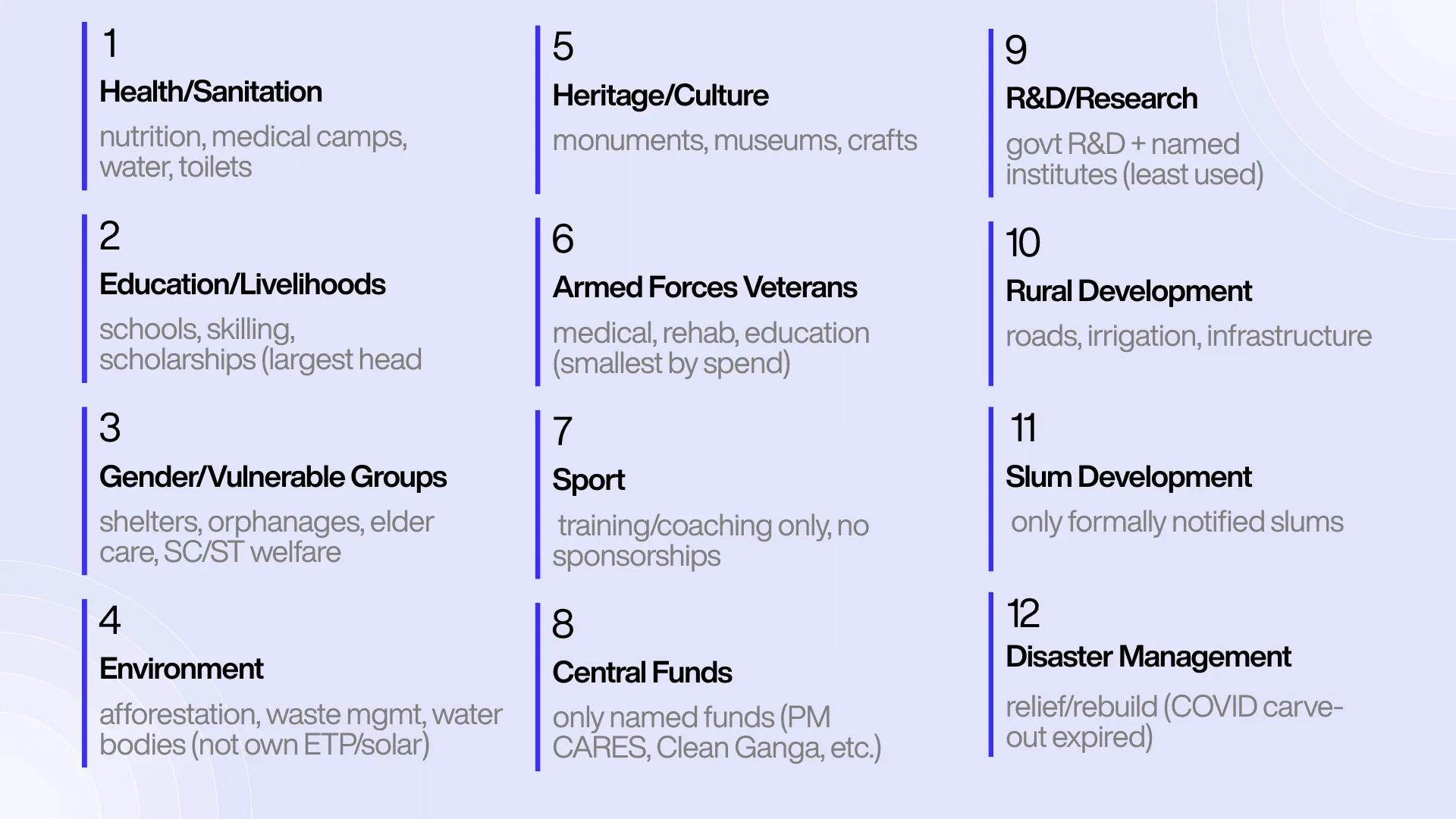
Statutory language is abstract. Here is what each item looks like when it meets a budget line and, more usefully, where teams get it wrong.
Item (i): Hunger, Health, Sanitation and Safe Drinking Water
The widest entry in the schedule, and the one that most easily absorbs adjacent activity.
What sits here comfortably: community kitchens, therapeutic and supplementary nutrition, anganwadi strengthening, mobile medical units, cataract and screening camps, diagnostic outreach, telemedicine, maternal and child health programmes, blood banks, TB and non-communicable disease programmes, toilet blocks and household sanitation, faecal sludge management, piped water schemes, borewell rehabilitation, rainwater harvesting for drinking water, and contributions to the Swachh Bharat Kosh.
The now-superseded 2014 clarification placed trauma care around highways and supplementary nutrition alongside government mid-day meals under this head. That reasoning still tells you something useful about how the Ministry thinks: the test is the substance of the benefit, not the label on the project.
Where teams go wrong: funding a hospital wing that primarily serves paying patients. The activity looks like health care, but if the beneficiary base is commercial, the character of the spend changes. The same goes for a water treatment plant whose primary offtake is your own factory.
Item (ii): Education, Skills and Livelihoods
The single largest destination for Indian CSR money, and the most elastic entry in the schedule.
What sits here: formal schooling, school infrastructure and classroom renovation, remedial and foundational literacy programmes, teacher training, scholarships and fellowships, digital classrooms and smart labs, STEM programmes, special education for children with disabilities, assistive technology, vocational training institutes, apprenticeship and on-the-job training support, entrepreneurship development, self-help group promotion, farmer producer organisation support, and micro-enterprise financing support.
The 2014 clarification mapped driver training, road-safety education and consumer-protection awareness into this head. It is the entry most likely to accommodate an activity that does not obviously fit anywhere else.
Where teams go wrong: running a skilling programme whose graduates are recruited into the sponsoring company. If the intake is effectively captive, the spend drifts towards both the normal-course-of-business exclusion and the employee-benefit exclusion. Design the cohort openly, publish the placement data, and the problem disappears.
Item (iii): Gender Equality, Orphans, Senior Citizens and Reducing Inequality
What sits here: women's shelters and one-stop crisis centres, working women's hostels, orphanages and childcare institutions, crèches and day care, old age homes, geriatric care and elder helplines, and interventions targeted at socially and economically backward groups Scheduled Castes, Scheduled Tribes, and communities in Aspirational Districts.
The 2014 clarification also treated slum redevelopment and EWS housing as fitting under the "reducing inequalities" limb of this item, a useful reminder that Schedule VII entries overlap and a single project can legitimately fit more than one.
A note on overlap. PRIME Database's own methodology acknowledges that for the same activity there could be an overlap between different schedules: skill development for women fits item (ii) and item (iii) equally well. Pick one head per project, document why, and stay consistent across the Board's report, Form CSR-2 and your BRSR disclosure. Inconsistency between those three documents is what auditors actually notice.
Item (iv): Environment, Ecology and Animal Welfare
What sits here: afforestation and assisted natural regeneration, wetland and lake restoration, watershed development, biodiversity conservation, mangrove and coastal work, solid and plastic waste management, air-quality monitoring and mitigation, soil health programmes, agroforestry, organic and regenerative agriculture, animal shelters and veterinary camps, and contributions to the Clean Ganga Fund. Renewable energy access projects were mapped here in the 2014 guidance under environmental sustainability and conservation of natural resources.
Where teams go wrong: treating your own effluent treatment plant, solar rooftop or emissions upgrade as CSR. If it serves your operations, it is business capex. If it discharges a legal duty under your consent to operate, it is compliance. It fails on two exclusions at once.
Item (v): National Heritage, Art and Culture
What sits here: monument and site restoration, museum and archive support, conservation labs, public libraries and reading rooms, documentation of endangered art forms and oral traditions, folk and classical arts training, and artisan cluster development. This is the head that quietly funds a large part of India's traditional crafts economy.
Practical note: MCA guidance treats art and culture as one of the entries that "transcend geographical boundaries and are applicable across the country." Local-area preference is weaker here than for, say, rural development.
Item (vi): Armed Forces and Paramilitary Veterans
What sits here: medical and pension supplements, prosthetics and rehabilitation, vocational retraining and second-career placement, housing, and education for dependents and widows.
This entry was quietly widened on 23 June 2020 to bring Central Armed Police Forces and Central Para Military Forces veterans, their dependents and widows inside the tent. It remains one of the smallest heads by rupee value, ₹68.04 crore nationally in FY 2023-24, which is a striking mismatch between reputational visibility and actual funding.
Item (vii): Sports
What sits here: training for rural sports, nationally recognised sports, Paralympic sports and Olympic sports. Athlete scholarships, coaching and sports science support, grassroots academies, para-athlete equipment, and training infrastructure.
Note the operative word: training. The entry funds athlete and coaching development. It does not fund stadium naming rights, team sponsorship, or a jersey logo. Sports is one of the faster-growing heads off a small base, more than doubling from ₹304 crore in FY 2019-20 to ₹692.09 crore in FY 2023-24.
Item (viii): Contributions to Central Funds
The contribution route: Swachh Bharat Kosh, Clean Ganga Fund, the Prime Minister's National Relief Fund, the PM CARES Fund, and any other Central Government fund notified by the MCA for the socio-economic development and welfare of SCs, STs, OBCs, minorities and women.
This is where a hard boundary matters most. The MCA has stated plainly that the Act does not recognise any contribution to any other fund, which is not specifically mentioned in Schedule VII, as an admissible CSR expenditure. A State relief fund, a Chief Minister's relief fund, a district mineral foundation, or a well-run private foundation corpus does not qualify under this item, however similar it looks.
Item (ix): Incubators, R&D and Research Institutions
Restructured on 24 August 2020 into two limbs.
(ix)(a) covers incubators and R&D projects in science, technology, engineering and medicine funded by the Central or State Government, a PSU, or an agency of either. (ix)(b) covers contributions to public-funded universities, IITs, national laboratories and a named list of autonomous bodies DAE, DBT, DST, the Department of Pharmaceuticals, AYUSH, MeitY, along with DRDO, ICAR, ICMR and CSIR conducting research in science, technology, engineering and medicine aimed at promoting the Sustainable Development Goals.
This is the most precisely drafted entry in the schedule and, as the spending data shows, the most under-used. Item (ix) attracted ₹1.91 crore across the entire country in FY 2023-24. That is not a category with modest uptake. That is a statutory head corporate India has effectively declined to use.
Item (x): Rural Development Projects
Deliberately open-ended: village roads and connectivity, community infrastructure, irrigation and micro-irrigation, farm productivity and mechanisation, post-harvest infrastructure, market linkages, rural housing support, and village electrification.
Companies with plants and supply chains in rural districts lean on this head heavily, because it aligns naturally with the local-area preference in the first proviso to Section 135(5).
Item (xi): Slum Area Development
Narrower than it appears. The Explanation restricts "slum area" to areas formally declared as such by the Central Government, a State Government, or a competent authority under a law in force.
Informal settlements that have never been notified fall outside item (xi), though the same work may still land legitimately under item (iii)'s inequality limb. If you are funding urban settlement upgradation, get the notification status of the area on file before you tag the project. It takes ten minutes and settles the question permanently.
Item (xii): Disaster Management
Inserted on 30 May 2019, and put to work almost immediately. Relief, rehabilitation and reconstruction: flood response, cyclone recovery, earthquake and landslide rebuilding, heat action plans, early warning systems, community disaster preparedness, and through 2020-21 the entire COVID emergency response, which the MCA repeatedly clarified as eligible.
A caution worth stating: the COVID-era carve-out permitting vaccine, drug and medical-device R&D by companies already in that line of business was time-bound to FY 2022-23. It** has expired**. There is no live exemption today.
Item (xiii): Zero Coupon Zero Principal Instruments on the Social Stock Exchange
The newest entry, and the one that changes the mechanics of CSR rather than its subject matter.
On 27 May 2026, the MCA notified two instruments together. G.S.R. 416(E) amended Schedule VII to insert item (xiii): "Subscription to zero coupon zero principal instruments on Social Stock Exchange." G.S.R. 415(E) notified the Companies (Corporate Social Responsibility Policy) Amendment Rules, 2026, which introduced definitions of "Not for Profit Organisation" and "zero coupon zero principal instrument" into Rule 2 and inserted a new Rule 4A governing implementation through the instrument.
The Ministry framed it as widening the ambit of Schedule VII "in line with the vision of Viksit Bharat," aimed at providing ease of compliance to companies while helping Not for Profit Organisations raise funding for public welfare projects in a transparent and regulated manner. NPOs registered on the Social Stock Exchange segment of a recognised stock exchange can issue ZCZP instruments in accordance with SEBI's regulations; the "Not for Profit Organisation" definition tracks Regulation 292A(e) of the SEBI (ICDR) Regulations, 2018.
Four conditions matter operationally:
The 10% cap. Expenditure incurred by CSR-mandated companies on such instruments shall not exceed ten per cent of total CSR expenditure for that financial year. Impact assessment shifts. Companies subscribing to these instruments are exempt from conducting impact assessment of the projects funded through them. Responsibility for execution and evaluation rests with the issuing NPO. A three-year project clock. Projects undertaken with funds raised through the instrument cannot exceed three succeeding financial years from the date of issuance. Unspent money still comes home. On termination of the listing, the issuing NPO must transfer any unspent amount to a fund included in Schedule VII and submit a compliance report to SEBI.
Rule 4A also applies the general provisions of Rule 4 to this route, except sub-rules (5) and (6).
Why this matters more than it looks. For twelve years, CSR had exactly two delivery mechanisms: do it yourself, or route it through a registered implementing agency. Item (xiii) adds a third: a regulated securities market channel with SEBI-supervised disclosure sitting between the corporate and the NPO. It also, incidentally, delivers a 2019 High Level Committee recommendation that the government had been sitting on: allowing CSR into social benefit bonds.
If your CSR policy was last approved before June 2026, it does not contemplate this route. That is a board agenda item, not a footnote.
Where the Money Actually Goes

Statutory lists tell you what is permitted. Spending data tells you what companies actually believe in. The two are strikingly different documents.
The national picture, FY 2024-25
Fulcrum's Bharat CSR Performance Report 2026, released on 18 July 2026, puts total Indian CSR spending at a record ₹40,794 crore in FY 2024-25, a 17% year-on-year increase, taking cumulative decade-long corporate investment in social and environmental development past ₹2.61 lakh crore.
The operational detail is as interesting as the headline:
- 29,546 companies contributed, including 1,012 first-time entrants into the CSR ambit (a 9% increase in participating companies)
- 72,233 projects were implemented, up 21%, at an average project size of ₹56.47 lakh
- The top 10 companies accounted for 17% of total expenditure (₹7,123 crore), led by Reliance Industries (₹1,309 crore), HDFC Bank (₹1,039 crore) and TCS (₹949 crore)
- 98% (₹39,851 crore) went directly to social projects; only 2% (₹943 crore) went to government funds, a 6% decline on the previous year Thematic concentration, FY 2024-25:
Thematic concentration, FY 2024-25:
| Thematic area | FY 2024-25 (₹ crore) | Share | Schedule VII item |
|---|---|---|---|
| Education (excluding special education) | 13,877 | 34% | (ii) |
| Healthcare | 8,531 | 21% | (i) |
| Environmental sustainability | 3,397 | 8% | (iv) |
| Livelihood enhancement projects | 2,548 | 6% | (ii) |
| Rural development projects | 2,477 | 6% | (x) |
| Top five thematic areas | 30,829 | 75% | — |
Education grew 14% year on year, healthcare 19%, and environmental sustainability a sharp 40%.
The official series, FY 2019-20 to FY 2023-24
For the government's own numbers, the reference point is the answer the MCA placed before Parliament on 4 August 2025 in reply to Lok Sabha Unstarred Question No. 2501. It shows total CSR spending rising from ₹24,965.82 crore in FY 2019-20 to ₹34,908.75 crore in FY 2023-24, based on annual filings in the MCA21 registry.
The development-sector split for FY 2023-24 makes the hierarchy unmistakable:
| Development sector | FY 2023-24 (₹ crore) | Schedule VII item |
|---|---|---|
| Education | 12,134.57 | (ii) |
| Health care | 7,150.81 | (i) |
| Environmental sustainability | 2,429.97 | (iv) |
| Rural development projects | 2,408.09 | (x) |
| Livelihood enhancement projects | 2,360.09 | (ii) |
| Vocational skills | 1,396.55 | (ii) |
| Poverty, hunger, malnutrition | 1,233.93 | (i) |
| Other Central Government funds | 1,000.83 | (viii) |
| Art and culture | 704.04 | (v) |
| Training to promote sports | 692.09 | (vii) |
| Animal welfare | 531.14 | (iv) |
| Women empowerment | 454.22 | (iii) |
| Conservation of natural resources | 423.47 | (iv) |
| Special education | 396.57 | (ii) |
| Sanitation | 375.23 | (i) |
| Safe drinking water | 327.45 | (i) |
| Gender equality | 204.17 | (iii) |
| Socio-economic equalities | 200.81 | (iii) |
| Senior citizens' welfare | 159.82 | (iii) |
| Agroforestry | 74.47 | (iv) |
| Armed forces, veterans, war widows | 68.04 | (vi) |
| Homes and hostels for women | 41.80 | (iii) |
| Slum area development | 38.82 | (xi) |
| Orphanages | 31.57 | (iii) |
| Technology incubators | 1.91 | (ix) |
Read the last row again. Item (ix) is the incubator and research head, the one with the most carefully drafted institutional list in the entire schedule, which attracted ₹1.91 crore across the whole country.
Education and health care together took roughly 55% of the FY 2023-24 total, up from around 44% a decade earlier. If you want the company-level view of that concentration, including the geographic skew towards a handful of states, our analysis of how India's top CSR spenders allocate across sectors and geographies breaks it down.
The Schedule VII-wise View: How Companies Actually Classify
Development-sector data shows where money lands. Schedule VII-wise data shows how companies classify it, and that is a different, sharper picture.
PRIME Database Group's analysis of NSE main-board company disclosures for FY 2024-25 mapped every disclosed project to its Schedule VII head. Total CSR spend by these 1,549 obligated companies rose 23% to ₹22,212 crore. Of those, 531 companies voluntarily disclosed project-level detail (the MCA removed the mandatory sector-and-location disclosure requirement in September 2022), and this breakdown covers that subset.-
| Schedule VII head | Amount (₹ crore) | Share of total |
|---|---|---|
| II — Education and vocational skills | 1,137.14 | 37.32% |
| I — Hunger, poverty and healthcare | 839.80 | 27.56% |
| Administrative expenses | 419.56 | 13.77% |
| IV — Environmental sustainability | 159.99 | 5.25% |
| X — Rural development | 122.25 | 4.01% |
| VII — Sports | 72.32 | 2.37% |
| III — Reducing inequalities | 71.60 | 2.35% |
| Impact assessment cost | 42.58 | 1.40% |
| V — National heritage | 36.07 | 1.18% |
| VIII — PM's relief funds | 31.84 | 1.05% |
| IX — Technology incubators | 30.73 | 1.01% |
| XII — Disaster management | 24.47 | 0.80% |
| VI — Armed forces veterans | 22.98 | 0.75% |
| XI — Slum development | 4.09 | 0.13% |
Items (i) and (ii) together take roughly 65% of everything. But look at the third-largest line: it is not a Schedule VII head at all. It is administrative expenses at 13.77%, larger than every statutory head except education and healthcare.
That figure deserves a careful read rather than an alarmed one. The MCA's FAQ circular is explicit that the maximum permissible limit for administrative overheads is five per cent of the total CSR expenditure of the company for the financial year. The apparent gap is largely a disclosure artefact: PRIME's percentage base is the disclosed project subset, not each company's total CSR expenditure, and PRIME's own methodology notes that where schedule-wise spends were not provided, the amounts were distributed across schedules.
But it makes an operational point worth taking seriously: If you cannot cleanly separate project cost from administrative overhead in your own records, you cannot demonstrate compliance with the 5% cap when someone asks.
Two Distinctions that Decay in Spreadsheets
Both of these come up in almost every audit conversation I sit in on, and both are settled law that teams still get wrong.
Your NGO partner's overhead is not your overhead. The MCA's position is unambiguous: expenses incurred by implementing agencies on the management of CSR activities shall not amount to administrative overheads and cannot be claimed by the company. Under Rule 2(1)(b), administrative overheads are expenses incurred by the company in the general management and administration of its CSR functions. Your implementing partner's management cost is project cost. Salary of your CSR team is administrative overhead. Salary of a school teacher in an education project is project cost.
Impact assessment sits outside the 5% cap. Expenditure of up to 5% of total CSR expenditure for the financial year or ₹50 lakh, whichever is lower, can be incurred separately for impact assessment. Under Rule 8(3), impact assessment by an independent agency is mandatory where a company has an average CSR obligation of ₹10 crore or more in the three immediately preceding financial years, and the project has an outlay of ₹1 crore or more and was completed at least a year before the assessment. Both conditions have to be met.
This is precisely the kind of distinction that decays when tracking lives in spreadsheets. It is also, in my experience, the single most common source of last-minute reconciliation panic in March. Our piece on why CSR reports fail, and the ten ESG data pitfalls behind it, covers the mechanics of how these classifications drift.
What Schedule VII Does not Cover
Here is the trap that catches experienced teams: matching a Schedule VII entry is necessary but not sufficient.
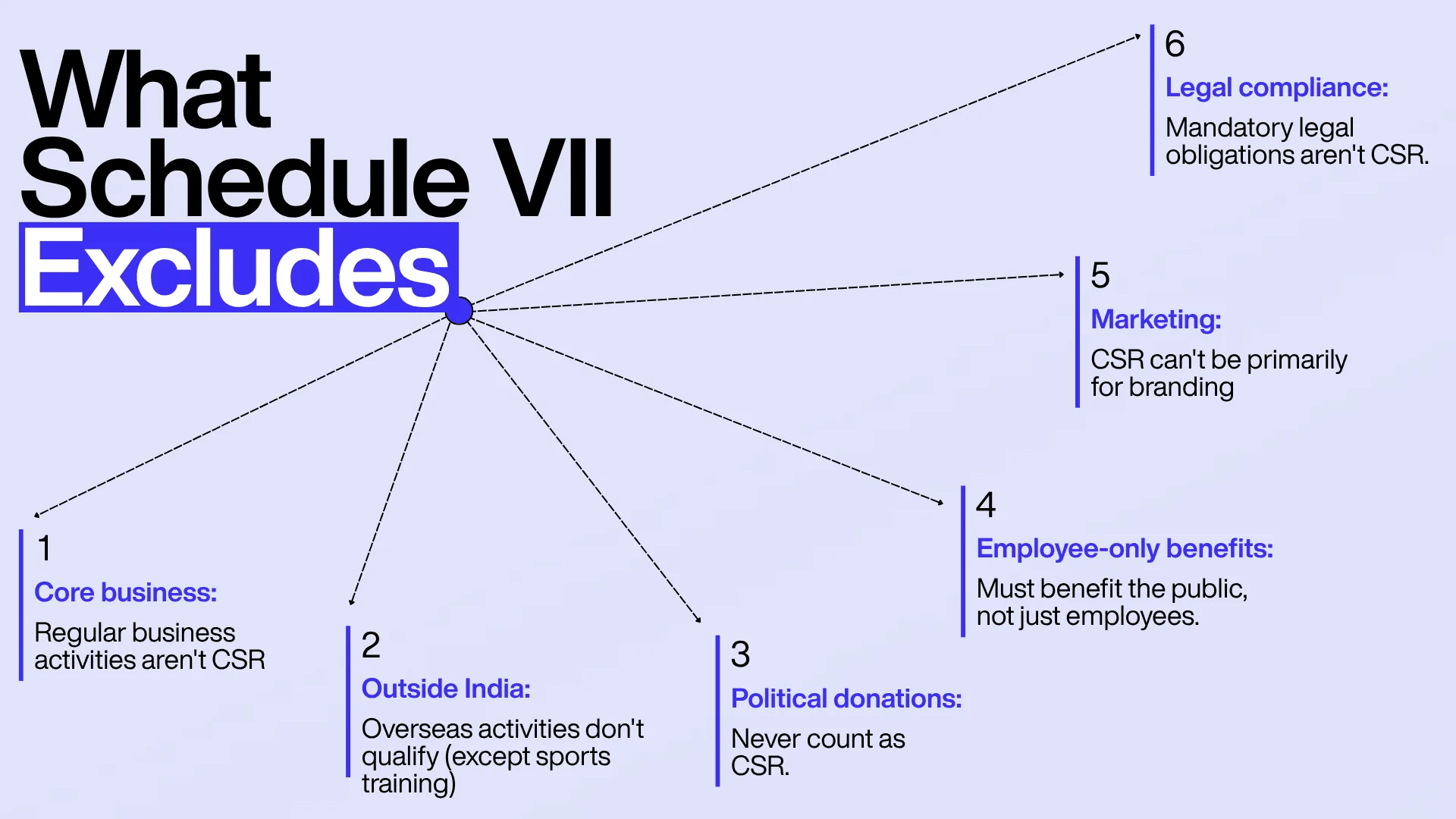
Rule 2(1)(d) of the Companies (CSR Policy) Rules, 2014 entirely excludes six categories from the definition of CSR. An activity can sit squarely inside item (ii) and still fail, because the negative list operates independently of the schedule.
1. Normal course of business: Activities undertaken in pursuance of the company's normal course of business. The COVID-era carve-out for vaccine, drug, and medical-device R&D expired at the end of FY 2022-23. There is no live exemption today.
2. Activities outside India: Any activity undertaken by the company outside India shall not be an eligible CSR activity. The only exception is training of Indian sports personnel representing any State or Union Territory at national level or India at international level. A relief grant to a neighbouring country during a disaster is generous and non-compliant.
3. Political contributions: Any amount, directly or indirectly, to any political party under Section 182.
4. Employee-only benefits: The line here is finer than most policies capture. Any activity designed exclusively for the benefit of employees shall be considered as an "activity benefitting employees" and will not qualify. But the door is not shut: any activity which is not designed to benefit employees solely, but the public at large, and if the employees and their family members are incidental beneficiaries, then such activity would not be considered as "activity benefitting employees." Design determines eligibility, not incidental headcount. ("Employees" here takes the meaning in Section 2(k) of the Code on Wages, 2019.)
5. Marketing sponsorships: The MCA's framing is unusually candid: Companies shall not use CSR purely as a marketing or brand-building tool for their business, but brand building as a collateral benefit does not vitiate the spirit of CSR. Brand lift as a by-product is fine. Brand lift as the purpose is not.
6. Statutory obligations: Anything already required by another Indian law. Effluent treatment mandated by your consent to operate is compliance, not CSR.
Three further boundaries surprise people:
Contribution to corpus is out. The contribution to corpus of any entity is not an admissible CSR expenditure w.e.f. 22nd January, 2021. Contributions in kind do not count. CSR contribution cannot be in kind and monetised. Employee volunteering time cannot be monetised. Involvement of employees in CSR projects of a company cannot be monetised. The hours still matter enormously for engagement and for BRSR narrative disclosure; see our guide on how to track volunteer hours for CSR reporting, but they are not spent.
The Seven-Gate Eligibility Test
Put the schedule and the exclusions together, and you get a sequence. Run every proposed project through it before the budget is committed, not after.
| Gate | Question | Required answer |
|---|---|---|
| 1 | Is the activity relatable to a Schedule VII entry? | Yes |
| 2 | Is it in your normal course of business? | No |
| 3 | Is any of it undertaken outside India? | No |
| 4 | Is it designed exclusively to benefit your own employees? | No |
| 5 | Is it a sponsorship bought for marketing benefit? | No |
| 6 | Is it already required by another law in force in India? | No |
| 7 | Is it a political contribution, direct or indirect? | No |
Clear all seven and the project is eligible. Fail one and the spend is not CSR; it cannot count towards the 2% obligation, and it is not deductible either, since Explanation 2 to Section 37(1) of the Income Tax Act, 1961 provides that expenditure on CSR activities referred to in Section 135 shall not be deemed to be expenditure incurred for the purposes of the business or profession.
Two adjacent questions come up constantly and are worth settling here:
Is local-area spending mandatory? No. The preference to the local area in the Act is only directory and not mandatory in nature, and companies need to balance local area preference with national priorities.
Can CSR fund a government scheme? Not as gap-filling. CSR should not be interpreted as a source of financing the resource gaps in Government Schemes. However, the Board of the eligible company may undertake similar activities independently, subject to the Rules. Design your own programme; do not write a cheque into someone else's budget line.
Mapping Schedule VII to the SDGs
Since 2019, the direction of travel has been explicit: Schedule VII is being steered towards the Sustainable Development Goals, one notification at a time. Item (ix)(b) now says so in terms. And with SEBI's BRSR framework asking listed companies to disclose social performance with the same discipline as financial results, the Schedule VII tag and the SDG tag increasingly need to sit side by side on the same project record.
This is a working map, not a statutory one, but it is the one most CSR teams end up building anyway:
What Happens When Classification Goes Wrong
Schedule VII misclassification does not usually announce itself. It shows up as a shortfall spend that the company counted and the Registrar did not, and the shortfall is what carries the penalty.
Section 135(7) sets the arithmetic: Non-compliance is a civil wrong. The company is liable to twice the unspent amount required to be transferred to any fund included in Schedule VII of the Act or Unspent CSR Account, as the case may be, or one crore rupees, whichever is less, and every officer in default to 1/10th of the unspent amount ... or two lakh rupees, whichever is less.
The mechanics are best understood through a real order.
Worked example: the Pace Digitek order
In the matter of Pace Digitek Limited, the Registrar of Companies, Bangalore imposed penalties on the company and its Managing Director for violating Section 135(7), by order dated 17 October 2025. The company had filed a suo-motu application on 8 January 2025 admitting non-compliance ahead of its listing.
| FY | CSR obligation | Spent | Amount that should have been transferred |
|---|---|---|---|
| 2020-21 | ₹7,39,697 | Nil | ₹7,39,697 |
| 2021-22 | ₹8,95,598 | Nil | ₹8,95,598 |
| 2022-23 | ₹16,50,000 | ₹30,15,000 | No violation; ₹13,50,000 excess available for set-off |
| 2023-24 | ₹23,93,000 | ₹10,28,000 (after set-off) | ₹10,28,000 |
| Total | — | — | ₹26,63,295 |
The penalty imposed was** ₹53,26,590 on the company** and ₹2,66,330 on the Managing Director.
Two details are worth pulling out, because they are where most commentary gets it wrong.
First, the caps are applied per default, not per company. Two times ₹26,63,295 is ₹53,26,590, comfortably under the ₹1 crore ceiling, so the ceiling offered no protection at all. On the officer's side, one-tenth of ₹26,63,295 is ₹2,66,330, which exceeds the ₹2 lakh cap. The reason the higher figure stood is that the penalty was computed financial year by financial year: one-tenth of each year's shortfall (₹73,970 + ₹89,560 + ₹1,02,800) was individually below ₹2 lakh. Three years of default means three penalties, not one capped penalty. This is the single most under-appreciated feature of Section 135(7).
Second, paying up late does not help. The company had already transferred the full ₹26,63,295 to the Prime Minister's National Relief Fund on 4 September 2025, six weeks before the order. It made no difference. The MCA's position is unambiguous: the penalty does not relieve the company from the obligations under the law, and the penalty is over and above the obligated amount required to be transferred. The penalty is the consequence of not abiding by the law, and not an alternative for the same.
And enforcement is not theoretical. Practitioners at Cyril Amarchand Mangaldas have observed that many companies have been receiving notices related to their CSR obligations, and that enforcement has increased recently, including for past procedural lapses that were not repeated.
The unspent-fund clock
This is where classification errors turn into cash consequences:
| Nature of unspent amount | Where it goes | By when |
|---|---|---|
| Relates to an ongoing project | Separate “Unspent CSR Account” in a scheduled bank | Within 30 days of the financial year end |
| Relates to anything else | Any fund included in Schedule VII | Within 6 months of the financial year end |
| Ongoing-project money still unspent after 3 FYs | Any fund included in Schedule VII | Within 30 days of the end of the third FY |
Three rules catch people out badly:
-
You cannot re-spend it in the intervening six months. Companies are not permitted to spend the unspent CSR amount, other than the amount on ongoing projects, on any CSR activity during the intervening period of six months after the end of the financial year. Discovering in May that a March project was misclassified does not give you until September to re-spend it. It gives you until September to transfer it.
-
Disbursement is not spending. Mere disbursal of funds for implementation of a project does not amount to spending unless the implementing agency utilises the whole amount. Money sitting in your partner's bank account on 31 March is not spent.
-
An "ongoing project" has a hard ceiling. Three financial years excluding the year of commencement (1+3) years. Under no circumstances shall the time period of an ongoing project be extended beyond its permissible limit. The 30-day and six-month clocks are unforgiving because they start automatically. Software that flags a looming shortfall in January is worth considerably more than software that reports it in April, which is really the argument our guide on what CSR software does and how to choose it makes at length.
The 30-day and six-month clocks are unforgiving because they start automatically. Software that flags a looming shortfall in January is worth considerably more than software that reports it in April, which is really the argument our guide on what CSR software does and how to choose it makes at length.
How Schedule VII has Changed Since 2014
The schedule has been amended nine times in twelve years. Not once has an item been deleted. It only ever grows.
| Date | Notification | What changed |
|---|---|---|
| 27 Feb 2014 | G.S.R. 130(E) | Schedule VII notified with items (i)–(x); in force 1 April 2014 |
| 31 Mar 2014 | G.S.R. 261(E) (corrigenda) | Item (i) widened to “health care including preventive health care” |
| 6 Aug 2014 | G.S.R. 568(E) | Item (xi) — slum area development — inserted |
| 24 Oct 2014 | G.S.R. 741(E) | Swachh Bharat Kosh added to (i); Clean Ganga Fund added to (iv) |
| 30 May 2019 | G.S.R. 390(E) | Item (xii) — disaster management — inserted |
| 11 Oct 2019 | G.S.R. 776(E) (corrigendum 19 Nov 2019) | Item (ix) widened to incubators, public-funded universities, IITs and national laboratories |
| 26 May 2020 | G.S.R. 313(E) | PM CARES Fund added to item (viii); deemed in force from 28 March 2020 |
| 23 Jun 2020 | G.S.R. 399(E) | CAPF and CPMF veterans, dependents and widows added to item (vi) |
| 24 Aug 2020 | G.S.R. 525(E) | Item (ix) restructured into (ix)(a) and (ix)(b), explicitly tied to the SDGs |
| 27 May 2026 | G.S.R. 416(E) (with G.S.R. 415(E)) | Item (xiii) — ZCZP instruments on the Social Stock Exchange — inserted |
The pattern behind the amendments is not random. The High Level Committee on CSR, chaired by Injeti Srinivas and presented to the Finance Minister on 13 August 2019, recommended aligning Schedule 7 with the SDGs by adopting an SDG plus framework, additionally covering sports promotion, senior citizens' welfare, welfare of differently abled persons, disaster management and heritage protection. It also recommended registration of implementation agencies on the MCA portal, balancing local-area preference against national priorities, impact assessment studies, treating CSR default as a civil offence, and allowing CSR in social benefit bonds.
Read the 2019, 2020 and 2026 amendments against that list and the direction becomes obvious. Nearly every one of those recommendations has now landed in law.
For anyone maintaining a CSR policy document, the practical implication is uncomfortable and simple: a policy that lists the permitted activities verbatim will go stale on a schedule you do not control. Reference the schedule; do not transcribe it.
Turning Schedule VII into an Operating System
Everything above is a classification problem wearing a legal costume. The companies that handle it well are not the ones with the best lawyers. They are the ones whose systems make the classification visible while it can still be changed.
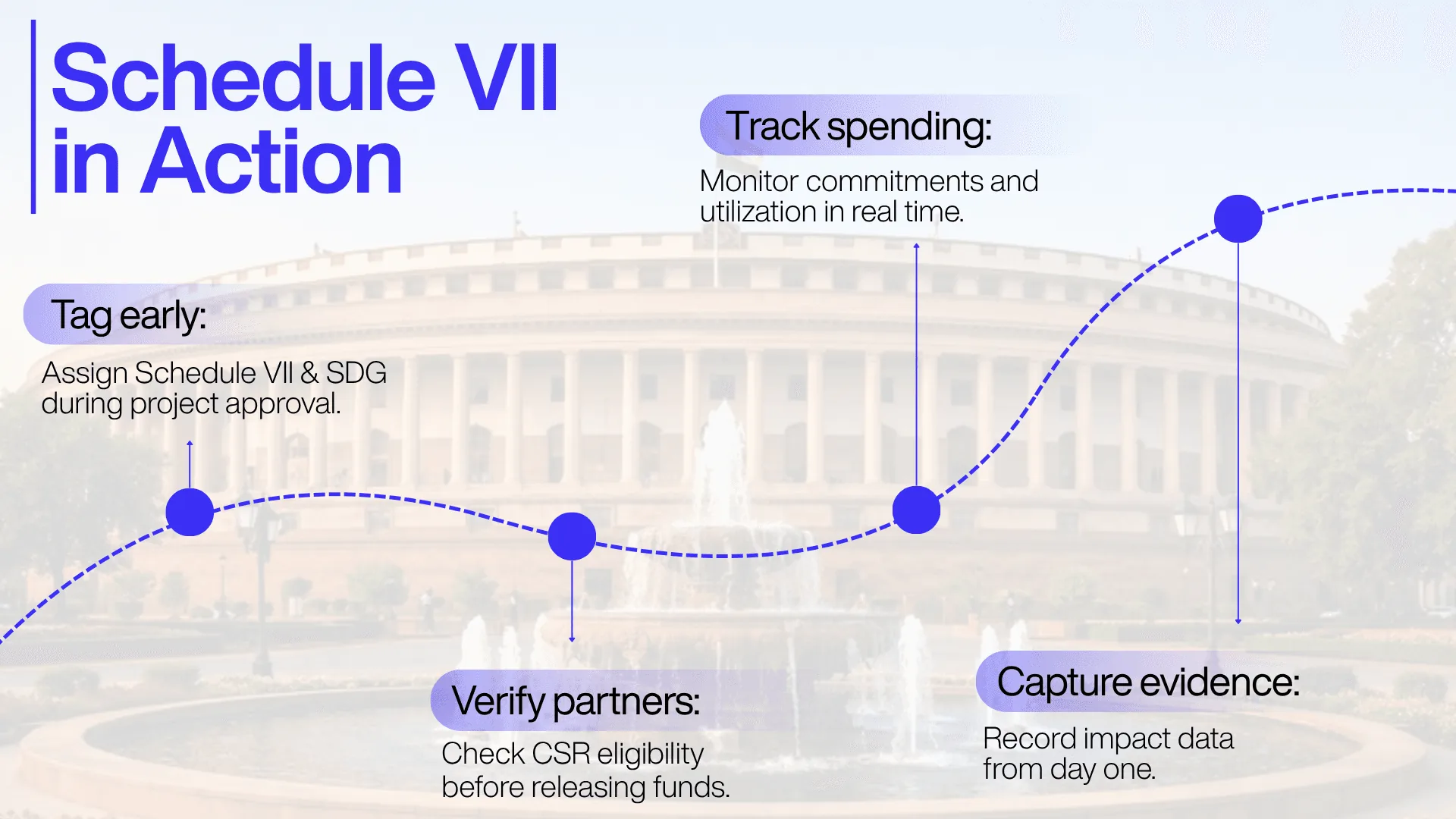
Four practices separate them.
**1. Tag once, at the point of approval: **Every project gets a single Schedule VII item and a single primary SDG at the moment the Board approves the annual action plan, not when the annexure is being drafted in April. Overlaps get documented with a one-line rationale, not argued about in March.
2. Verify the partner before the first rupee moves: Every implementing agency mentioned in rule 4(1) of the Companies (CSR Policy) Rules, 2014 shall mandatorily register itself in the MCA21 portal w.e.f. 01st April 2021. Eligible entities are Section 8 companies, registered public trusts and registered societies holding both 12A and 80G registration, statutory bodies established under an Act of Parliament or a State legislature, and entities established by the Central or State Government.
An international organisation cannot act as an implementing agency, though it may be engaged for design, monitoring, evaluation or capacity building under Rule 4(3). The compliance risk sits with you, not the partner.
3. Track commitment against actual utilisation in real time: The 30-day and six-month clocks start automatically. In FY 2024-25, NSE-listed companies transferred ₹3,223 crore to Unspent CSR Accounts a number that tells you how routine the shortfall problem has become. Notably, 315 of those companies missed the 2% mandate outright.
**4. Capture impact evidence at source: ** Outcome data reconstructed after the fact rarely survives contact with an independent assessor. In FY 2024-25, only 152 of the 531 disclosing NSE companies reported any impact assessment spend at all.
This is the work Relific is built around. ProGran runs the programme and grants lifecycle with Schedule VII categories, Indian fiscal-year budgeting and rupee formatting built in rather than bolted on. Surve-R handles field data capture where connectivity is thin. Voluntee-R captures employee engagement without pretending volunteer hours are spent. The reporting layer assembles the Board's report annexure, Form CSR-2 and BRSR disclosures from one governed dataset, so the project-versus-overhead split is a system rule rather than a year-end reconstruction.
If you are still deciding what you need, our decision framework for choosing CSR software, our comparison of the leading Indian platforms and our head-to-head with SoulAce are the places to start. For the wider strategic picture, our piece on the shift from compliance CSR to ESG accountability traces where the regulatory direction is heading, and our guide to automated CSR reporting covers the reporting stack that sits underneath.
Where this leaves your CSR committee
Schedule VII is thirteen lines of statutory text that decide whether a year's worth of good work counts. It is not a difficult list. It is a list that punishes casual reading, and casual reading is exactly what happens when the classification decision is made in a spreadsheet, in a hurry, in the last week of the financial year.
The companies that get this right have made one structural change, and it is not a technology change first. They moved the Schedule VII decision to the front of the project lifecycle instead of the back. The head is chosen when the Board approves the annual action plan. The partner's CSR-1 registration is verified before the first disbursement. Evidence accumulates as the work happens. By the time the annexure is due, there is nothing to reconstruct, only something to print.
That is not a compliance posture. It is a better way to run a programme, and compliance is what falls out of it.
If your team is still assembling that picture from partner emails and half-remembered numbers each March, the gap is not effort. It is infrastructure. Book a demo with Relific to see what Schedule VII tagging, real-time fund-utilisation tracking and audit-ready evidence look like when they live in one system, or talk to us about where your current process is leaking proof.
Thirteen doors. Choose deliberately, document the choice, and spend the year proving it was the right one.
Frequently asked questions
Thirteen. Items (i) through (xii) have existed since May 2019, and item (xiii) subscription to zero-coupon, zero-principal instruments on the Social Stock Exchange was inserted by G.S.R. 416(E) dated 27 May 2026.
No. The MCA's position is categorical: CSR expenditure cannot be incurred on activities beyond Schedule VII. What the Ministry does permit is a liberal reading within each entry, so an activity that captures the essence of a listed subject qualifies even if the exact words do not appear.
Item (ii), covering education, special education, vocational skills and livelihood enhancement. Education alone drew ₹13,877 crore in FY 2024-25 (34% of national CSR spend), and among NSE-listed companies that disclosed project details, item (ii) accounted for 37.32% of reported outlay.
Not necessarily. Six exclusions under Rule 2(1)(d) override a schedule match: normal course of business, activities outside India, political contributions, employee-only benefits, marketing sponsorships and statutory obligations. All seven gates must clear.
No. Only funds specifically named in Schedule VII qualify: Swachh Bharat Kosh, Clean Ganga Fund, PMNRF, PM CARES, and other Central Government funds notified by the MCA for the welfare of SCs, STs, OBCs, minorities and women. Contributions to funds outside that list are not admissible CSR expenditure.
Expenditure on zero coupon zero principal instruments cannot exceed 10% of the company's total CSR expenditure for that financial year. Projects funded this way are exempt from company-level impact assessment, and must be completed within three succeeding financial years from the date of issuance.
A Not for Profit Organisation registered with the Social Stock Exchange segment of a recognised stock exchange, issuing in accordance with SEBI's regulations. The definition of "Not for Profit Organisation" in the amended CSR Rules follows Regulation 292A(e) of the SEBI (ICDR) Regulations, 2018.
They count within total CSR expenditure but are capped at 5% of it. Overheads incurred by an implementing agency cannot be claimed as your administrative overheads. Impact-assessment expenditure sits outside the 5% cap, subject to its own limit of 5% of total CSR spend or ₹50 lakh, whichever is lower.
Preference for the local area is directory, not mandatory. Companies are expected to balance local-area preference against national priorities, and several Schedule VII entries art and culture, war widows' welfare transcend geography by their nature.
Yes, and often they do. Skill development for women fits item (ii) and item (iii) equally. The rule of practice is to pick one primary head, record a one-line rationale in the annual action plan, and apply it consistently across the Board's report, Form CSR-2 and BRSR.
Only if both Rule 8(3) conditions are met: an average CSR obligation of ₹10 crore or more in the three immediately preceding financial years, and a project with an outlay of ₹1 crore or more completed at least one year before the assessment. Otherwise, it is voluntary.
Under Section 135(7), the company faces twice the amount that should have been transferred or ₹1 crore, whichever is lower. Every officer in default faces one-tenth of that amount or ₹2 lakh, whichever is lower. Penalties are computed default-by-default, so multiple years of non-compliance attract multiple penalties. Transferring the money late does not extinguish the liability.
No. Explanation 2 to Section 37(1) of the Income Tax Act, 1961 provides that expenditure on CSR activities referred to in Section 135 of the Companies Act, 2013 shall not be deemed to be expenditure incurred for the business or profession.
On the India Code portal maintained by the Legislative Department, and on the MCA website, where the amendment notifications G.S.R. 415(E) and G.S.R. 416(E) dated 27 May 2026 have been placed.