

Key Takeaways
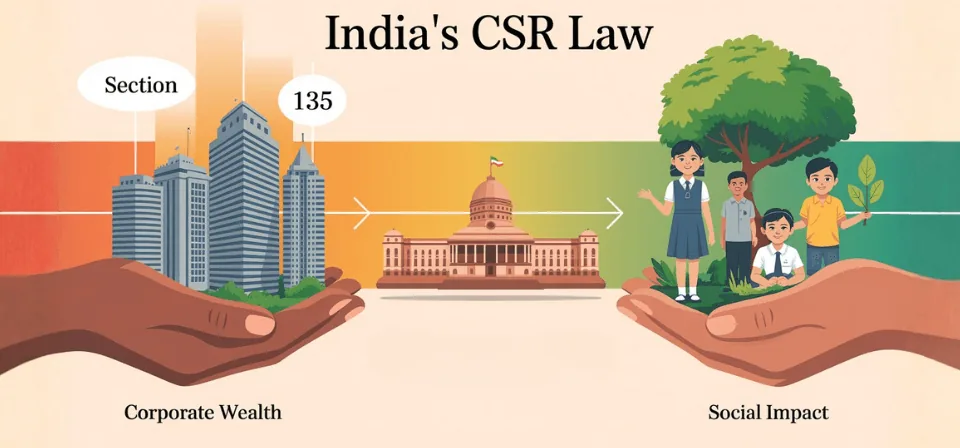
- Form CSR-2 is a mandatory annual e-form that every company covered under Section 135(1) of the Companies Act, 2013 must file to report its CSR activities, expenditure, and outcomes to the Registrar of Companies.
- The FY 2024–25 filing cycle is the live one. CSR-2 for FY 2024–25 is filed separately, after AOC-4, with a due date of 30 December 2025, a different date, and a different reporting year from the FY 2023–24 cycle whose deadline was 30 June 2025. Always check the current MCA notification before you plan your calendar.
- The form has 13 numbered sections, from basic company identity to a director's digitally signed declaration, and each maps to a specific compliance obligation. Section 9, the reason for underspending the 2%, has become one of the most scrutinised fields in the whole form.
- Three 2025–2026 changes reshaped the CSR landscape and every practitioner should know them: the CSR-1 registration overhaul (July 2025), the new ZCZP / Social Stock Exchange route (May 2026), and the pending Corporate Laws (Amendment) Bill, 2026, which proposes to double the net-profit trigger from ₹5 crore to ₹10 crore.
- Enforcement is real and current. In July 2026, the Registrar of Companies, Cuttack, penalised a company for filing CSR-2 nearly four years late, proof that late filing carries a live, monetary cost.
- Manual reconstruction from spreadsheets is the single biggest source of filing errors. Relific's ProGran platform calculates CSR obligation automatically and auto-populates all 13 sections of CSR-2 straight from the programme data it already holds, turning the filing from a data-entry marathon into a review-and-sign step.
Form CSR-2 is the annual e-form every company covered by Section 135 of the Companies Act, 2013 files with the Registrar of Companies to report its CSR spend, projects, and outcomes. Thirteen numbered sections, filed after your AOC-4, mandatory. Not a formality you wave through at year-end.
But knowing what CSR-2 is was never the hard part. Assembling it is.
The form asks for numbers that live in five different places at once. Three years of financials sit with finance. Project spend sits with the CSR team. Attendance records are buried in board minutes. Transfer dates are in a bank statement someone has to go dig up. And the CSR-1 registration numbers you need are in a partner's inbox from eight months ago. Try to pull all of that together the week before a deadline, and something will be wrong, usually the thing you didn't check twice.
The ground has also shifted, hard, in the last eighteen months. A new filing portal. A fresh run of penalty orders naming companies outright. Three separate rule changes that quietly rewrote parts of how and in some cases whether you file at all. If you're working from last year's checklist, parts of it are already stale.
So here's what's actually true right now, section by section, with the changes flagged wherever they bite.
The 30-Second Version
- Who files: Any company that crossed ₹500 crore net worth, ₹1,000 crore turnover, or ₹5 crore net profit in the preceding year. Same trigger as CSR itself.
- When: After AOC-4. Deadlines shift most years; for FY 2024-25 it was 30 December 2025 (now passed). Always pull the date for your filing year from the current MCA notification.
- What it asks: 13 sections: company identity, the financial thresholds, committee composition, expenditure, unspent-fund trails, capital assets, and a director's signed declaration.
- The field everyone underrates: Section 9, your written reason for underspending the 2%. It sits on the public record and regulators read it closely.
- The cost of getting it wrong: ₹10,000 plus ₹1,000/day under Section 450 for a filing default and far more if the underlying issue is unspent money. RoC Cuttack penalised a company for a late CSR-2 as recently as July 2026.
What CSR-2 is and Why it Exists at All
CSR-2 arrived through the Companies (Accounts) Amendment Rules, 2022, notified on 11 February 2022. Its job is narrow: give the Ministry of Corporate Affairs one standard, structured way for Section 135 companies to report their CSR every year.
Before it, that reporting was a mess. Companies attached CSR details to their Board Report in whatever format they liked and, if they had a website, published something there too. No single form. No comparable data. Nothing the MCA could actually run analysis on.
Which was the whole point of building CSR-2. Instead of mining thousands of scattered PDFs buried in annual reports, the ministry now gets clean, machine-readable data it can sort and compare across the entire population of covered companies. Read the form, and the intent is obvious in the design: every field is a data point the government wants to be able to slice.
One thing worth saying plainly, because a lot of teams miss it: CSR-2 is one instrument in a stack, not the stack itself. CSR in India is statutory, not voluntary, and the 2% mandate now expects documented outcomes, not just a spend figure. The full compliance load runs across the Board's report annexure, this form, mandatory impact assessment, and for the top 1,000 listed companies, SEBI's BRSR. If you want to see how those four pieces actually fit together, Relific's guide to automated CSR reporting for Indian companies maps the whole picture.
Who has to File CSR-2?

If your company is required to do CSR, it's required to file CSR-2. There's no separate test.
The trigger is Section 135(1). You're in if, during the immediately preceding financial year, your company had any one of these:
- Net worth of ₹500 crore or more, or
- Turnover of ₹1,000 crore or more, or
- Net profit of ₹5 crore or more.
Cross even one, and you must constitute a CSR Committee, adopt a CSR policy, and from FY 2020-21 onward file CSR-2. From there, Section 135(5) requires you to spend at least 2% of your average net profit over the three preceding years, every year.
Here's the part people get wrong. Applicability is checked year by year, against the preceding year's figures. A company can drift in and out of the CSR net as its financials move. So the year you're filing for and the year whose numbers decide applicability are not the same year, and CSR-2 has to reflect the right one.
One trap worth flagging: under Rule 3(1) of the CSR Policy Rules, if you're holding any money in an Unspent CSR Account, you still have to keep a CSR Committee and comply with sub-sections (2) to (6) even if you've since dropped below every threshold. The obligation follows the money.
And this isn't just a big-conglomerate problem. A mid-sized manufacturer has one strong year, or a services company clears the turnover line after a funding round, and suddenly there's a CSR compliance function to build from nothing. If that's you, Relific's CSR software guide is a sane place to start.
⚠️ Watch this: the ₹5 crore trigger may double. The Corporate Laws (Amendment) Bill, 2026, introduced in the Lok Sabha on 23 March 2026, proposes lifting the net-profit trigger from ₹5 crore to ₹10 crore, leaving net worth and turnover untouched. If it passes, an estimated 30,000-40,000 companies caught only by the net-profit test could fall out of CSR entirely. But it's a Bill, not law. Until it gets assent and is notified, the ₹5 crore threshold stands. Don't file or skip filing on the assumption it's already changed. More on the Bill below.
When is CSR-2 due?
CSR-2 is filed after your AOC-4, and the deadline has moved almost every single year. Which means "when is it due" has no fixed answer; it depends entirely on which financial year you're filing for. Pull the date from the current MCA notification. Not from memory, not from last year's calendar, not from a summary you found on some tax portal.
Here's the full run of deadlines to date:
|
Reporting year |
CSR-2 due date |
How it's filed |
|---|---|---|
|
FY 2020-21 (first year) |
31 March 2022 |
Separately, after AOC-4 |
|
FY 2021-22 |
With AOC-4 |
Addendum |
|
FY 2022-23 |
With AOC-4 |
Addendum |
|
FY 2023-24 |
30 June 2025 |
Separately (post-migration) |
|
FY 2024-25 |
30 December 2025 |
Separately, after AOC-4 |
If you're reading this in 2026: the FY 2024-25 window (30 December 2025) has closed. If you missed it, you're now filing late, which means Section 450 exposure (see the penalty section), so file and regularise rather than wait. If you're getting ahead of FY 2025-26, watch the MCA portal for that year's notification, because the date will almost certainly move again.
The AOC-4 Extension Trap
This is the one that catches people. Read it twice.
On 30 December 2025, the MCA issued General Circular No. 08/2025, extending the annual-filing fee relaxation for FY 2024-25 to 31 January 2026. Sounds like breathing room. Then you read the fine print, and the relaxation names an exact set of forms: MGT-7, MGT-7A, AOC-4, AOC-4 CFS, AOC-4 NBFC (Ind AS), AOC-4 CFS NBFC (Ind AS), and AOC-4 (XBRL).
CSR-2 is not on that list.
So yes, your AOC-4 fee window stretched to 31 January 2026. No, that doesn't mean CSR-2 came along for the ride. Unless a notification specifically extends CSR-2, treat CSR-2's own stated deadline as the one that binds you. We've watched teams see the AOC-4 headline, assume the whole annual-filing bundle moved together, and quietly slip into a late CSR-2 without realising it. Two forms, one circular, two different deadlines that's the trap.
The V3 Migration Changed How You File.
There was a structural shift alongside the extensions. The old V2 portal was decommissioned from 18 June 2025. For a short transitional window, 14 July to 15 August 2025, companies still holding a V2 SRN could file CSR-2 as an independent form on V3.
That window is closed. Annual filing forms AOC-4 and CSR-2 are now live only on the MCA21 V3 portal, and most are web-based rather than downloadable PDFs.
None of which is really about portals. The deeper point is that a deadline moving every year is a risk you absorb far more easily when your obligation and spend data are tracked continuously, sitting ready instead of being reconstructed in a panic each filing season. That's the whole argument behind Relific's CSR software buying guide.
How to File CSR-2, Step by Step
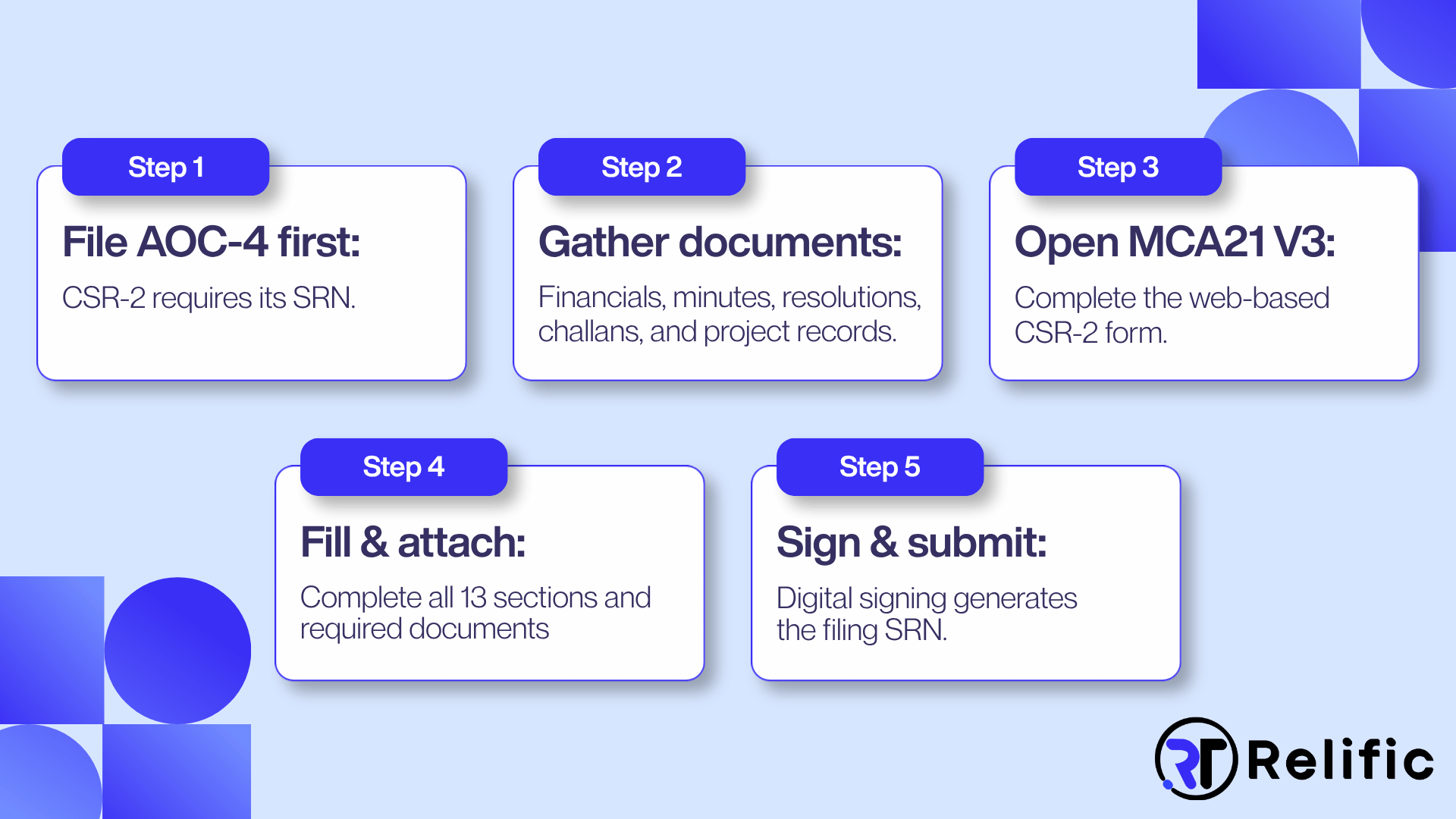
The sequence is the same whatever year you're reporting.
1. Finish AOC-4 first: CSR-2 is built around your financial-statement filing, and it needs the SRN of that filing as an input. File AOC-4, then start CSR-2.
2. Pull your documents together: Audited financials, CSR committee minutes, the board resolution authorising the filing, paid expenditure challans, project reports, and any unspent-fund records. (Full checklist below.)
3. Open the form on MCA21 V3: Log in with company credentials. Post-migration, CSR-2 is web-based, not a downloadable PDF.
4. Fill the 13 sections and attach: Company identity, thresholds, committee, expenditure, unspent amounts, capital assets. The section-by-section walkthrough is next.
5. Sign and submit: An authorised director, IRP, RP, or liquidator signs digitally with their DIN or PAN. Submission generates an SRN that's your proof of filing. Keep it.
This is the point where doing it by hand and doing it with software look completely different. With Relific's ProGran, obligation is already calculated from the three-year average, unspent funds are already tracked with the 3+1 aging rule, and all 13 sections are already populated from your programme data. Steps 4 and 5 stop being data entry and become review-and-sign.
What You Need Before You Start
Keep this on hand before you open the form:
- Audited financials for the reporting year and the two before it (Section 5 needs all three)
- CSR committee minutes and attendance records
- The board resolution authorising the CSR-2 filing
- Project reports: objectives, outcomes, evidence
- Unspent-fund records and proof of transfer to the Unspent CSR Account or a Schedule VII fund
- CSR-1 registration numbers for every implementing agency you used
That scattered, multi-source scramble is the real problem, and it's what Relific's analysis pins as the root cause of filing errors. Ask any CSR lead how their last impact report came together, and you'll usually hear some version of "three weeks chasing spreadsheets, partner emails, and half-remembered numbers to rebuild work we'd already finished." The everyday drag is real, too: survey data cited in Relific's coverage puts 61% of sustainability leaders at four-plus hours a week compiling reports by hand.
Surve-R is built to kill that step: field data comes in through AI-assisted offline forms with GPS, photos, and e-signatures, so it's already structured by the time Section 7's project tables need it. And where employee volunteering counts toward your spend, Voluntee-R tracks hours against Schedule VII categories and computes their impact value; Relific's guide on tracking volunteer hours for CSR reporting walks through that.
The 13 Sections of Form CSR-2, Explained.
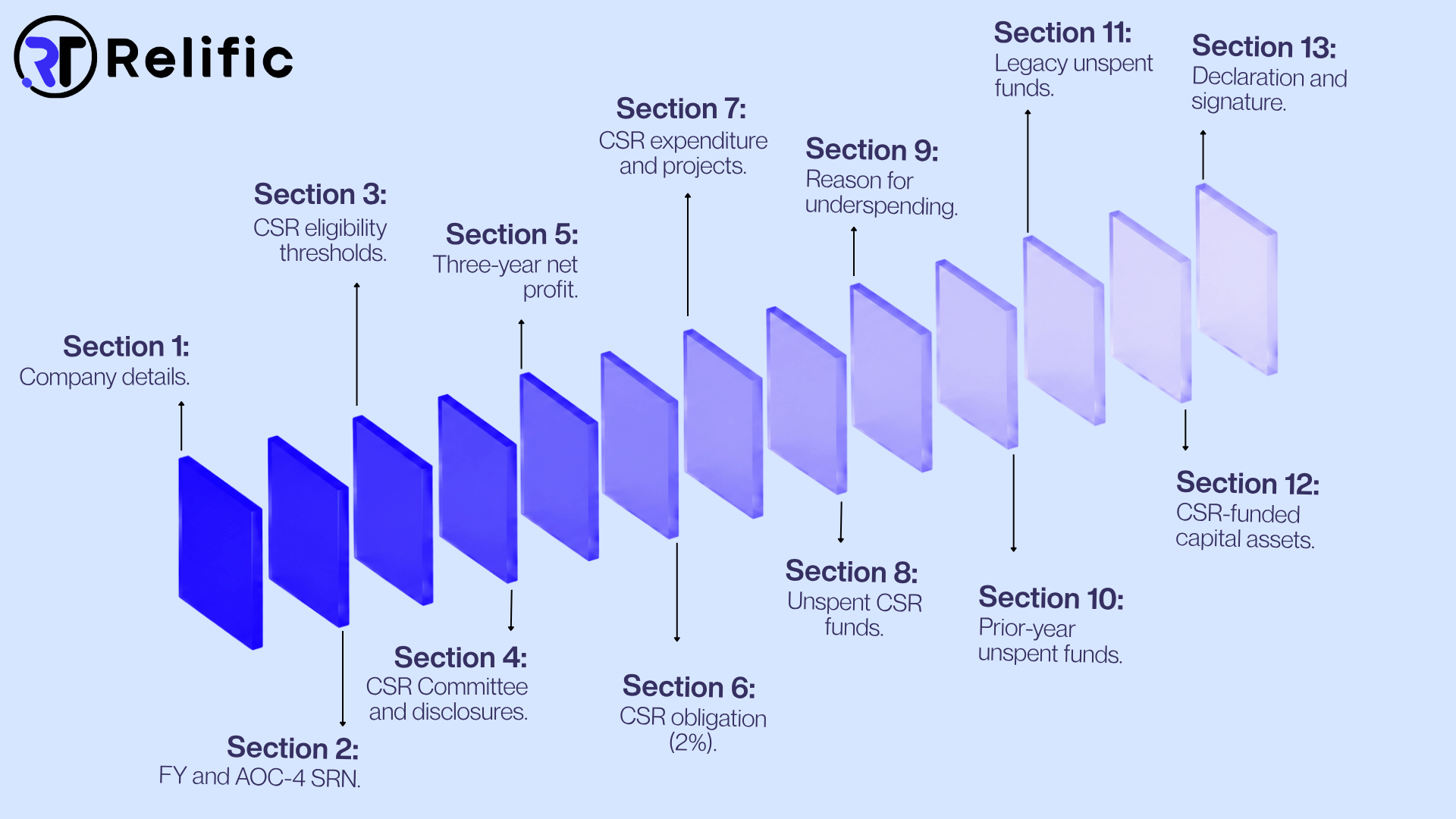
None of these are hard on their own. It's the combination and the continuous data discipline they assume that catches teams out. Recent rule changes are flagged where they touch a section.
Section 1: Company information. CIN, registered name, registered office, company email. Mostly auto-filled by the portal. It just anchors the filing to a legal entity.
Section 2: Financial year and AOC-4 reference. The exact year the report covers, plus the SRN of your AOC-4 (or XBRL / NBFC variant). This is the field that ties CSR-2 back to your financials, and a mismatch here is a leading cause of rejection.
Section 3: The three thresholds and what triggered you. Net worth, turnover, net profit, and which one pulled you into Section 135. The classic error: using the wrong year. The test looks at the immediately preceding year, not the year you're reporting on.
Section 4: Committee composition and website disclosures. How many directors on the committee (by category: independent, woman, independent woman, other), meetings held, attendance. Plus whether your website carries the committee composition, CSR policy, and board-approved projects per Rule 9 and whether impact assessment was done and disclosed, and whether any amount is available for set-off under Rule 7(3).
On impact assessment: It applies to companies with an average CSR obligation of ₹10 crore or more over the three preceding years, for projects of ₹1 crore or more completed at least a year before the study. One detail teams routinely miss: the cost you can book for impact assessment was amended from 5% to 2% of total CSR expenditure (or ₹50 lakh, whichever is higher), and it's a separate head from the 5% admin-overhead cap. Don't book one as the other.
Section 5: Three years of net profit. Confirms whether you've completed three financial years (younger companies report what they have), then profit before tax, net profit under Section 198, and Rule 2(1)(h) adjustments across the three preceding years. The average this produces is the base for every calculation that follows.
Section 6: Your CSR obligation for the year. 2% of that Section 5 average, adjusted for carried-forward surplus and any set-off. This is the number every expenditure section gets measured against and exactly what ProGran calculates for you.
Section 7 Expenditure (usually the longest section). Whether you spent, and against ongoing projects, other projects, or both, with separate tables capturing project ID, Schedule VII activity, name, location down to state and district, duration, amount spent, and whether implementation was direct or via an agency (whose CSR-1 number you then need). It closes by totalling admin overheads (capped at 5%), impact-assessment spend, total spent, and anything unspent or in excess.
New route to know about: The Companies (CSR Policy) Amendment Rules, 2026 added Rule 4A, letting companies route part of their CSR through Zero Coupon Zero Principal (ZCZP) instruments on SEBI's Social Stock Exchange, capped at 10% of annual CSR spend, and exempt from impact assessment. It won't touch most FY 2024-25 filings, but it'll start appearing in expenditure disclosures. Detail below.
Section 8: Where unspent money went. If Section 7 shows a shortfall, this tracks the transfer either to your Unspent CSR Account under Section 135(6), or a Schedule VII fund under the second proviso to Section 135(5). Both need amount due, amount transferred, transfer date, and deficiency. The clocks are tight: transfer to the Unspent CSR Account within 30 days of year-end, spend within three financial years, or it goes to a Schedule VII fund within 30 days of the third year closing.
⚠️ Proposed change: 30 days may become 90. The Corporate Laws (Amendment) Bill, 2026 proposes extending the transfer window for unspent amounts on ongoing projects from 30 days to 90. If it's enacted, Section 8's deadline logic changes. Until then, 30 days stands.
Section 9: Why you didn't hit 2%. Short, free-text, and far more consequential than it looks. If you underspent, you explain why in writing, on the permanent public record. Regulators scrutinise these closely; MCA orders show them examining even the format of the disclosure, not just whether it exists. Do not treat this field as a box to tick.
Section 10 Unspent funds from the last three years. Utilisation of amounts carried forward from up to three prior years (specifically, years ending after 22 January 2021, when the 2021 amendment took effect). Amounts spent against those balances, status of ongoing projects, and whether any new project was started from carried-forward money with tables that mirror Section 7.
Section 11: Legacy unspent funds (FY 2014-15 to 2019-20). A narrow, mostly historical section for companies still holding balances from the earliest CSR years. Same project-level detail where it applies.
Section 12: Capital assets from CSR funds. Whether you created or acquired capital assets with CSR money and, if so, an asset-level breakdown: description, full address, pincode, date, amount spent, and the owning entity (which, under Rule 7(4), has to be a Section 8 company, a registered trust/society with a CSR number, the beneficiaries, or a public authority).
Section 13 Declaration and signature. The legal attestation. A director (or IRP/RP/Liquidator) confirms, by board resolution number and date, that everything is true, correct, and complete, then signs with their DIN or PAN. The form flags Sections 448 and 449 (false statements, false evidence), so this is a real legal declaration, not a formality.
The Mistakes that get CSR-2 Delayed or Rejected
Nearly all of them trace to the same root: data living in disconnected spreadsheets instead of one system. Relific's deep-dive on why CSR reports fail covers the underlying pitfalls; here are the CSR-2-specific ones.
|
Mistake |
Where it bites |
Why it happens |
|---|---|---|
|
AOC-4 and CSR-2 figures don't match |
Section 2's SRN link vs Sections 3, 5, 6 |
Financials pulled at different times from different files |
|
Wrong year's net worth/turnover/profit |
Section 3 misstates your whole basis |
The trigger looks at the preceding year, not the reporting year |
|
Incomplete implementing-agency details |
Sections 7 and 10 need the CSR-1 number |
Partner data never centralised; chased last-minute |
|
Treating Section 9 as optional |
A weak disclosure has drawn the minimum penalty |
Underrating how closely the reason field is read |
|
Losing the multi-year unspent trail |
Sections 8, 10, 11 track different horizons |
No running ledger; years-old transfer dates rebuilt from memory |
|
Impact assessment booked as admin overhead |
Section 4 / Section 7 misclassification |
Confusing the 2% impact head with the 5% admin cap |
ProGran's answer to that whole bottom half of the table is the same one: it runs a live 3+1 year aging rule on CSR balances and auto-flags anything unspent past three years, so the Section 8/10/11 trail is maintained as you go, not reconstructed at the end.
What Happens if You File Late or Don't File

The form itself carries no dedicated penalty. So Section 450 of the Act's catch-all applies: ₹10,000 on the company and every officer in default, plus ₹1,000 a day for a continuing default, capped at ₹2 lakh (company) and ₹50,000 (officer).
And this is not a theoretical risk anymore. On 13 July 2026, the Registrar of Companies, Cuttack, penalised Kashvi Power & Steel Private Limited and its officers for filing CSR-2 for FY 2020-21 nearly four years late. The form was due 30 June 2022. It was finally filed on 1 June 2026. The Registrar wasn't impressed by the eventual filing; the delay was the offence. Read that order alongside the V3 portal's tighter, system-level validations and the direction is clear: the MCA is now working back through old CSR-2 defaults, and those defaults are far easier to spot than they used to be.
The numbers get a lot bigger when the problem isn't the form but the money it reports. Under Section 135(7), defaulting on the spend (sub-section 5) or the unspent transfer (sub-section 6) is penalised at twice the amount that should have been transferred, or ₹1 crore, whichever is less, with every officer in default liable to a tenth of that, or ₹2 lakh, whichever is less. And here's the part people assume their way out of: fixing it later doesn't undo it. Companies have been penalised even after voluntarily transferring their entire unspent amount to a relief fund, because the default had already crystallised the moment the deadline passed.
A softening is proposed, but it isn't here yet. The Corporate Laws (Amendment) Bill, 2026 would ease several CSR penalties as part of an ease-of-doing-business push. Whether that dilutes genuine CSR or just cuts litigation over minor lapses is being debated. Either way, the current regime Section 135(7) and Section 450 is fully in force until the Bill is enacted.
There's a compounding cost beyond the money, too. Directors and committee members can be held personally liable, and a pattern of late filings shows up in your broader compliance record, which investors, lenders, and rating agencies now read as closely as the Registrar does.
The Three 2025-2026 Changes Every Filer Should Know
If you read nothing else here, read this part. Three different instruments reshaped CSR in the last year; they do completely different things, and mixing them up is a fast route to a wrong filing or a wrong assumption. Here's the clean map, then each one in plain terms.
|
Instrument |
Date |
What it changed |
Status |
|---|---|---|---|
|
CSR Policy Amendment Rules, 2025 |
Effective 14 July 2025 |
Rebuilt CSR-1 registration into a web-based e-form; tightened agency documentation |
In force |
|
CSR Policy Amendment Rules, 2026 (G.S.R. 415(E)) |
27 May 2026 |
Added Rule 4A CSR via ZCZP / Social Stock Exchange, capped at 10%, exempt from impact assessment |
In force |
|
Corporate Laws (Amendment) Bill, 2026 |
Introduced 23 March 2026 |
Proposes: trigger ₹5 cr → ₹10 cr; unspent transfer 30 → 90 days; committee exemption ₹50 lakh → ₹1 cr; power to exempt classes of companies |
Bill not law |
1. The CSR-1 overhaul (in force): From 14 July 2025, CSR-1, the form every implementing agency files to get a CSR Registration Number, became a new web-based e-form with tighter documentation. This matters directly to you, because Sections 7 and 10 of CSR-2 need every partner's CSR-1 number. Check your NGO partners' registration status before the filing crunch, not during it.
2. The ZCZP / Social Stock Exchange route (in force): From 27 May 2026, new Rule 4A lets companies route part of their CSR through Zero Coupon Zero Principal instruments issued by NPOs on SEBI's Social Stock Exchange. A ZCZP instrument pays no interest and returns no principal; in plain terms, a donation, but structured and tracked as a regulated securities-market instrument. The mechanics:
- 10% cap: no more than 10% of your total CSR expenditure for the year through this route; the rest goes through the usual Rule 4 channels.
- No impact assessment: ZCZP spend is exempt, on the logic that SSE-listed NPOs already face SEBI's disclosure and social-audit regime.
- No CSR-1 for this route; the NPO's SSE registration replaces it.
- Due diligence shifts: your job becomes verifying, at subscription, that the NPO is validly SSE-registered and the instrument properly issued, rather than tracking project-level utilisation.
It's narrow and optional; as of mid-2026 only a handful of NPOs had actually listed instruments, but it's now a real line item that'll start showing up in Section 7.
3. The Corporate Laws (Amendment) Bill, 2026 (pending): File this one under watch closely, change nothing yet. Introduced in the Lok Sabha on 23 March 2026 and referred for scrutiny, it proposes to:
- Raise the net-profit trigger from ₹5 crore to ₹10 crore (net worth and turnover unchanged), potentially removing 30,000-40,000 companies from CSR;
- Extend the unspent-transfer window for ongoing projects from 30 to 90 days (changing Section 8's logic);
- Raise the CSR-committee exemption from ₹50 lakh to ₹1 crore; and
- Give the Central Government new power to exempt classes of companies.
The net-profit change has drawn commentary for its asymmetry: a company pulled in by profit gets relief, one pulled in by net worth or turnover doesn't. But none of it is operative. Until the Bill gets assent and is notified, keep complying with the ₹5 crore threshold, the 30-day rule, and the current CSR-2 format. Monitor it; don't pre-empt it.
CSR-2 vs The Other CSR Documents
CSR-2 doesn't stand alone, and conflating it with the others causes real confusion. Here's how they differ.
|
Document |
What it is |
Governing rule |
Who reads it |
|---|---|---|---|
|
Board's Report CSR annexure |
Narrative disclosure in the annual report |
Rule 8, CSR Policy Rules |
Shareholders |
|
Form CSR-2 |
Structured electronic filing to the MCA |
Rule 12(1B), Accounts Rules |
Registrar of Companies |
|
Impact assessment |
Independent evaluation of completed projects |
Rule 8(3) avg. obligation ≥ ₹10 cr, projects ≥ ₹1 cr |
Board; feeds CSR-2 Section 4 |
|
BRSR |
Broad ESG disclosure, CSR is one part |
SEBI (LODR) top 1,000 listed firms |
Investors/markets |
A large listed company may be assembling data for all four at once, on overlapping timelines. Which is precisely why treating CSR data as a continuous, centralised feed instead of four separate annual fire drills has become the more defensible way to work. One source of truth, feeding all four disclosures. That's the case Relific makes in its automated CSR reporting guide.
How Relific Closes the Gap
Look back at everything CSR-2 asks for: three years of financials, attendance records, project spend tagged to Schedule VII, multi-year unspent trails, every partner's registration number. In almost every company, all of that is scattered across finance, the CSR team, and field partners long before anyone opens the form. Closing that gap is precisely what Relific is built for, and it does it through three connected tools:
- ProGran runs programmes and grants end-to-end activity-based budgets on the Indian fiscal year with Schedule VII categories, automatic obligation calculation from the three-year average, unspent tracking split across ongoing and Schedule VII accounts with the 3+1 aging rule, set-off accounting, multi-company support so group subsidiaries close independently, and auto-population of all 13 CSR-2 sections.
- Surve-R collects field data through AI-generated offline forms, GPS, photos, e-signatures, and DPDPA-2023-compliant PII handling, feeding straight into ProGran's KPIs and budget actuals.
- Voluntee-R runs corporate volunteering with QR check-in, automatic hour computation, Schedule VII mapping, and social-impact valuation, counting volunteer hours as in-kind CSR.
Comparing platforms before your next cycle? The guide to building a Theory of Change is a good next step, or book a demo and see the compliance dashboard directly.
Where CSR Reporting is Heading
More scrutiny, tighter integration. That's the direction, and the ease-of-doing-business softening in the pending Bill doesn't really change it. The numbers make the case better than any prediction can.
Cumulative CSR spend grew 2.47× from ₹10,065.93 crore in FY 2014-15 to ₹34,908.75 crore in FY 2023-24, with participating companies rising from 16,548 to 27,188, per National CSR Portal data. Among listed companies specifically, PRIME Database recorded a 16% jump to ₹17,967 crore in FY 2023-24. But unspent CSR funds also hit a five-year high of ₹1,475 crore in FY23 a reminder that the reporting problem (where did it go, and why the shortfall?) is now as pressing as the spending one. That shortfall is exactly what Sections 8, 9, 10, and 11 exist to capture.
The software market tracks the same curve. Grand View Research projects India's CSR software market growing at a 13.7% CAGR from 2026 to 2033. The broader ESG reporting software category is moving faster. MarketsandMarkets puts it at a 17.4% CAGR, from roughly US$1,313 million in 2026 to US$2,931 million by 2031. The pattern is clear: spreadsheet-era processes are being priced out by the sheer verifiability regulators, auditors, and investors now demand.
What counts as "good" reporting is shifting too. The spreadsheet era isn't ending because software is fashionable. It's ending because BRSR-grade disclosure now needs hundreds of individually verifiable data points, and manual work simply can't hand those over audit-ready. As independent verification becomes standard rather than exceptional, expect CSR-2's Section 4 impact-assessment disclosures to carry more weight over time, not less. ProGran's Theory-of-Change canvas, which wires each outcome directly to its KPIs and budget lines, exists for exactly that reason: at this point, compliance-grade reporting and genuine outcome measurement are turning into the same underlying dataset, and it's easier to build them together than to reconcile them apart.
The Bottom Line
CSR-2 asks for a lot in a single form: three years of financials, committee governance, project-by-project spend, multi-year unspent trails, a signed legal declaration because it was built to replace vague annual-report prose with one structured record the regulator can actually read. Take any one of the 13 sections on its own, and it's manageable. Put them together, and they quietly demand something most CSR teams don't have: continuous data discipline, kept all year, not summoned in December.
And the target won't sit still. A new portal, a run of penalty orders, three rule changes inside eighteen months. Whatever process got you through last cycle is worth re-checking against this one before you trust it.
So the honest advice, whether this is your first CSR-2 or your fifth, is the same and slightly unglamorous: stop treating it as a form you fill in once a year, and start treating it as data you keep clean all year. Do that, and the filing itself becomes almost boring, which, at deadline time, is exactly what you want it to be. That shift, from year-end scramble to year-round record, is the whole reason Relific built ProGran, Surve-R, and Voluntee-R.
Frequently Asked Questions
No. The annexure is a narrative disclosure under Rule 8, published in the annual report for shareholders. CSR-2 is a structured electronic filing submitted directly to the Registrar through the MCA portal. Both are required, and they serve different audiences.
30 December 2025, filed separately after AOC-4. Note that the MCA's General Circular No. 08/2025 extended the AOC-4 fee relaxation to 31 January 202, but that circular doesn't name CSR-2, so don't assume it extended CSR-2 too. Always verify the current position on the MCA portal for your filing year.
File as soon as you can and regularise. A late CSR-2 attracts the Section 450 penalty (₹10,000 plus ₹1,000/day, capped at ₹2 lakh for the company and ₹50,000 per officer), and the MCA is actively penalising even years-old defaults, so waiting only increases exposure.
Applicability is assessed annually against the preceding year's figures, so if net worth, turnover, and net profit all fall below the Section 135(1) lines, obligations may not apply for that cycle. But confirm carefully if you're holding any balance in an Unspent CSR Account; you still have to keep a CSR Committee and comply with sub-sections (2) to (6).
That's the proposal in the Corporate Laws (Amendment) Bill, 2026, introduced 23 March 2026 and still pending. If enacted and notified, the net-profit trigger doubles to ₹10 crore (net worth and turnover unchanged). Until then, ₹5 crore is fully in force; don't act as if it's already changed.
Yes. A revised CSR-2 can be filed, consistent with how corrections are generally permitted for MCA e-forms.
No. CSR-2 started as an addendum to AOC-4; during the V2-to-V3 transition, it could be filed independently on a V2 SRN, but only between 14 July and 15 August 2025. Either way, it's its own distinct submission with 13 sections. Check the MCA's current guidance for your year.
Section 10 covers unspent amounts from the three years immediately preceding the reporting year (for years ending after 22 January 2021). Section 11 separately covers legacy balances back to FY 2014-15.
No. Rule 4A(2) of the 2026 amendment exempts ZCZP / Social Stock Exchange spend from impact assessment, but that route is capped at 10% of your total CSR expenditure for the year.
It depends what went wrong. A procedural filing default draws Section 450: ₹10,000 plus ₹1,000 a day, capped at ₹2 lakh for the company and ₹50,000 per officer. Failing to transfer unspent funds is a different order of magnitude: Section 135(7), twice the untransferred amount or ₹1 crore, whichever is less. And a July 2026 RoC Cuttack order confirms the MCA is now penalising even years-old CSR-2 delays, so "we filed it eventually" isn't the defence people hope it is.