
Key Takeaways
- CSR software centralises Section 135 spend, grants, volunteering, beneficiary data, and impact tracking within a single auditable system, replacing scattered spreadsheets.
- In India, CSR is statutory, not voluntary: the 2% mandate now demands outcomes and, for larger programs, independently assessed impact.
- Software tags every project to Schedule VII and the SDGs, keeping spending defensible at audit and meaningful in reporting.
- It tracks unspent CSR funds in real time, surfacing shortfalls before the 30-day Unspent CSR Account deadline.
- Compliance work spans the Board's report annexure, Form CSR-2, mandatory impact assessment, and, for top 1,000 listed companies, SEBI's BRSR.
- Choose by your dominant need: statutory monitoring, field M&E, employee engagement, or an all-in-one multi-state platform.
- Most rollouts fail on adoption, not features; verify NGO CSR-1 registration, test with real users, and scale in stages.
Ask a CSR lead how their last impact report came together, and the answer usually involves three weeks of chasing spreadsheets, partner emails, and half-remembered numbers to reconstruct work that was already finished. A survey of sustainability leaders found that 61% spend at least 4 hours per week just compiling reports or CSR data by hand, time that could be saved with standardised software or platforms.
That gap between doing the work and proving it is the problem CSR software exists to solve. In India, the cost of leaving it unsolved has risen sharply. CSR here is a statutory obligation under Section 135 of the Companies Act, 2013, and the rules now demand outcomes and, for larger programs, independently assessed impact, not just a record of money spent. For listed companies, SEBI's BRSR has put ESG performance on the same public footing as financial results. Investors, rating agencies, and auditors can all tell the difference between a polished narrative and one backed by evidence.
This guide is written for the people who actually run these programs. It covers what CSR software is, how it works across the full program lifecycle, the capabilities that separate serious platforms from glorified spreadsheets, how it handles the current ESG and compliance landscape, and a framework for choosing one without overbuying.
What Is CSR Software?
Definition: CSR software is a category of platform that centralises the planning, execution, measurement, and reporting of a company's corporate social responsibility programs giving, volunteering, grants, community projects, and sustainability initiatives in a single system rather than across spreadsheets, shared drives, and email.
Quick answer: CSR software brings a company's social-impact programs into one place. It manages donations, grants, volunteering, budgets, and beneficiary data, then turns that data into ESG- and SDG-aligned reports. It replaces manual spreadsheet tracking with structured workflows, real-time visibility, and audit-ready records.
The mechanics are not exotic. Data enters through standardised forms and system integrations; the platform applies approval rules, budget controls, and workflows to it; and dashboards and reports come out the other end. What changes is the discipline. Once a grant application, a volunteer hour, or a project milestone has to be recorded in a defined field rather than described in an email, the organisation ends up with a continuous, queryable record of everything it does instead of a pile of artefacts it has to interpret later.
The deeper shift is from output to outcome. Funding ten classrooms is an output. Higher attendance in those classrooms is an outcome. CSR software is built to link the two, because outcome data is precisely what regulators, funders, and boards now expect.
CSR Software vs. Manual CSR Management
Most teams do not start with software. They start with spreadsheets, and the spreadsheets work fine until the program grows past one person's ability to hold it all in their head. The table below shows where the manual approach quietly breaks down.
| Aspect | Manual CSR Management | CSR Software |
|---|---|---|
| Data location | Scattered across files, drives, inboxes | Single source of truth |
| Visibility | Periodic, reconstructed for deadlines | Real-time dashboards |
| Approvals | Email and signatures | Automated, logged workflows |
| Impact tracking | Activity counts | Outcomes linked to indicators |
| Reporting | Manual assembly, days to weeks | Framework-aligned exports |
| Audit readiness | Reconstructed under pressure | Continuous audit trail |
| Scalability | Breaks past a few programs | Scales across sites and partners |
| Key risk | Lost data, version conflicts, errors | Implementation and adoption effort |
The hidden cost of manual management is not the time spent in spreadsheets. It is the work that never gets recorded: the volunteer event no one logged, the outcome no one measured, the grant condition no one tracked, which means the organisation can neither prove its impact nor learn from it.
Key takeaway: Manual tools fail on proof and scale, not on effort. The trigger for adopting CSR software is program complexity, multiple stakeholders, states, or mandatory Section 135 and BRSR reporting, not company size.
What CSR Software Does Across the Program Lifecycle
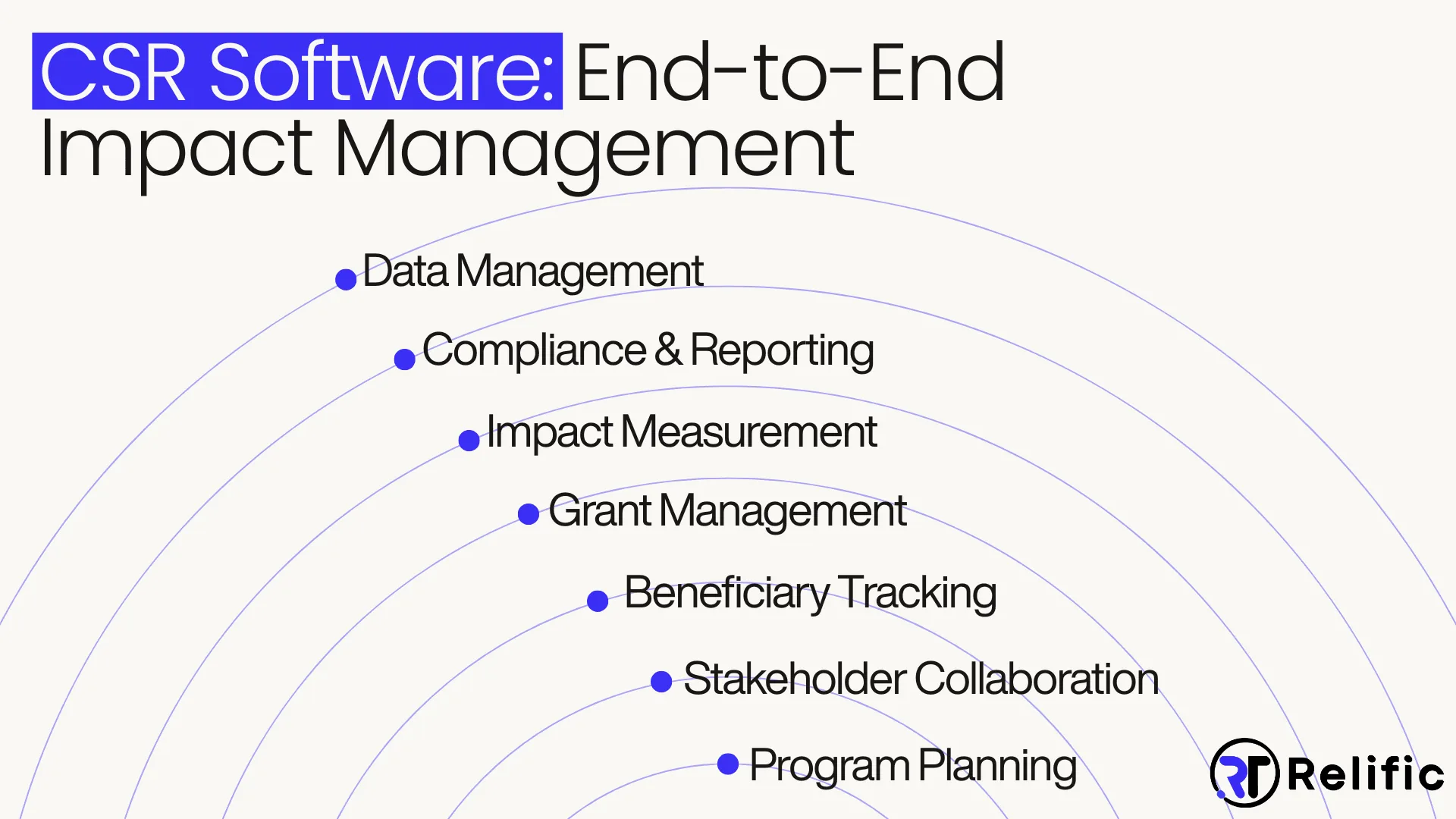
A capable platform supports a CSR program from design through disclosure. Each stage carries its own implementation pitfalls, and the ones below are where I most often see good programs lose value.
Program planning and design
Strong software lets teams define a program's logic up front: objectives, target beneficiaries, activities, and the indicators that will measure success before any money is spent. The common mistake is designing programs around what is easy to count rather than what matters. A nutrition program tracked by "meals distributed" looks busy; the same program tracked by "change in child malnutrition rates" tells you whether it worked. Decide the indicators during planning, not the week before the report is due.
Stakeholder and NGO collaboration
CSR rarely happens inside one company. Implementation partners, NGOs, finance teams, auditors, and employees all touch the work. Good platforms give each group role-based access and a shared view, so an NGO can submit progress, finance can see utilisation, and leadership can see status without anyone emailing a file around. In India, where most CSR is delivered through registered implementing agencies, the platform also has to hold partner records CSR-1 registration, due diligence documents, and utilisation reports, not just task lists. And because field partners often work in low-connectivity districts, mobile and offline-capable data capture matters far more than buyers expect when they evaluate from a head office in a metro.
Beneficiary tracking
Knowing who you reached, and reaching them well, depends on clean beneficiary records. This is where data discipline and ethics intersect. Duplicate records inflate impact numbers; missing consent creates privacy exposure. Mature platforms use unique beneficiary identifiers, deduplication, and access controls that respect data-protection obligations in India, the Digital Personal Data Protection (DPDP) Act, 2023. Treating beneficiary data casually is one of the fastest ways to undermine an otherwise credible program.
Grant and donation management
For foundations and grantmaking teams, software manages the full cycle: application, review, approval, milestone-based disbursement, utilisation tracking, and reporting. In the Indian context, that also means capturing utilisation certificates and linking each disbursement to a Schedule VII head, so the spend is defensible later. Milestone-linked disbursement matters because it is the main control against funds being released faster than results are delivered. The error I see is treating grants as a one-time transfer rather than a tracked relationship, which leaves teams unable to answer the only question that counts at audit: what did this money actually achieve?
Impact measurement
This is the capability buyers most overvalue in demos and most underuse in practice. The hard part is not generating charts; it is honest measurement: establishing baselines, distinguishing contribution from attribution, and resisting the temptation to report activity as if it were impact. Software helps by holding indicators, baselines, and results in one structured place, but it cannot supply the measurement rigour. That has to come from program design.
Compliance and reporting workflows
The platform should turn the data it already holds into the filings Indian law requires: the CSR annexure to the Board's report, Form CSR-2 with the MCA, mandatory impact assessments, and, for listed entities, SEBI's BRSR. Done well, this means capturing data once and reporting it many ways. Done poorly, compliance becomes a parallel project that duplicates everything.
Data management
Underneath all of it is a single, governed dataset. The value of every other capability depends on data quality, so integration with existing HR, finance, and identity systems is not a nice-to-have. Each manual export between systems is a future error and a gap in the audit trail.
Key takeaway: The software organises the work; it does not supply the judgment. Programs win or lose on how indicators are defined and how honestly outcomes are measured; the platform makes that rigour visible and repeatable.
Essential Capabilities Modern CSR Software Should Offer
The feature lists vendors publish are long. The capabilities that actually determine whether a platform gets used, and trusted, are shorter.
-
A unified dashboard. One live view of programs, partners, budgets, and outcomes. If status still lives in separate files after implementation, the core problem is unsolved.
-
End-to-end grant and budget control. Applications through utilisation, with automated routing and transparent audit trails.
-
Outcome-level impact tracking. Custom indicators, baselines, and real-time reporting, not just activity counts.
-
Employee giving and volunteering. Simple sign-up, hour logging, and matching, with mobile access so deskless and distributed staff can participate.
-
Framework alignment. Mapping to ESG standards and the UN SDGs so reporting is a byproduct of the work, not a separate effort.
-
Audit-ready documentation. Policies, approvals, and records held in one place, ready when a regulator or auditor asks.
-
Role-based collaboration. Secure access for NGOs, finance, employees, and auditors that shows each party what it needs and nothing it should not.
-
Localisation and scalability. Support for multiple Indian languages and field-level data capture, so a program that starts in one state or district scales across others without losing consistency.
-
Open integration. Connections to the HR, finance, identity, and communication systems already in use.
The buying principle is restraint: you do not need a hundred features, you need the handful that match your program's centre of gravity. A platform that is exceptional at grantmaking but indifferent to volunteering is the right purchase for a foundation and the wrong one for an engagement program.
Basic CSR Tools vs. Enterprise CSR Software
Not every organisation needs an enterprise platform, and overbuying is as common a mistake as underbuying. The distinction below helps right-size the decision.
| Basic CSR Tools | Enterprise CSR Software | |
|---|---|---|
| Best for | Single programs, smaller teams | Multi-program, multi-state portfolios |
| Scope | Giving or volunteering | Full lifecycle and reporting |
| Reporting | Standard summaries | Multi-framework, audit-grade |
| Compliance | Limited | Built for Section 135, CSR-2, and BRSR |
| Integrations | Few | Deep into HR, finance, identity |
| Collaboration | Internal | Multi-stakeholder, partner portals |
| Pricing | Lower, sometimes free tiers | Quote-based, demo-led |
| Risk | Outgrown quickly | Over-engineered for simple needs |
CSR Software vs. CSR Project Management Software
CSR project management software focuses on running individual CSR projects: timelines, tasks, milestones, and budgets. CSR software covers the whole portfolio of social-impact programs, including giving, volunteering, grants, impact measurement, and ESG-aligned reporting. One keeps a project on schedule; the other keeps the entire program accountable.
The trap is trying to run a serious program on a generic project tool such as Asana, Trello, or Monday.com. They handle tasks and deadlines well, but they were never built for social impact: no grant lifecycle, no volunteer analytics, no SDG or ESG mapping, no outcome reporting. They suit a small team with simple initiatives and stop scaling the moment grants, partners, or disclosures enter the picture. Dedicated CSR software absorbs that complexity instead of buckling under it.
How CSR Software Supports ESG Reporting and Compliance in India
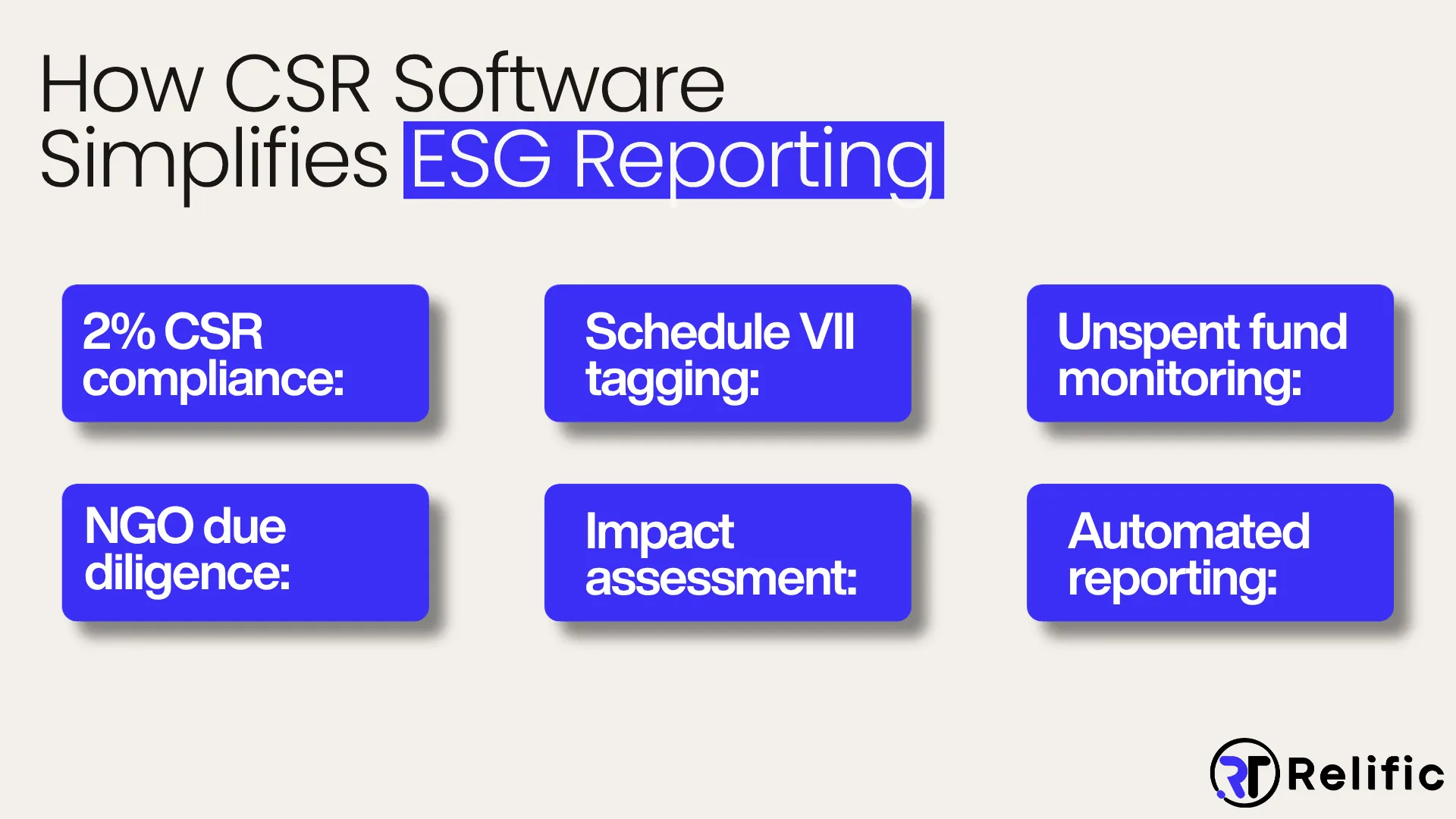
Quick answer: In India, CSR software helps companies meet their obligations under Section 135 of the Companies Act, 2013 and SEBI's BRSR framework. It tags spending to Schedule VII activities, tracks unspent CSR funds, runs NGO due diligence, and assembles the data for the Board's report, Form CSR-2, impact assessments, and BRSR disclosures from one source.
India's CSR regime is unusual by global standards: it is statutory, not voluntary, which makes the compliance burden concrete and the software's role more than cosmetic. The pieces that actually matter on the ground:
The 2% mandate (Section 135). A company that meets any one of three thresholds net worth of ₹500 crore or more, turnover of ₹1,000 crore or more, or net profit of ₹5 crore or more in the preceding financial year must spend at least 2% of its average net profit over the preceding three years on CSR, and constitute a CSR Committee and policy. The software holds the calculation, the committee approvals, and the project-level allocations in one auditable record rather than across finance emails.
Schedule VII tagging. Permitted CSR activities are defined under Schedule VII: education, healthcare, poverty alleviation, environmental sustainability, rural development, and so on. Capable Indian CSR software lets you tag each project to the relevant Schedule VII entry and, in parallel, to the UN SDGs. That dual tagging is what keeps spending defensible at audit while still telling a coherent impact story.
Unspent CSR funds. This is where teams most often stumble. An unspent amount tied to an ongoing project must be transferred to a dedicated Unspent CSR Account within 30 days of the financial year-end and used within three financial years; other unspent amounts must go to a fund specified in Schedule VII within six months. Software that tracks commitments against actual spend in real time surfaces a looming shortfall while there is still time to deploy it, not in the week the books close.
NGO due diligence and Form CSR-1. Implementing agencies must be registered with the Ministry of Corporate Affairs through Form CSR-1. The compliance risk sits with the company, not the partner, which is why mature platforms build in partner vetting, registration checks, document storage, and performance scoring rather than treating NGO selection as an offline decision.
Mandatory impact assessment. A company with a CSR obligation of ₹10 crore or more must commission independent impact assessments for projects with outlays of ₹1 crore or more that were completed at least a year earlier. This requirement is the clearest expression of India's shift from measuring spend to measuring outcomes, and outcome data captured at source is precisely what structured software is built to hold.
Reporting: Board's report, CSR-2, and BRSR. CSR activity is disclosed in an annexure to the Board's report and filed with the MCA through Form CSR-2. Separately, SEBI's Business Responsibility and Sustainability Report (BRSR) is mandatory for the top 1,000 listed companies by market capitalisation. Within it, BRSR Core, a curated subset of key ESG KPIs, carries reasonable assurance on a phased glide path that has widened from the top 150 companies toward the top 1,000, a stricter assurance bar than several other jurisdictions apply. For listed Indian companies that also report to global investors, BRSR increasingly sits alongside voluntary international standards such as GRI and the ISSB baseline (IFRS S1 and S2).
The common thread is verification. Indian regulation now expects companies to prove outcomes and, increasingly, to have key data independently assured. That is only practical when data is captured at source, tagged to Schedule VII and the SDGs, and traceable back to evidence, which is the core job CSR software does in the Indian context.
Traditional reporting vs. automated CSR reporting
| Traditional Reporting | Automated CSR Reporting | |
|---|---|---|
| Data gathering | Manual collection at period-end | Captured continuously at source |
| Time to report | Weeks | Days or hours |
| Framework mapping | Rebuilt each cycle | Mapped once, reused |
| Error risk | High, manual transcription | Low, single dataset |
| Verification | Difficult to evidence | Traceable audit trail |
| Multi-framework | Duplicated effort per standard | One dataset, many outputs |
Key takeaway: In India, CSR is a statutory obligation with assurance attached, not a voluntary gesture. Software earns its place by making Section 135 spend, unspent-fund tracking, NGO due diligence, impact assessment, and BRSR data auditable from a single source, though the disclosure itself always remains the company's responsibility.
CSR Software Examples: Indian Platforms to Compare in 2026
Because India's CSR rules are statutory, the platforms that serve this market are built around Schedule VII tagging, fund-utilisation tracking, NGO due diligence, and impact assessment, not just employee giving. The options below are India-focused. Pricing is almost always quote-based with a demo on request, so treat any list price elsewhere as a starting point and shortlist by the problem that dominates your program.
| Platform | Best for | Notes |
|---|---|---|
| Relific | All-in-one, multi-sector CSR and impact management | Unified dashboard, grant tracking, SDG/ESG alignment, and AI-assisted analytics; used by corporate CSR teams and NGOs reporting across sectors such as education, health, agriculture, and livelihoods |
| Metta Social | End-to-end CSR plus employee engagement | Pune-based SaaS spanning CSR project management, grant management, employee volunteering and payroll giving, with ESG, DEI, and corporate-citizenship modules |
| Impact Dash | Real-time impact monitoring and reporting | Dashboard-led tracking and reporting of CSR projects and outcomes; suited to teams whose priority is live visibility and report generation |
| Dhwani RIS | Custom, field-heavy CSR and M&E programs | Tech-for-development specialist (founded 2012) offering configurable CSR project management, NGO/MIS workflows, monitoring-and-evaluation data, and budget dashboards; strong on field data capture |
| SoulAce | CSR project monitoring and assessment | India-focused CSR monitoring platform with role-based access, M&E, and impact-assessment support for corporates working with NGO partners |
| Samhita | CSR program design and implementation at scale | Social-impact platform and program partner across skilling, livelihoods, financial inclusion, and community development — a fit when you need delivery and advisory, not only software |
| TechCSR | Compliance-led monitoring with GIS | India-focused platform combining GIS and MIS for project monitoring, Schedule VII and SDG tagging, NGO due diligence, fund allocation, and impact assessment, with mobile field capture |
Read the list by your dominant need. If the priority is statutory monitoring and reporting, Schedule VII tagging, fund utilisation, BRSR data, TechCSR, SoulAce, and Impact Dash are built around it. If you need configurable, field-data-heavy M&E across many projects, Dhwani RIS is in that territory. If employee engagement sits alongside compliance, Metta Social spans both. If you need delivery and advisory as well as a platform, Samhita leans that way. And for an all-in-one, multi-sector system with measurement and reporting in one place, that is what platforms such as Relific are built for. Almost nothing is best at everything, so buy for your center of gravity.
How to Choose CSR Software: A Decision Framework
Run a shortlist through these criteria in order. The sequence matters; most failed purchases skip straight to features.
-
Define the goal first. Name your priority: grantmaking, employee engagement, impact measurement, or framework compliance. This single decision removes most of the market.
-
Filter on the few capabilities that matter. Insist on a unified dashboard, outcome-level reporting, and the specific framework alignment your disclosures require. Ignore the long-tail features.
-
Confirm it fits your stack. It must integrate with the HR, finance, identity, and communication systems you already run. Every manual export is a future failure point.
-
Test with real users. Move from demo to trial, and put it in front of the people across CSR, HR, finance, and IT who will actually use it. If it is not intuitive, it will go unused regardless of the feature list.
-
Pressure-test the data and reporting. Load a real program, run a real report, and check whether the output would survive an auditor. This is where polished demos and working software diverge.
-
Evaluate the vendor, not just the tool. Onboarding quality, support responsiveness, and a roadmap that keeps pace with shifting ESG rules matter as much as today's feature set.
-
Roll out in stages. Start with one region or function, refine the workflow, then scale. Staged rollouts surface problems while they are still cheap to fix and build the internal trust that drives adoption.
The most common buying mistakes are predictable: choosing on feature count rather than fit, skipping the user trial, and underestimating change management. The software is rarely the reason a rollout fails. Adoption is.
CSR Technology Trends Shaping 2026 in India
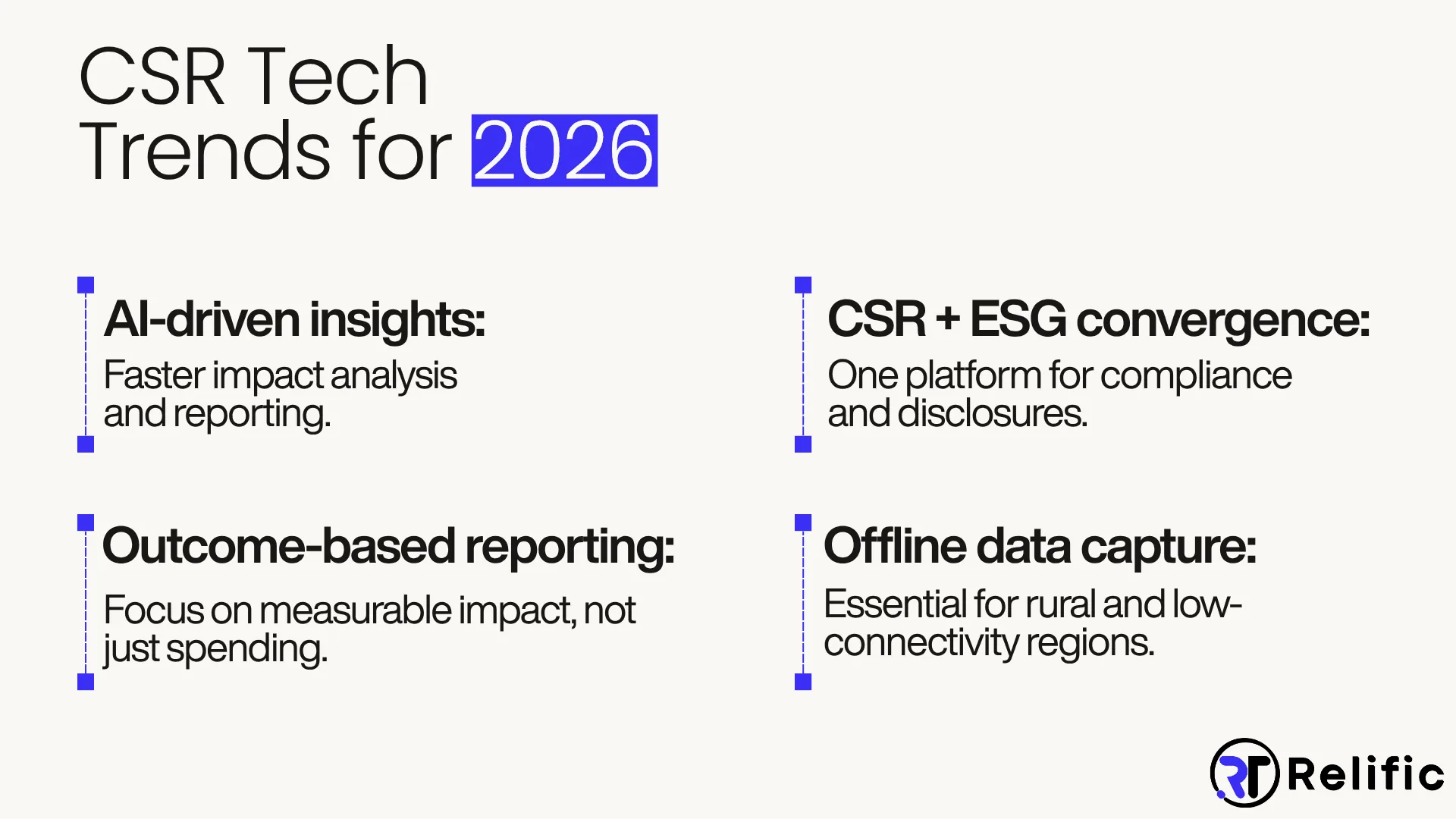
A few shifts are worth watching as you plan.
AI-assisted impact analysis. Platforms increasingly use AI to surface patterns in program data, flag anomalies in fund utilisation, and draft report narratives from structured inputs. It speeds analysis; it does not replace the judgment behind measurement.
ESG and CSR converging under one regime. With BRSR bringing environmental and social disclosure under a single SEBI framework, the data that used to sit in separate CSR and sustainability silos is moving into one system. Buyers increasingly want a platform that spans Section 135 reporting and ESG disclosure together.
Outcome-based regulation. India's regulatory direction is unmistakable: mandatory impact assessment under Section 135 and reasonable assurance on BRSR Core both push toward verified outcomes rather than spend totals, which raises the premium on clean, traceable data.
Mobile and offline field capture. As more impact work happens in rural and low-connectivity parts of India, the ability to capture beneficiary and program data offline has moved from a niche feature to a serious selection criterion.
Where This Leaves CSR Teams
In India, CSR has become a measured, statutory business function, and the tooling reflects it. Spreadsheets record activity but cannot prove outcomes, satisfy Section 135 and BRSR obligations, or scale across partners and states. CSR software exists to convert fragmented effort into an accountable, reportable program, capturing good data once, tagging it to Schedule VII and the SDGs, and making impact visible to the regulators, auditors, and stakeholders who now ask for proof rather than promises. The right platform depends entirely on your program's shape; the discipline it enforces is what turns good intentions into evidence.
Frequently Asked Questions
CSR software is a platform for planning, managing, measuring, and reporting corporate social responsibility programs in one place. It takes in structured data through forms and integrations, applies approval and budget workflows, links activities to measurable outcomes, and produces dashboards and framework-aligned reports.
It captures program data in structured, auditable form and maps it to India's requirements: Section 135 spend, Schedule VII and SDG tagging, unspent-fund tracking, Form CSR-2, mandatory impact assessment, and SEBI's BRSR (including BRSR Core assurance) so one dataset can generate multiple disclosures. It organises the evidence; the company owns the disclosure.
A unified dashboard, end-to-end grant and budget control, outcome-level impact tracking, employee giving and volunteering tools, ESG and SDG alignment, audit-ready documentation, role-based collaboration, localisation, and open integration with existing systems.
Scattered data, slow manual reporting, poor program visibility, weak collaboration with partners, and compliance and audit risk. It replaces files and email with a single, trackable, auditable source of truth.
By recording every commitment, approval, and result against an owner and a timestamp, then making that record visible to leadership, funders, employees, and regulators. Shared, current data means impact claims rest on evidence rather than assertion.
CSR project management software runs individual project tasks, timelines, and budgets. CSR software manages the whole portfolio of social-impact programs plus impact measurement and ESG-aligned reporting. One keeps projects on schedule; the other keeps the program accountable.
No. Companies with CSR obligations across several states and BRSR-reporting duties get the most from full platforms, but lighter tools serve smaller teams running a single giving or volunteering program. Program complexity, not company size, is what justifies the investment.
When teams are routinely chasing updates across files, losing track of project detail, struggling to prove outcomes, or dreading reporting deadlines, the signs a program has outgrown manual tracking.