

Key Takeaways
- Your CSR obligation is 2% of the average net profit of the three immediately preceding financial years, computed under Section 198, not the profit on your P&L.
- CSR applies if you cross any one of three triggers in the preceding financial year: net profit ≥ ₹5 crore, turnover ≥ ₹1,000 crore, or net worth ≥ ₹500 crore.
- The "₹10 crore net profit threshold" circulating in 2026 comes from a Bill that has not yet been passed or notified. The live threshold is still ₹5 crore.
- Section 198 starts from profit before tax, then adds back and strips out specific items. Income tax stays in as non-deductible; capital profits and share premium come out.
- Two further exclusions sit above Section 198, from the CSR Rules: profits of overseas branches and dividends from other Indian companies already covered by Section 135.
- If your CSR obligation is under ₹50 lakh, you don't need a separate CSR Committee, but the 2% spend still applies.
Most companies that miscalculate their CSR spend don't get the arithmetic wrong. They get the starting number wrong. Someone opens the audited profit and loss statement, takes profit before tax, multiplies by 2%, and files it. That figure is usually off, sometimes by lakhs, because the law doesn't run the 2% on your accounting profit at all.
It runs on a separately computed figure the Companies Act calls "net profit under Section 198," which can differ materially from what your books show. Start from the wrong figure and every step that follows inherits the mistake: the board's spending commitment, the CSR-2 filing, the unspent-amount transfers, the disclosure in the annual report.
This guide covers the calculation the way a company secretary or finance lead actually has to do it. Which companies are caught, how the ₹5 crore trigger works (and why the "₹10 crore" figure you may have read about isn't law yet), how to build the Section 198 number step by step, and the specific adjustments that trip people up.
What Is a CSR Obligation?
A CSR obligation is the minimum amount a qualifying company must spend each year on social and environmental activities under Section 135 of the Companies Act, 2013. The amount is fixed at 2% of the company's average net profit over the three immediately preceding financial years, with net profit computed under Section 198 of the Act rather than taken from the financial statements.
That's the short answer. The rest of this article is about the two places it goes wrong in practice: deciding whether the obligation applies to you at all, and arriving at the right net-profit figure to run the 2% on.
Worth being clear on what kind of requirement this is. CSR in India is not voluntary philanthropy in policy dressing. It's a statutory spending mandate. India was the first country in the world to include CSR provisions in company law and make CSR expenditure mandatory, and the framing matters, because a mandate means the 2% is a compliance figure your auditors will test and the Registrar can question, not a best-effort estimate.
There are really two questions inside every CSR calculation, and people routinely collapse them into one:
- Does CSR apply to my company at all? Decided by the three thresholds, tested on the immediately preceding financial year.
- If it applies, how much must I spend? Decided by the 2% calculation on the three-year average net profit.
Different time windows, different figures. Keeping the two apart is the first discipline of getting CSR right.
Which Companies Have To Comply
CSR is triggered when a company meets any one of the following three thresholds during the immediately preceding financial year:
Trigger | Threshold |
|---|---|
Net worth | ₹500 crore or more |
Turnover | ₹1,000 crore or more |
Net profit | ₹5 crore or more |
The triggers are independent. You don't need all three. Crossing one is enough to activate the full set of obligations: committee formation where required, a CSR policy, the 2% spend, and annual reporting.
That independence is what catches companies off guard. A firm with a modest ₹6 crore net profit but turnover well below ₹1,000 crore is still inside Section 135 through the profit route alone. A company with a large net worth but thin profits can be pulled in through the net-worth trigger in a lean year. The test is applied fresh each year, so a company can move into CSR applicability and, if its numbers fall, back out of it. One caveat on exiting: once CSR provisions become applicable, they continue to apply unless the company ceases to meet all of the criteria for three consecutive years.
A point specific to the net-profit trigger: the ₹5 crore test is run on the net profit of the single immediately preceding year, computed under Section 198. Same computation method as the 2% spend, just applied to one year for the applicability test instead of averaged across three.
The "₹10 crore threshold" confusion, and why it matters?
Search this topic in 2026, and you'll find confident statements that the threshold is now ₹10 crore. Several of them present it as settled law. It isn't, and the distinction has real consequences.
Here's the accurate position. The Corporate Laws (Amendment) Bill, 2026, introduced in the Lok Sabha on 23 March 2026, proposes raising the CSR net-profit trigger from ₹5 crore to ₹10 crore (the Bill's wording is "ten crore, or such sum as may be prescribed"). On the day of introduction, the House referred the Bill to a Joint Parliamentary Committee for detailed scrutiny. The committee's report was later tabled in both the Lok Sabha and the Rajya Sabha.
But a Bill that has been through committee is still a Bill. Following the JPC report, the Bill has to be taken up again for consideration and passage, after which the amendments may be notified and brought into force, either immediately or in phases. As of this writing, that passage has not happened, and nothing has been notified in the Official Gazette. The legally binding net-profit trigger remains ₹5 crore. For FY 2026–27 computations, apply ₹5 crore and treat ₹10 crore as a change to watch, not a rule to act on.
This is precisely where acting on a headline can hurt. If your net profit sits between ₹5 crore and ₹10 crore and you've stopped budgeting for CSR because you read that the threshold doubled, you may be opening a compliance gap that penalties attach to. Confirm the enactment status before you rely on it, and make that call with your company secretary rather than a news summary.
For how the proposed changes fit the wider reform picture, what every company needs to know about CSR software and choosing a platform is a useful companion read once applicability is settled.
Why Net Profit Under Section 198 Is Not Your P&L Profit
This is the heart of the calculation, so it's worth stating without hedging.
For CSR, "net profit" means the figure computed under Section 198 of the Companies Act, 2013. Not the profit shown in your financial statements, and not your taxable profit under the Income Tax Act.
Section 198 is titled "Calculation of profits." It was written originally to govern managerial remuneration, and its job is to measure a company's genuine operating earnings by removing items that would otherwise distort the picture: capital gains, certain notional credits, and profits that have effectively been accounted for elsewhere. Section 135 borrows the same methodology for CSR, and the CSR Rules define "net profit" as net profit per the financial statement, but excluding certain further sums on top of the Section 198 computation.
The practical upshot: three different "profit" numbers can exist for the same company in the same year: accounting profit, taxable profit, and Section 198 profit, and they rarely match. Reaching for the wrong one is the single most common CSR error, and it usually happens in good faith, because the audited P&L is simply the most convenient number to hand.
How To Calculate Net Profit Under Section 198, Step By Step
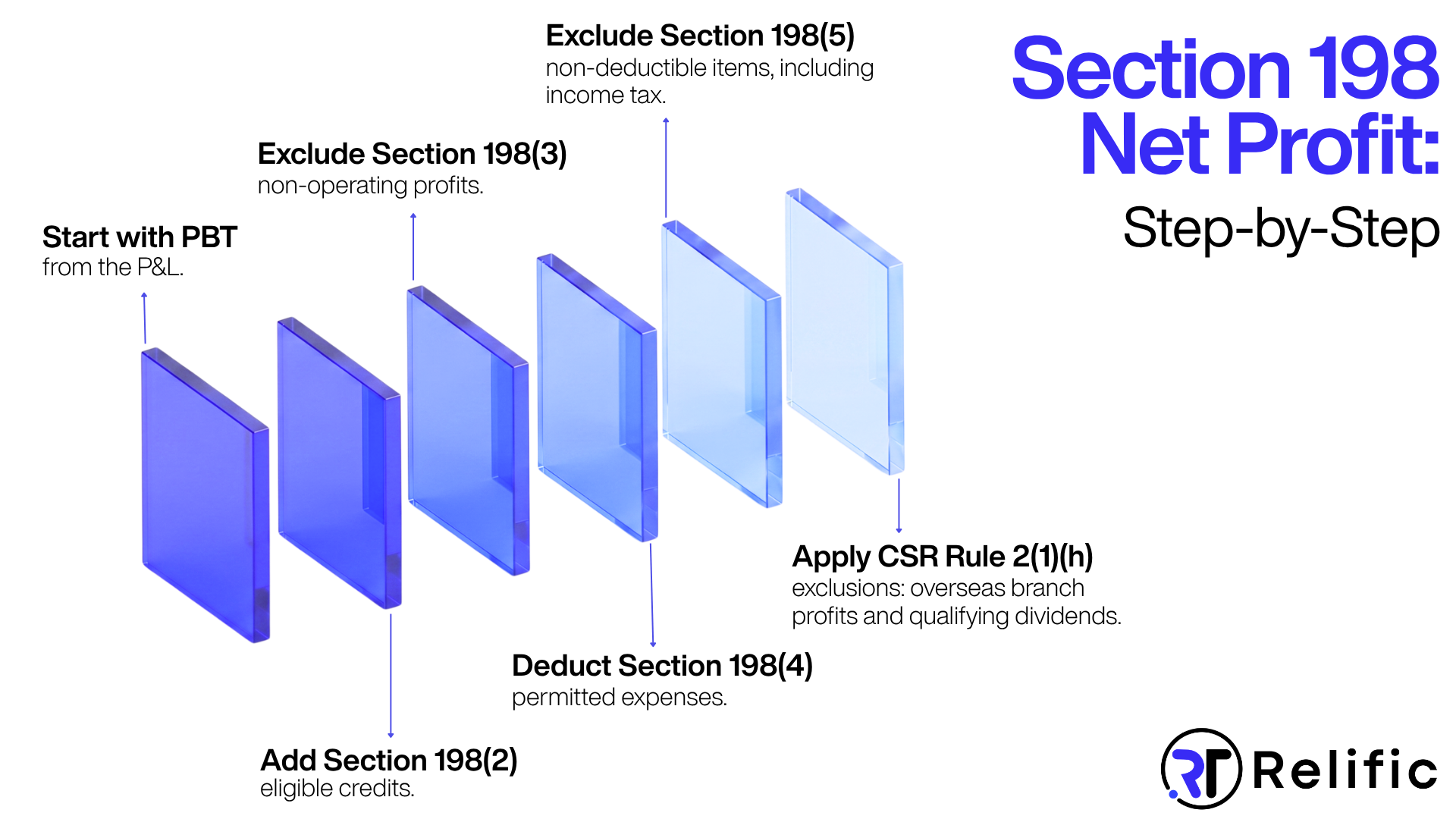
The cleanest route is the direct method: start from profit before tax, then apply the specific add-backs and deductions the section prescribes. Starting from PAT and re-adding tax also works, but starting from PBT avoids a common double-counting trap, since expenses like directors' remuneration and depreciation are already reflected in PBT and shouldn't be taken out twice.
The structure runs like this.
Step 1. Start with Profit Before Tax (PBT) from the profit and loss account for the year in question.
Step 2. Give credit for the items Section 198(2) allows. Mainly bounties and subsidies received from any government or public authority, unless the Central Government directs otherwise.
Step 3. Do not give credit for the items in Section 198(3). These are excluded because they aren't operating profit:
- Premium on shares or debentures, unless the company is an investment company
- Profits on the sale of forfeited shares
- Profits of a capital nature, including profit on the sale of the undertaking or any part of it
- Profit from the sale of fixed assets or immovable property of a capital nature, unless buying and selling such assets is the company's business
- Any change in the carrying amount of an asset or liability recognised in equity reserves, including surplus on measuring assets or liabilities at fair value
Step 4. Deduct the items Section 198(4) permits. If you started from PBT, these are largely already reflected, but the category includes usual working charges, directors' remuneration, bonuses and commissions paid, tax on abnormal or excess profits, interest on borrowings, non-capital repairs, depreciation per Schedule II, and prior-period losses, among others.
Step 5. Do not deduct the items in Section 198(5). This is the one that catches people: it includes income tax. For Section 198 purposes, income tax payable is not a deductible expense. Also non-deductible are voluntary compensation or damages, and losses of a capital nature such as loss on the sale of the undertaking or of capital assets.
Step 6. Apply the two exclusions the CSR Rules add above Section 198. Rule 2(1)(h) of the Companies (CSR Policy) Rules, 2014 layers on two exclusions specific to CSR. Beyond the Section 198 adjustments, net profit for CSR also excludes any profit from overseas branches of the company, and any dividend received from other Indian companies that are themselves covered by and complying with Section 135.
The dividend exclusion exists to stop the same rupee of profit being counted for CSR twice, once in the company that earned it and again in a company that received it as a dividend.
One frequently muddled point is worth calling out. Directors' remuneration is added back only when computing profit for managerial remuneration under Section 197. It is not added back for CSR. For CSR, directors' remuneration stays a normal deduction. Crossing the Section 197 and Section 135 treatments is a subtle but genuine source of error.
Worked example
Say a company's Section 198 net profit lands as follows for its three preceding financial years:
Financial year | Net profit (Section 198) |
|---|---|
FY 2022–23 | ₹6 crore |
FY 2023–24 | ₹9 crore |
FY 2024–25 | ₹7.5 crore |
Average net profit = (6 + 9 + 7.5) ÷ 3 = ₹7.5 crore
Mandatory CSR spend = 2% × ₹7.5 crore = ₹15 lakh
That ₹15 lakh is the floor: the minimum to spend on Schedule VII activities in the coming financial year. It's a floor, not a ceiling. Spending more is allowed, and genuine excess can be carried forward under specific conditions, covered below.
What if one of the three years was a loss?
If a company posts a loss under Section 198 in one of the three years, that negative figure goes into the average. A loss year pulls the three-year average down rather than being dropped from the calculation. Several quick guides skip this, and it can move the obligation meaningfully. Where the computation gets genuinely involved, loss set-offs or the treatment of the "excess of expenditure over income" carried forward under Section 198 have a professional check the working papers.
Companies less than three years old
A company that hasn't completed three financial years since incorporation takes the average over the years actually available, whether that's two years or one. Companies in existence for fewer than three financial years must calculate the average net profit based on the financial years available since incorporation. The rule adapts to the company's age; it doesn't exempt a young-but-qualifying company from the obligation.
After The Calculation: What The Number Obligates You To Do
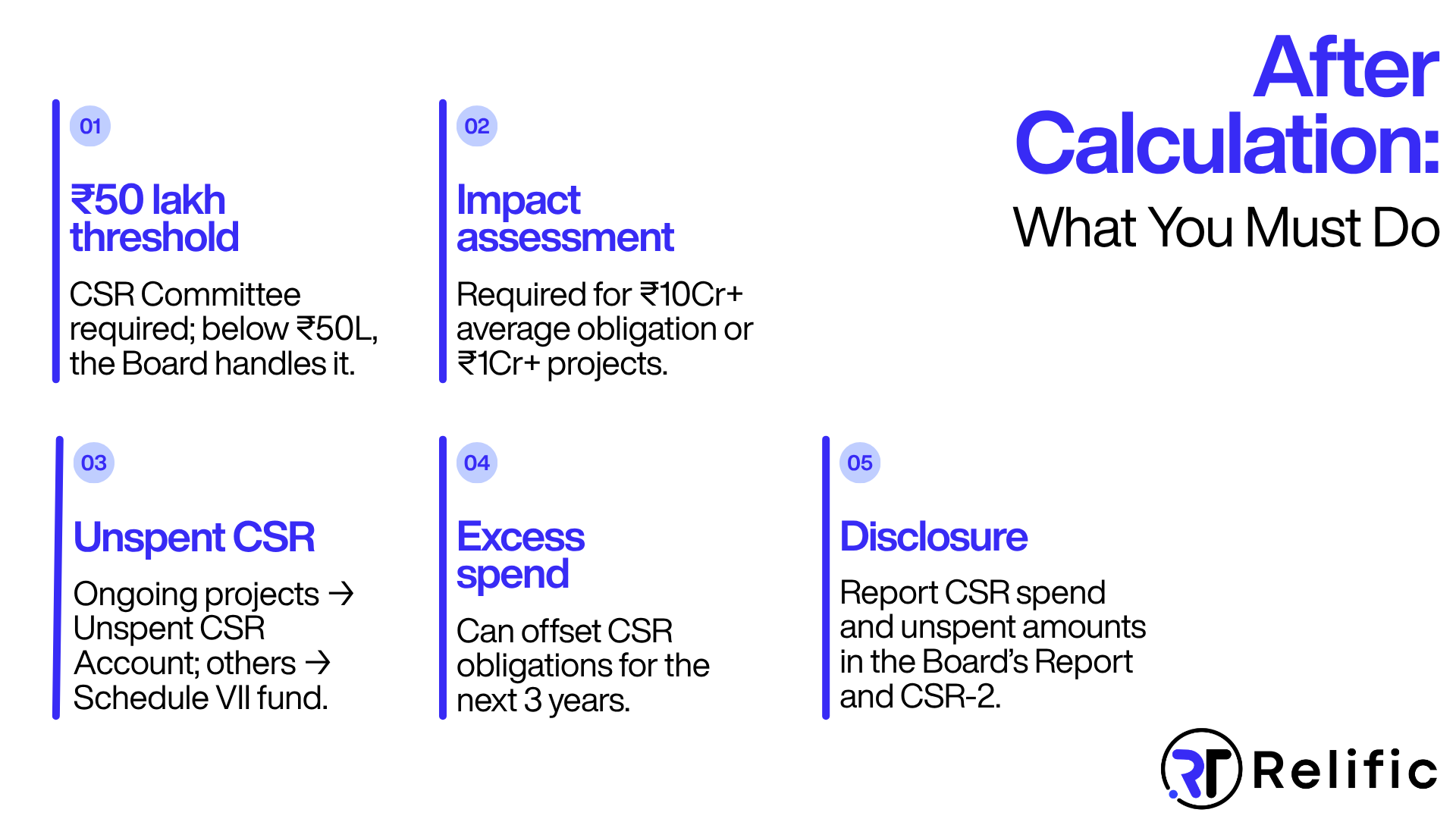
Arriving at the 2% figure is the start, not the finish. Several consequences follow directly from the amount.
The ₹50 lakh committee line:
If your CSR obligation is ₹50 lakh or more, you must constitute a CSR Committee of the Board. Where the amount required to be spent does not exceed fifty lakh rupees, constituting a CSR Committee is not mandatory, and the Board itself discharges the committee's functions. This is a governance simplification only. The spending obligation still applies in full. (The pending 2026 Bill proposes lifting this committee threshold to ₹1 crore, which, like the ₹10 crore trigger, is not yet in force.)
Impact assessment for larger programmes:
Companies with an average CSR obligation of ₹10 crore or more in the three preceding years, or individual projects of ₹1 crore or more, must commission independent impact assessments for qualifying projects under the 2021 amendments. If your obligation is heading toward that band, budget for it.
Unspent amounts have a binary treatment:
If you don't spend the full amount, the rules split by project type. Money tied to an ongoing project moves to a dedicated "Unspent CSR Account" and must be spent within three financial years. Money not tied to an ongoing project transfers to a Schedule VII fund within six months of year-end. Missing these transfers is what turns an underspend into a penalty exposure. The 2021 amendments matter here: they converted CSR from a "comply or explain" regime into a "comply or pay" one, introducing Section 135(7) monetary penalties for non-compliance.
Excess spend can be carried forward:
Overspend in a year and that excess can be set off against your required 2% in the immediately succeeding three financial years, subject to the conditions in Rule 7(3). This quietly rewards front-loaded, well-planned programmes over a scramble to spend in Q4.
Disclosure is mandatory:
The obligation, the actual spend, and any unspent transfers all have to be reported in the Board's Report and via Form CSR-2 to the MCA. Filing the annual accounts without the CSR annexure invites Registrar scrutiny.
Common Mistakes That Cause CSR Miscalculations
The errors that show up again and again are remarkably consistent:
- Using P&L or taxable profit instead of Section 198 profit. The default mistake, and the most expensive. Rebuild the number under Section 198 every time.
- Deducting income tax. Under Section 198, income tax is not deductible. Start from PAT, forget to add it back, and you understate the obligation.
- Testing applicability on the three-year average. The three thresholds are tested on the immediately preceding single year. Only the spend uses the three-year average.
- Forgetting the overseas-branch and inter-company-dividend exclusions. These sit above Section 198 and are easy to miss.
- Crossing the Section 197 and Section 135 treatments of directors' remuneration. Added back for managerial remuneration, not for CSR.
- Acting on the ₹10 crore threshold early. Until the 2026 Bill is passed and notified, the trigger is ₹5 crore. Don't declare yourself exempt on the strength of a proposal.
- Counting marketing or brand campaigns as CSR. Activities in the normal course of business, activities outside India, political contributions, employee-benefit activities, and marketing or sponsorship for deriving benefits for products or services are all excluded from eligible CSR.
Getting The Calculation Right Is A Data Problem As Much As A Legal One
The Section 198 computation is mechanical once you know the rules. Doing it accurately year after year, across a real chart of accounts, with the right items added back and stripped out, is where companies actually stumble. So is tracking what comes after: which spend counts, which projects are "ongoing," what moves to an unspent account and by when, which projects need impact assessments, and what the Board's Report and Form CSR-2 have to show.
That reconciliation, between the legal definition of the obligation and the operational reality of the spend, is the gap Relific works in. As an AI-powered CSR and impact management platform, it helps compliance and impact teams move from a defensible obligation number to clean, auditable reporting, with the Indian regulatory context (Section 135, the CSR Rules, BRSR) built into how the data is structured. If you're weighing whether a dedicated platform earns its place, the guide on what CSR software is and how to choose the right one is a straightforward starting point, and the 25-term CSR and impact measurement glossary helps anyone new to the vocabulary.
The obligation itself, though, always begins in the same place: the right net-profit figure, computed under Section 198, averaged over the right three years. Get that number right, and the rest of the compliance chain has something solid to stand on.
Frequently Asked Questions
Neither, directly. It's calculated on net profit computed under Section 198, which begins from profit before tax and then applies specific statutory add-backs and deductions. Income tax itself is treated as non-deductible in that computation.
Start from profit before tax, give credit for government bounties and subsidies, exclude capital profits and share or debenture premium, keep income tax in as non-deductible, then remove profits from overseas branches and dividends from other Section 135-compliant Indian companies. The result is your Section 198 net profit for CSR.
At least 2% of the average net profit of the three immediately preceding financial years, for companies that cross any one of the three applicability thresholds.
The three financial years immediately preceding the year you're computing the obligation for. A company younger than three years uses the years available since incorporation.
Not yet. The Corporate Laws (Amendment) Bill, 2026 proposes raising the net-profit trigger to ₹10 crore, and its committee report has been tabled in Parliament, but it hasn't been passed and notified. The binding threshold is still ₹5 crore until that changes.
Unspent amounts tied to ongoing projects move to an Unspent CSR Account and must be spent within three years; other unspent amounts go to a Schedule VII fund within six months. Since the 2021 amendments, failure to comply attracts monetary penalties under Section 135(7).
Only if your CSR obligation is ₹50 lakh or more. Below that, the Board can perform the committee's functions itself, though the 2% spending obligation still stands.
No. Section 198 profit, accounting profit, and taxable profit under the Income Tax Act are three distinct figures with different add-backs and exclusions. Only the Section 198 figure governs CSR.