
Key Takeaways
- The best mobile data collection apps for NGOs match the project: Relific Surve-R for India-focused data protection, KoboToolbox for free surveys, CommCare for case tracking.
- KoboToolbox is free for nonprofits, government agencies, UN bodies, and educational institutions, up to 5,000 submissions a month with 1 GB storage.
- ODK is free to self-host with no licence fees, and forms written in XLSForm, a shared spreadsheet standard, usually transfer between ODK, KoboToolbox and SurveyCTO.
- For repeat visits to the same beneficiaries, use CommCare, SurveyCTO, ODK Entities or DHIS2 Tracker; KoboToolbox links forms but does not manage cases.
- mWater is free for unlimited use with no submission caps, and runs on Android, iOS and the web, with over 390,000 users across 199 countries and territories.
- India's Digital Personal Data Protection (DPDP) Act holds whoever decides why and how beneficiary data is collected accountable; key duties apply from 13 May 2027.
- Cost at scale varies widely: for 30 enumerators sending 8,000 records a month, list prices run from free (self-hosted) to over $1,200 a month.
Picture day three of a baseline survey in a block with no mobile signal. Your enumerators are carrying two days of unsynced households on their phones. The free plan you signed up for is a few hundred submissions short of its monthly cap. And the CSR partner funding the work has just emailed to ask who can see beneficiaries' Aadhaar numbers.
None of that came up in the demo.
That's the real test of a mobile data collection app. Nearly every tool can run a tidy survey on office wifi. They split on the hard parts: days without signal, follow-up visits to the same households, the bill grows, and what happens to sensitive data after it leaves the field.
This guide compares eight mobile data collection apps used by non-governmental organisations (NGOs), monitoring and evaluation (M&E) teams and corporate social responsibility (CSR) programmes: Relific Surve-R, KoboToolbox, ODK, SurveyCTO, CommCare, DHIS2, mWater and Fulcrum. Each one is measured against the same eight criteria, so you can build a shortlist around the kind of project you actually run.
What Is Mobile Data Collection Software?
Mobile data collection software lets field staff fill in digital forms on a phone or tablet, usually without an internet connection, and sends the records to a central server once a signal returns. In place of a paper questionnaire, the enumerator works through a form that checks answers as they're entered, records GPS coordinates, photos, and signatures, and puts the data in front of the programme team the same day it syncs.
Most platforms follow the same five steps:
- A programme or M&E team builds the form, either in a web-based builder or in XLSForm, a spreadsheet format for writing survey logic.
- The team publishes the form to enumerators' devices.
- Staff collect responses in the field, offline if needed.
- Records sync when connectivity returns.
- The team reviews, cleans, and exports the data for analysis or reporting.
How We Compared These Apps
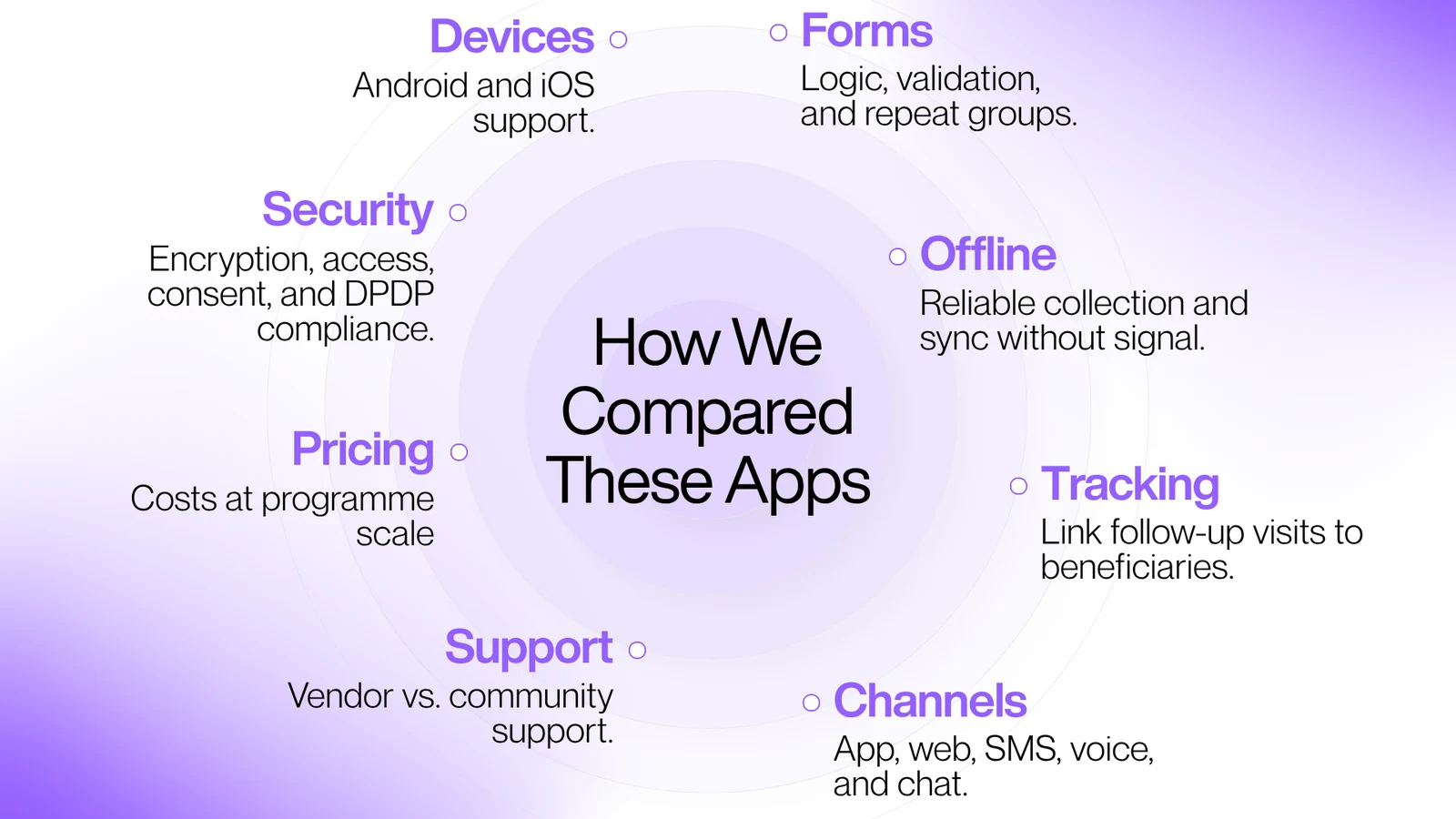
We looked at each platform the way a programme or M&E lead would during procurement: what breaks in the field, what it costs once the programme grows, and what it means for beneficiary data. Eight criteria shaped every entry, and they're the same questions worth asking of any tool you evaluate:
- Offline reliability: Can field staff keep collecting for days without signal, with photos queued, and sync later without losing records? An afternoon offline is easy for most tools. A three-day field trip is the real test.
- Form logic and validation: We checked for skip logic, cascading selects (district, then block, then village), range checks, and repeat groups for household members. Strong logic catches errors at the doorstep instead of in the office weeks later.
- Follow-up and case tracking: Can the tool link a second or third visit back to the original household or beneficiary? Programmes that follow the same people over time need this from day one, because bolting it on later usually means matching records by hand.
- Channels: Can data come in through an app, a browser, SMS, a voice call, or chat? This decides whether you can reach respondents who don't own a smartphone.
- Device support: Which phones does the collection app run on? Several apps are Android-only, which matters if some staff or partner organisations use iPhones.
- Data protection: We looked at encryption, access controls, consent capture, deletion tools, and where data is hosted. For Indian programmes, this is now a legal question under the DPDP Act, not just a feature checklist.
- Pricing at scale: How does the price change as submissions, users, or messages grow? Each tool was priced at a realistic programme size, not only at pilot size.
- Support model: Who helps when something breaks? Open-source tools lean on community forums and in-house skills, while commercial plans include vendor support with set response times.
Pricing and features come from vendor pricing pages, product documentation, and help centres, checked in September 2026. Where a vendor doesn't publish something, we say so rather than guess.
Quick Answer: Which Mobile Data Collection App Should an NGO Choose?
If you only need a starting point, match your project to one of these:
- India-based CSR and NGO programmes that need DPDP safeguards built into forms: Relific Surve-R
- Free surveys and assessments for nonprofits: KoboToolbox
- Self-hosted deployments with no licence cost: ODK
- Funded research needing data-quality tools and 24/7 support: SurveyCTO
- Tracking beneficiaries across repeat visits: CommCare
- Programmes linked to a national health information system: DHIS2
- Free WASH and site monitoring at scale: mWater
- Inspections, asset audits and GIS-heavy fieldwork: Fulcrum
Mobile Data Collection Apps for NGOs: Side-by-Side Comparison
All eight tools support offline collection on mobile devices. What separates them is follow-up, channels, device support, and price.
| Tool | Best suited for | Follow-up/case tracking | Channels | Collection apps | Entry price (Sept 2026) |
|---|---|---|---|---|---|
| Relific Surve-R | India CSR and NGO programmes needing DPDP safeguards | Nested forms, up to 2 levels | App | Android, iOS | No public pricing; free trial |
| KoboToolbox | Free surveys and assessments for nonprofits | Linked forms only | App, web form | KoboCollect (Android); web forms on any device, including iOS | Free for nonprofits, up to 5,000 submissions/month |
| ODK | Self-hosted deployments with in-house technical skills | Yes, via Entities | App, web form | ODK Collect (Android); browser forms | Free self-hosted; ODK Cloud from $199/month |
| SurveyCTO | Funded research needing data-quality tools | Yes, offline case management (tiered) | App, web form | SurveyCTO Collect (Android, iOS) | $225/month billed annually |
| CommCare | Case management across repeat visits | Yes, core design | App; web apps and two-way SMS on Advanced | Android app; browser Web Apps (Advanced) | $100/month billed annually |
| DHIS2 | Programmes linked to national health systems | Yes, Tracker | App, web, SMS fallback | DHIS2 Android Capture app; web | Free, open source; implementation costs apply |
| mWater | Free WASH and community site monitoring at scale | Yes, longitudinal site tracking | App, web | Android, iOS, web | Free; optional Stellar add-ons from $500/month |
| Fulcrum | Inspections, asset audits, GIS | Linked and parent-child records | App | Android, iOS | $43/user/month, annual, 5-user minimum |
The 8 Best Mobile Data Collection Apps for NGOs
1. Relific Surve-R: Built for India's DPDP Act
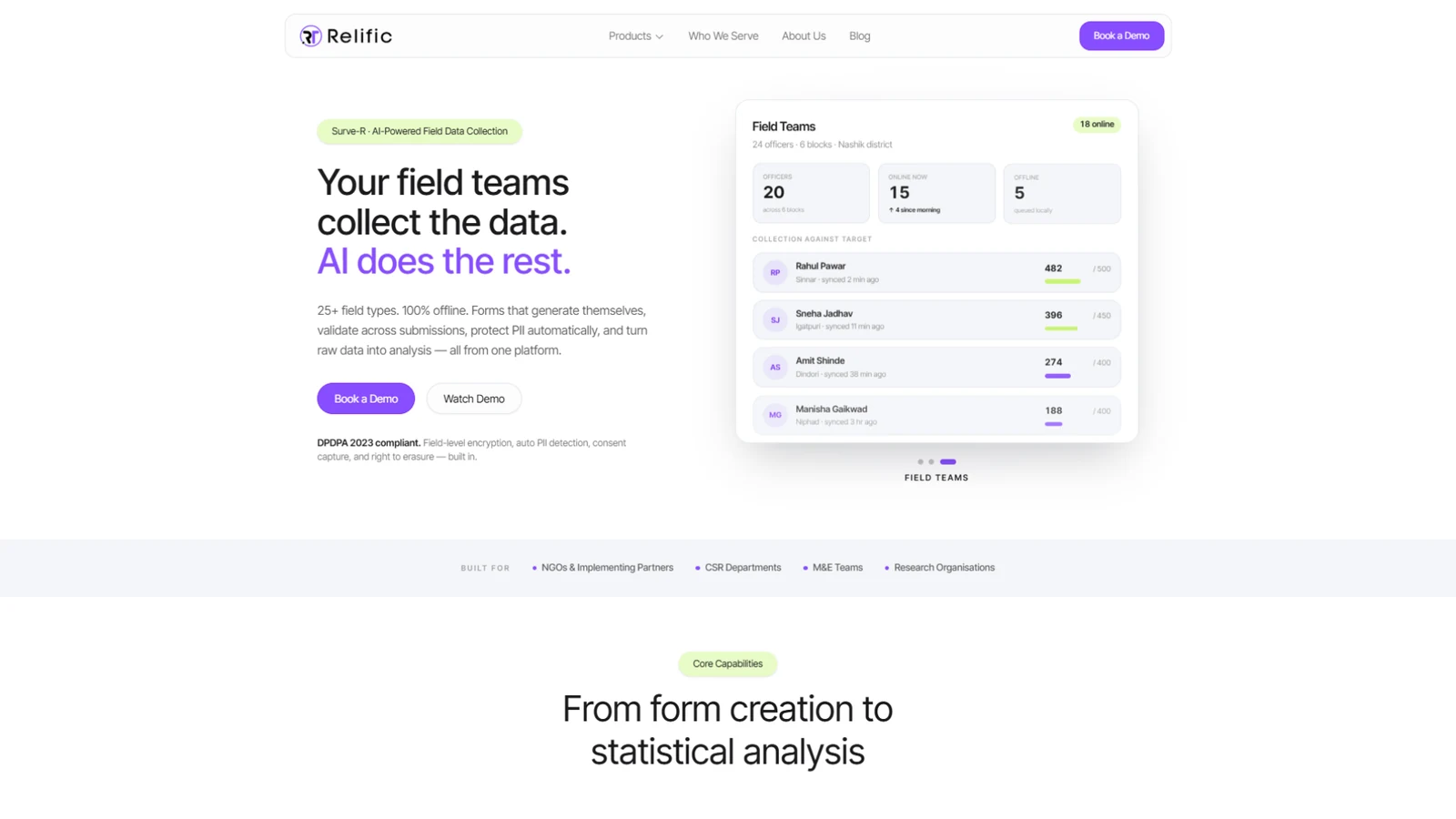
Relific Surve-R is an AI-assisted field data collection tool from Relific Technologies Private Limited, built for NGOs and implementing partners, CSR departments, M&E teams and research organisations. It's the only tool in this comparison designed specifically around India's DPDP Act, which is why it leads a guide written for Indian programmes. Its privacy controls live inside the form builder, not in a settings page someone has to remember to switch on.
Best for: India-based NGO and CSR programmes that collect beneficiary data covered by the DPDP Act, especially when a funder needs field data to feed programme and grant reporting.
What stands out:
- Forms that start from a description: Tell Relific's AI assistant, AI-R, what data you need in plain language, and it drafts the fields, validation rules, conditional logic, and personal-data classifications. A drag-and-drop builder handles the fine-tuning, with previews on desktop, tablet, and mobile. Relific says a 42-field baseline survey can be drafted in under a minute.
- Offline by default: Surve-R has 25+ field types, including GPS, photos, signatures, and cascading dropdowns, and all of them work fully offline on Android and iOS. Records are stored on the device and sync automatically when the phone reconnects.
- Household-style nesting: Nested forms go up to two levels deep: register a household, add its members, then add records for each member. The data flattens automatically for analysis, so nobody has to stitch tables together afterwards.
- Governance for larger teams: A versioned form library, governance modes that control who can create, edit, and publish forms, and role-based permissions down to form, field, and data level.
How it handles sensitive data:
- Phone numbers, email addresses, and Aadhaar fields are classified as personally identifiable information (PII) the moment they're added to a form.
- Each sensitive field is individually encrypted at rest with AES-256-GCM.
- Dashboards mask sensitive values by default.
- Consent is captured in the form, and children's data sits behind a mandatory parental consent gate.
- A beneficiary's data can be erased across all forms, with a full audit trail.
- Access to sensitive fields is granted for a maximum of 72 hours, requires a written justification, and is logged every time.
- Only the last four digits of an Aadhaar number are stored.
From field to funder report: Surve-R submissions flow straight into ProGran, Relific's programme and grants management product, where they update budgets and KPIs. A programme manager can see progress against targets without exporting a single spreadsheet. The Data Studio module adds natural-language analysis on top.
Pricing: Relific doesn't publish pricing. A free trial and demo are available.
Watch out for:
- Surve-R is a younger platform, with a smaller public track record than KoboToolbox or CommCare.
- Collection runs through the Android and iOS apps, so confirm browser or SMS options if your respondents need them.
- Follow-up works through nested forms. Ask during the demo how repeat visits against earlier records would work for your programme.
- The DPDP features are described by Relific. Ask for the supporting documentation, and confirm where data is hosted, before you sign.
2. KoboToolbox: Free Surveys for Nonprofits
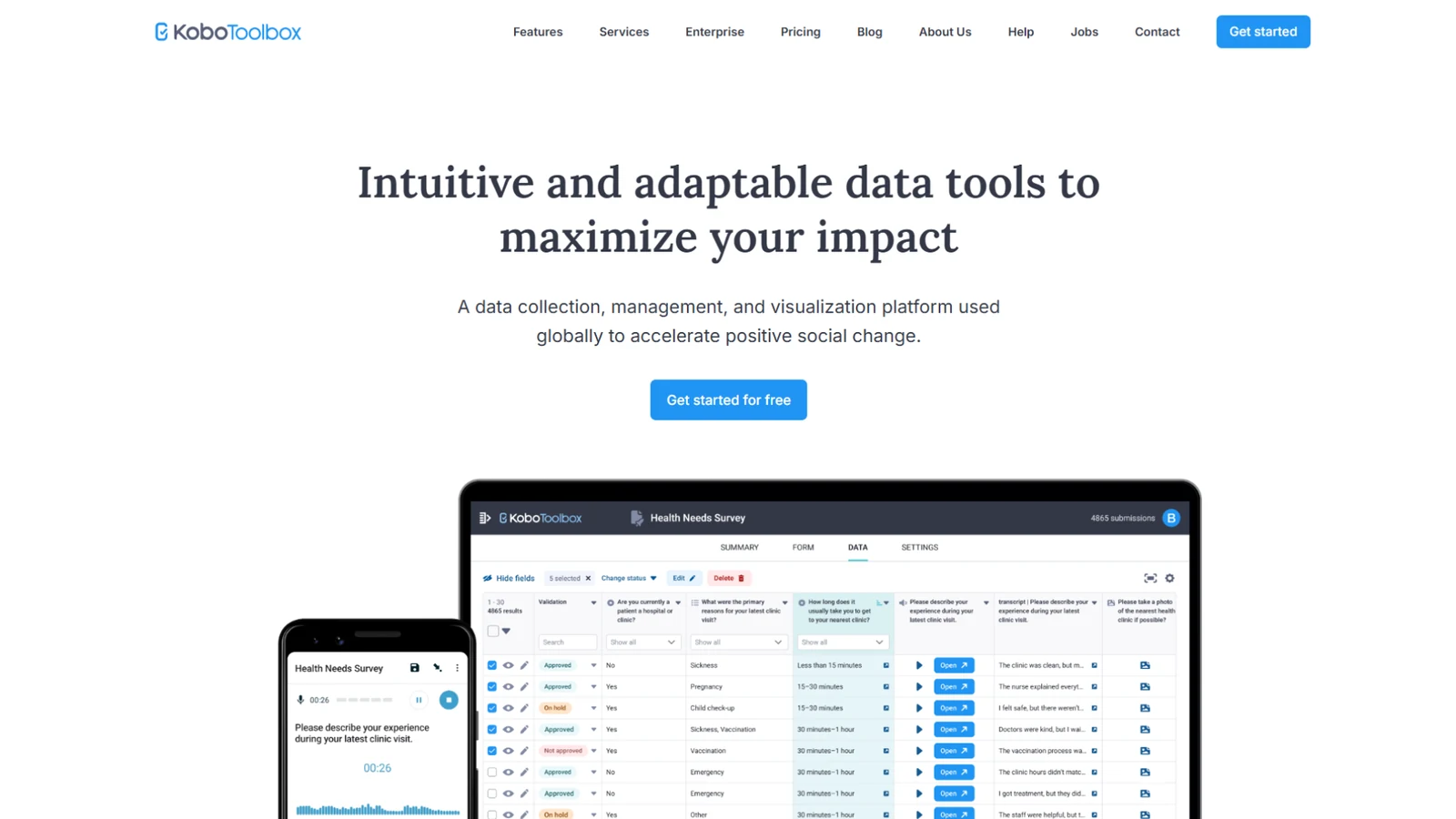
KoboToolbox is an open-source data collection platform. It started as a project at the Harvard Humanitarian Initiative and is now run by Kobo, Inc., an independent nonprofit based in Cambridge, Massachusetts. If you're a registered nonprofit and your survey fits within its monthly cap, it's hard to beat on price, because it costs nothing.
Best for: needs assessments, baseline and endline surveys, and routine monitoring by nonprofits that stay within the free submission cap.
What stands out:
- Skip logic, validation, in-survey guidance notes, translated forms, GPS and multimedia questions, all on the free plan.
- Offline collection through the KoboCollect app, or through web forms on any device, including iOS and desktop.
- XLSForm compatibility, a shared question library and locked templates, which help keep forms consistent across distributed teams.
- Encryption at rest and in transit, two-factor authentication, activity logs, and free data processing agreements.
- Exports and integrations for Excel, Google Sheets, Power BI, Tableau, ArcGIS and Stata, plus an API.
Pricing: KoboToolbox's pricing page treats nonprofits, government agencies, UN organisations, and educational institutions as one "Nonprofit" category.
- Community Plan: free, with 5,000 submissions a month and 1 GB of storage.
- Professional: $159 a month ($129 billed annually) for 25,000 submissions a month.
- Teams: $289 a month ($249 billed annually) for 50,000 submissions a month.
- Private companies and personal use: the same Community Plan costs $99 a month.
Watch out for:
- Storage runs out faster than you'd expect. If each photo is around 300 KB, 1 GB holds roughly 3,000 of them, which a photo-heavy household survey can use up quickly.
- There's no case management and no SMS or voice collection.
- Guaranteed support response times only start with the paid plans.
3. ODK: Open-Source and Self-Hosted
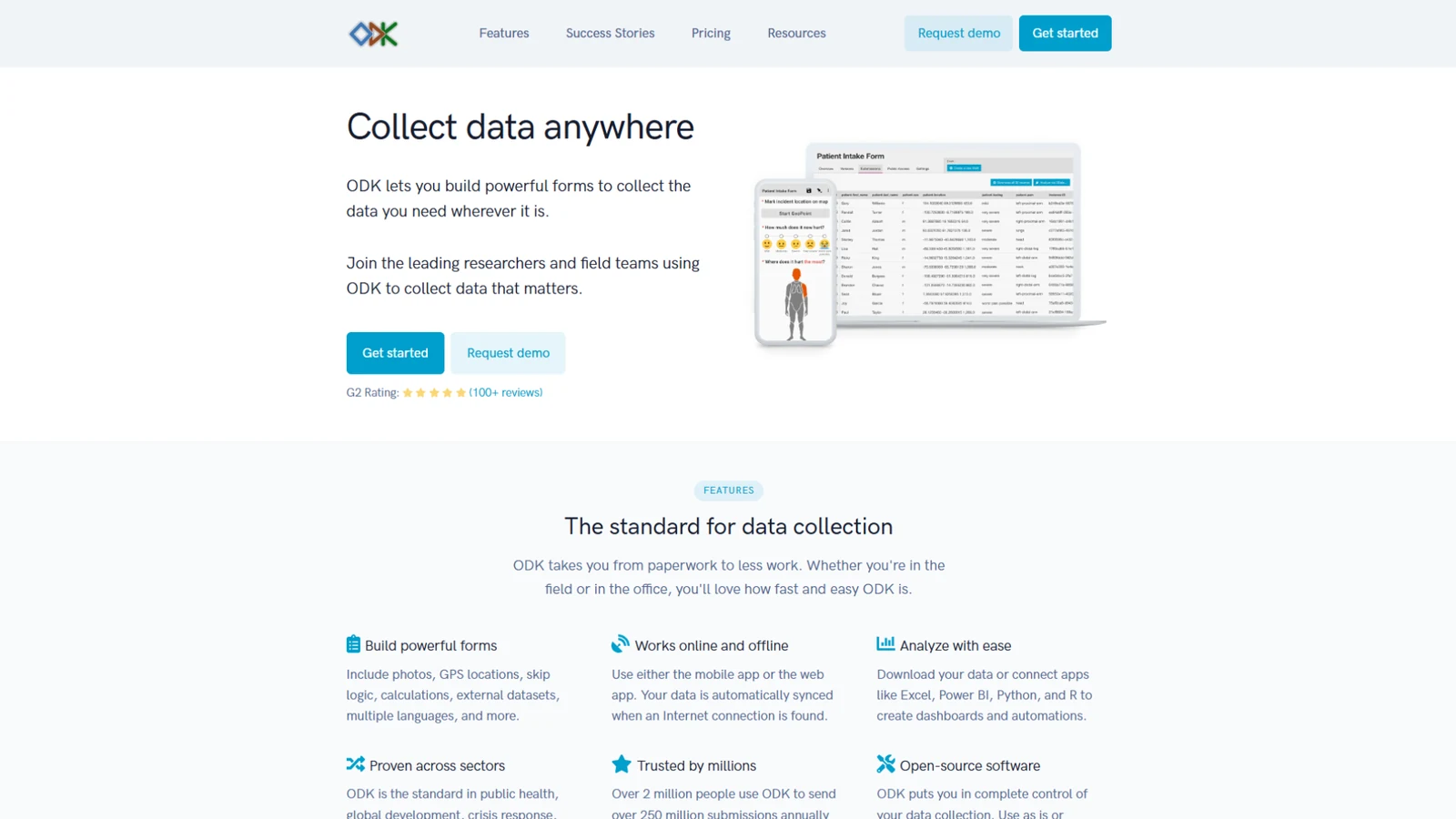
ODK is a free, open-source toolkit with two main parts: ODK Central, the server that manages forms, users, and submissions, and ODK Collect, the Android app enumerators use to fill in forms offline. It suits teams that would rather run their own server than pay a subscription.
Best for: organisations with in-house technical capacity that want no licence costs, full control of their server and no vendor submission caps.
What stands out:
- Role-based permissions and encrypted forms.
- Forms can be filled in on the mobile app or in a web browser.
- OData connections to Excel, Power BI, and R.
- The Entities feature, which shares data between forms so a team can register participants once and record follow-up visits against them over time.
Pricing:
- Self-hosting: the software is free. You pay for the server and for the time it takes someone to run it.
- ODK Cloud: hosted by the ODK team. Standard costs $199 a month for one active project and 10,000 submissions a month. Professional costs $499 a month for 25,000 submissions and adds Entities and API access.
Watch out for:
- On a self-hosted server, security, backups, updates, and uptime are all your responsibility.
- ODK Collect is Android-only, so anyone on an iPhone relies on browser forms.
- Support comes from the community forum unless you subscribe to ODK Cloud.
4. SurveyCTO: Research-Grade Surveys With 24/7 Support
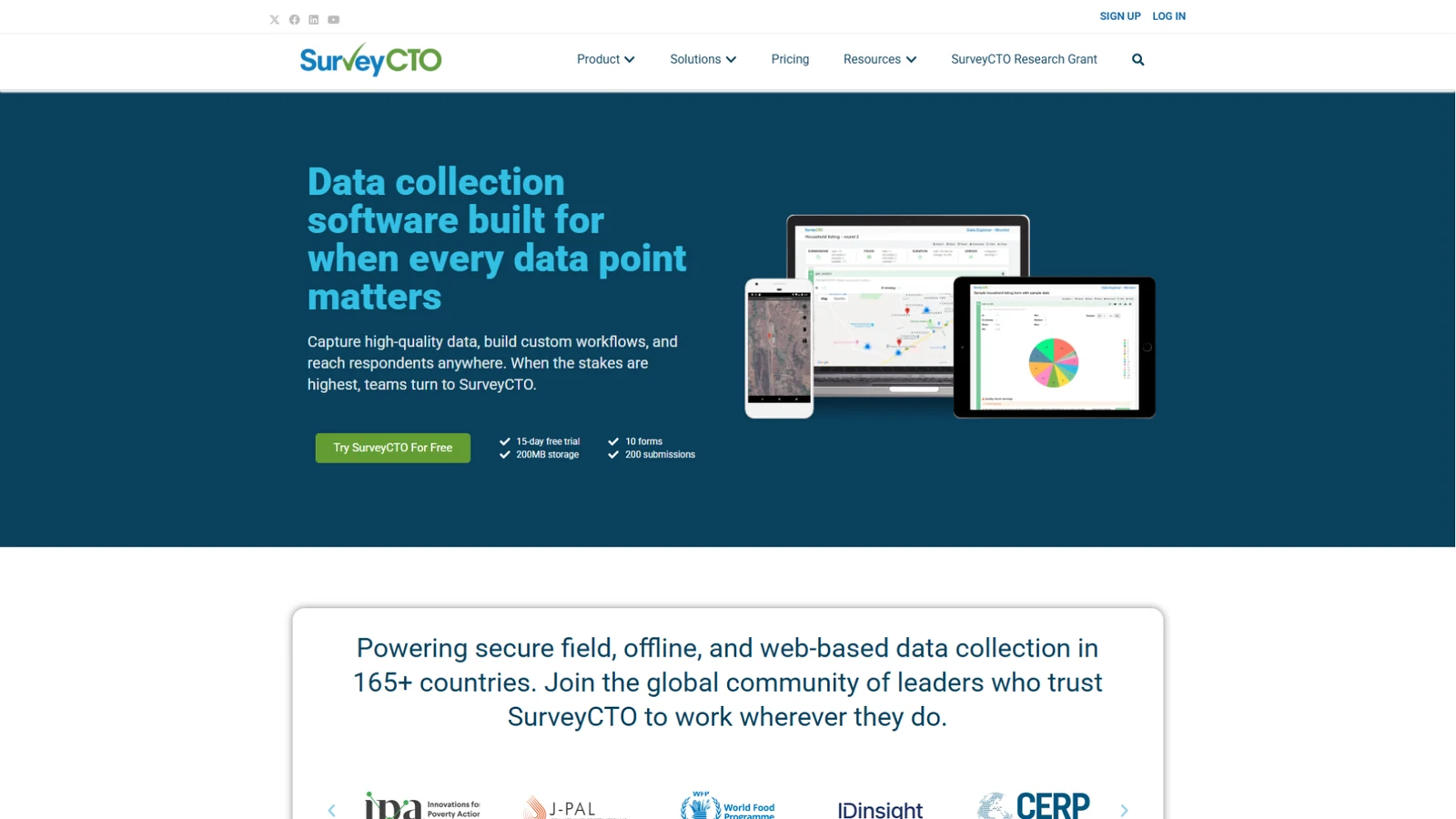
SurveyCTO is a commercial data collection platform from Dobility, Inc., with forms written in the XLSForm standard. Research teams tend to pick it when data quality has to stand up to scrutiny, whether that's an impact evaluation or a donor-funded study.
Best for: funded research, evaluations, and large surveys where the budget covers a subscription and the team would rather have 24/7 expert support than manage its own server.
What stands out:
- Offline collection and case management for longitudinal studies.
- Complex survey logic, plus preloading of external data for panel surveys.
- Error detection using submission metadata, automated statistical checks, and tools to review and correct records before analysis.
- Single sign-on, 2048-bit encryption, and SOC 2 compliance.
- The SurveyCTO Collect app is available on both Google Play and the App Store.
Pricing: from SurveyCTO's plans page:
- Basic: $225 a month billed annually or $250 monthly, for 5,000 submissions, 100 forms, and 10 GB of storage.
- Pro: $315 or $350 a month for 10,000 submissions, plus a choice of server location.
- Advanced: $630 or $700 a month for unlimited submissions and full API access.
- Extra submissions: $100 per 1,000.
- Free options: a free community subscription for testing and training allows 10 forms and 200 submissions a month, and there's a 15-day trial.
Watch out for:
- It has the highest entry price of the XLSForm-based tools.
- Basic and Pro both cap monthly submissions.
- API access on Pro is limited.
5. CommCare: Case Management Across Repeat Visits
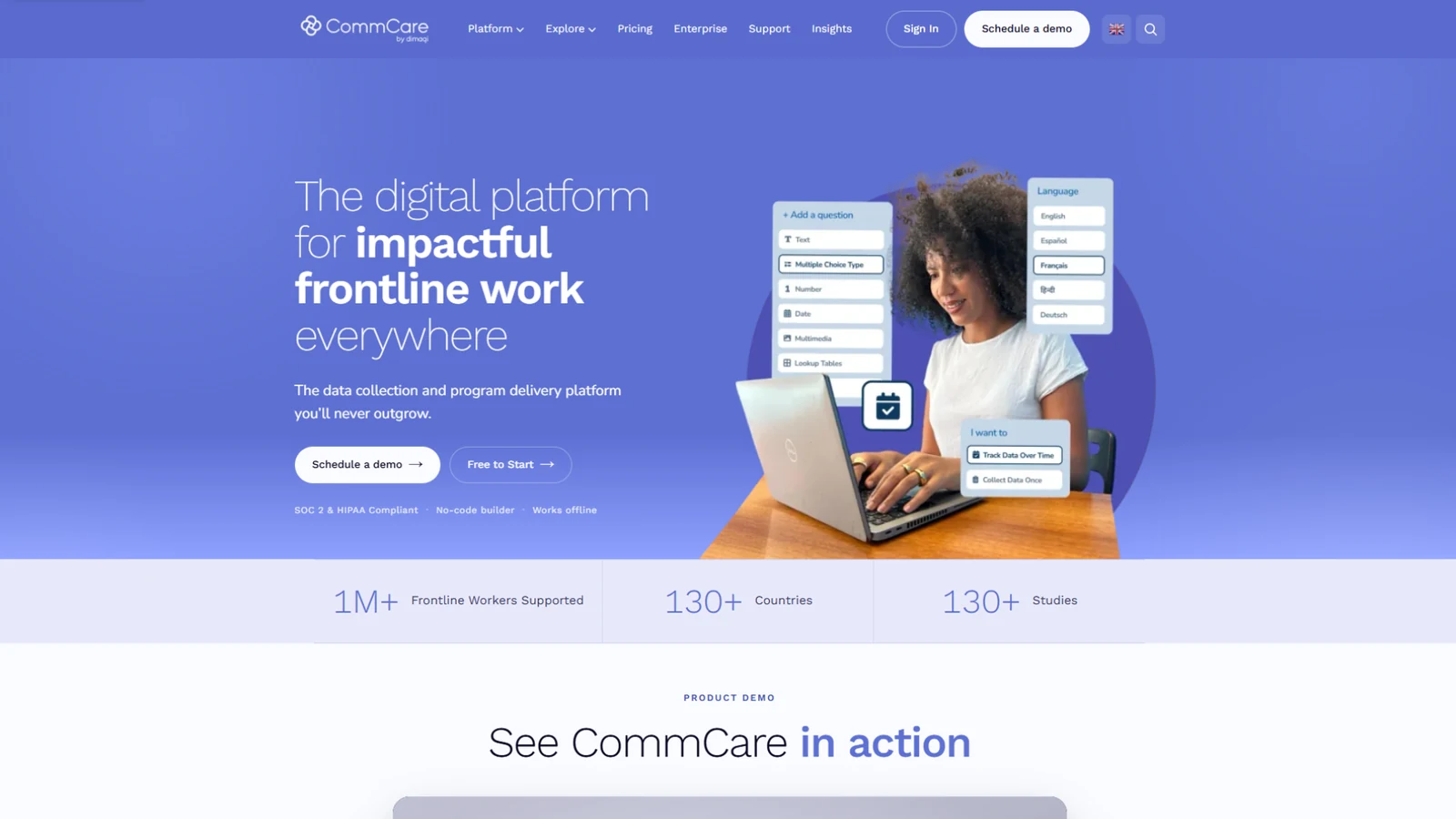
CommCare, built by Dimagi, is designed around cases rather than one-off forms. A pregnant woman, a household, or a patient is registered once, and every later visit is logged against that same record. For programmes built on repeat visits, that design choice matters more than any other feature.
Best for: maternal and child health, nutrition, social protection casework, and any programme that follows the same people across repeat visits.
What stands out:
- Offline case management on every plan, including the free edition.
- Multi-language forms and multimedia support.
- Case sharing and child cases from the Pro plan.
- Case deduplication, two-way SMS, Power BI and Tableau integration, and browser-based Web Apps on the Advanced plan.
- Unlimited submissions and storage, with cloud hosting available in the US, EU and India.
Evidence base: Dimagi's CommCare evidence base lists more than 130 studies and evaluations, including 120 peer-reviewed papers and 8 randomised controlled trials. A Johns Hopkins assessment of COVID-19 digital tools, as summarised by Dimagi, singled out DHIS2 and CommCare for maturity, flexibility, and large-scale deployment.
Pricing: from Dimagi's pricing page:
- Standard: $100 a month billed annually ($120 monthly), with 50 users.
- Pro: $500 a month billed annually, with 250 users.
- Advanced: $1,000 a month billed annually, with 500 users.
- Enterprise: from $4,000 a month.
- Extra mobile workers: $2 a month each.
- Free edition: five mobile workers, meant for practice rather than live data.
Watch out for:
- The mobile app is built for Android. Browser access through Web Apps needs the Advanced plan.
- Designing a case-based app takes longer than building a single survey, so allow time for it before launch.
6. DHIS2: For Work Inside National Health Systems
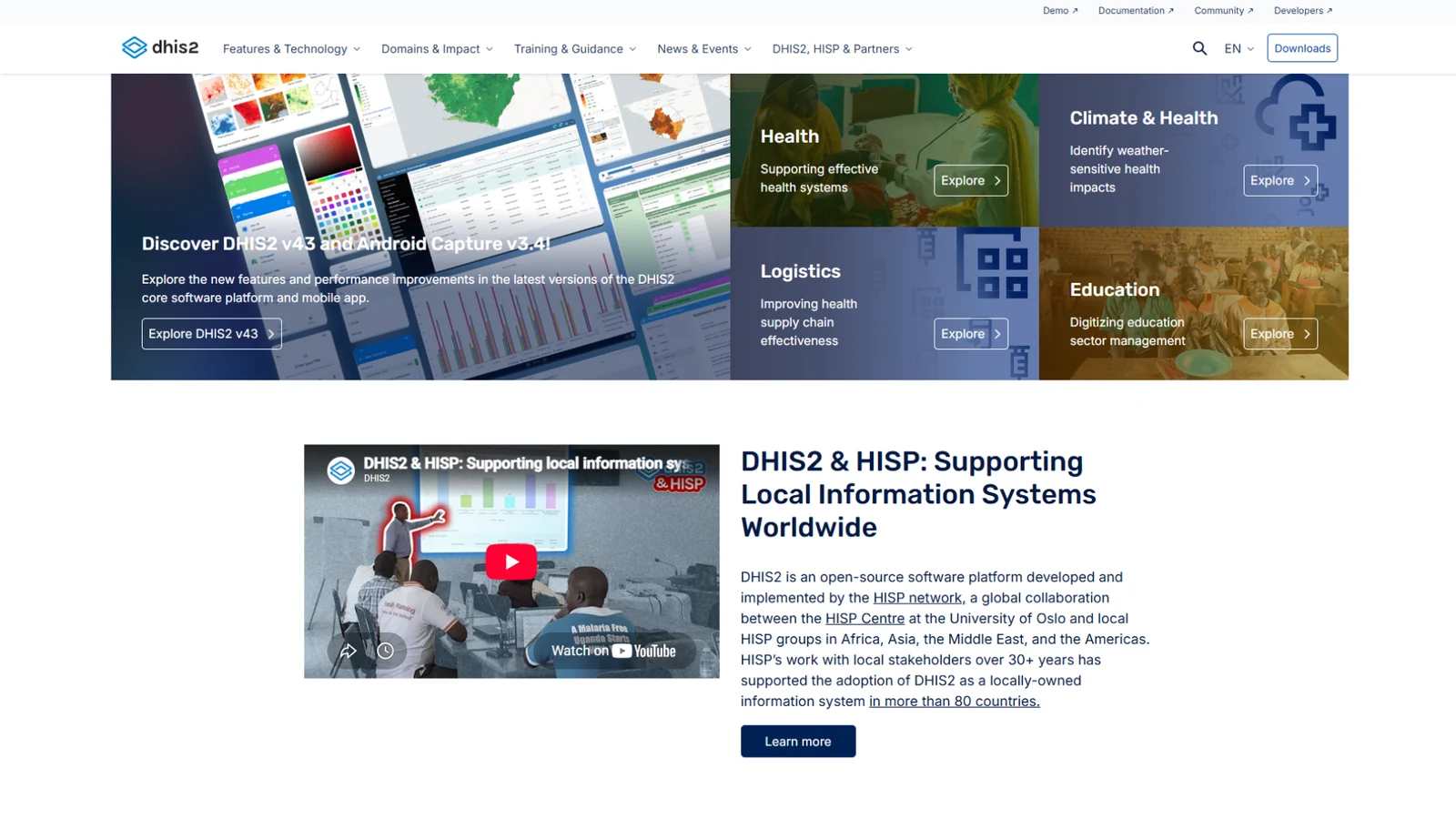
DHIS2 is a free, open-source platform developed by the HISP Centre at the University of Oslo. According to DHIS2, it's the world's largest health management information system (HMIS) platform:
- Ministries of Health in more than 75 low- and middle-income countries use it as their system of record, covering about 3.2 billion people.
- Counting NGO and other deployments, it's active in more than 130 countries.
Best for: NGOs working within or alongside a government health system that already runs DHIS2, where reporting into the same system saves everyone from entering data twice.
What stands out:
- Collection and analysis of both aggregate and individual-level data, including Tracker programmes that follow individuals over time.
- An Android Capture app that can send tracker data by SMS when there's no internet connection.
- Use beyond health, including education and logistics.
Pricing: DHIS2 is released under the BSD 3-clause licence, so there are no licence fees. Hosting, configuration, and training still cost money. Implementation support is available through a network of 23 HISP partner groups.
Watch out for: DHIS2 takes serious configuration work. For a standalone NGO survey, it's usually more platform than the project needs.
7. mWater: Free WASH and Community Monitoring at Scale
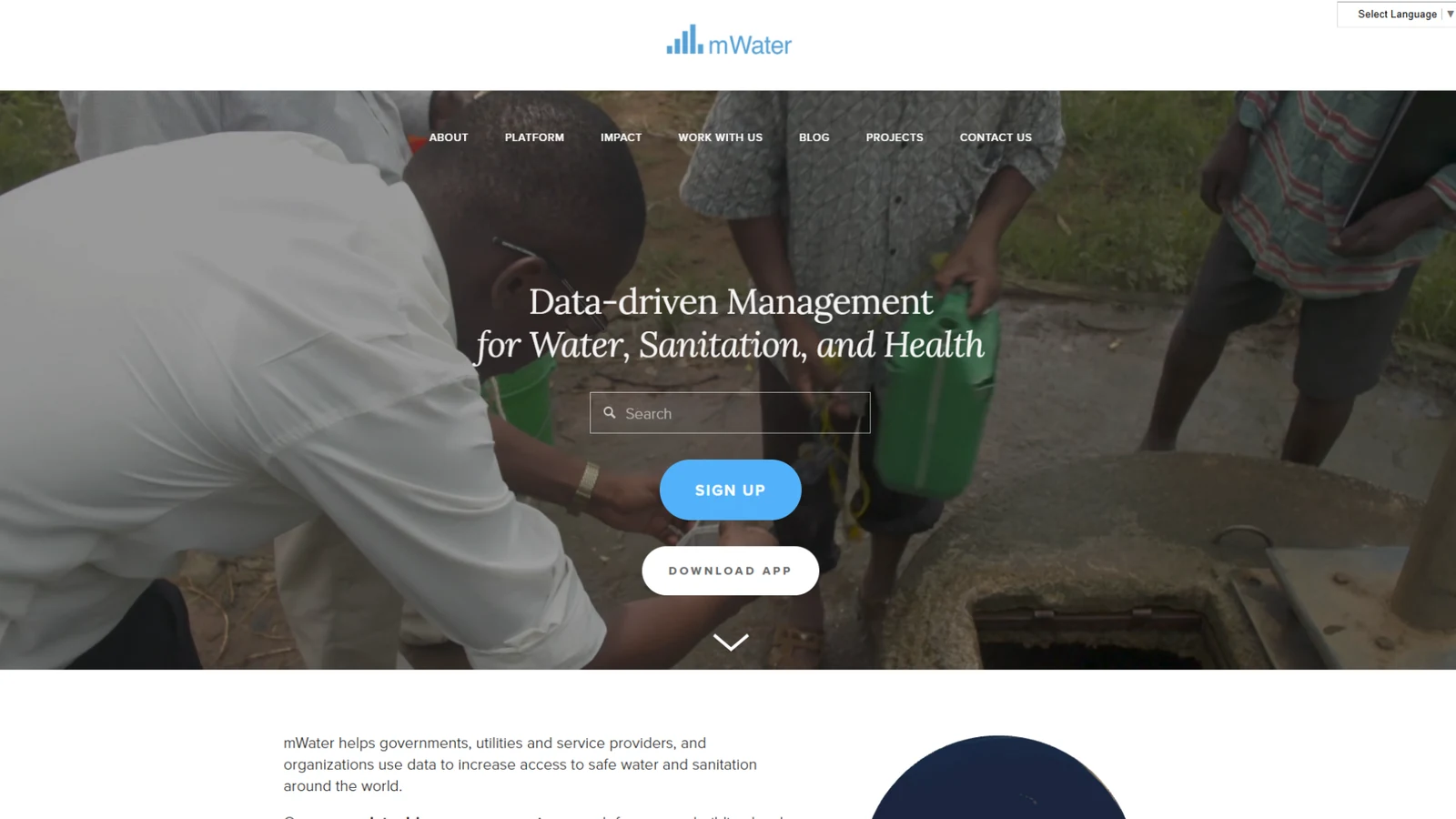
mWater is a free, offline-first data platform from the mWater Foundation, built for water, sanitation and health (WASH) programmes but used well beyond them. Where most tools charge as a programme grows, mWater stays free at any volume. It has over 390,000 user accounts across 199 countries and territories, with more than 51 million survey responses submitted, and national health and water ministries in several countries run their systems of record on it.
Best for: WASH, community and health monitoring programmes that need to map and track sites or infrastructure over time, and that want a free platform without submission caps.
What stands out:
- Offline collection on Android, iOS and the web, with automatic sync when a connection returns.
- Longitudinal site monitoring: register a water point, facility, school or community once, then track it across repeat surveys over time.
- Built-in mapping, dashboards and real-time analysis, plus a library of standard forms and indicators to keep data comparable across teams.
- Available in dozens of languages, with task assignment for field teams.
- Users own their data, can download all of it at any time, and decide what stays private.
Pricing: the full platform is free for unlimited use, including offline collection, mapping, and dashboards. Two optional Stellar subscriptions add expert technical support or higher-volume API and storage, at $500 a month or $5,500 a year each; ordinary survey collection stays free regardless.
Watch out for:
- It's designed around WASH and infrastructure monitoring, so a household beneficiary survey may need more form-building work than a purpose-built survey tool.
- There's no built-in SMS, voice, or chat collection, so it can't reach respondents who don't have a smartphone.
- Data is hosted on mWater's cloud servers, so confirm hosting location and terms against your DPDP obligations before collecting personal data.
8. Fulcrum: Inspections and GIS Fieldwork
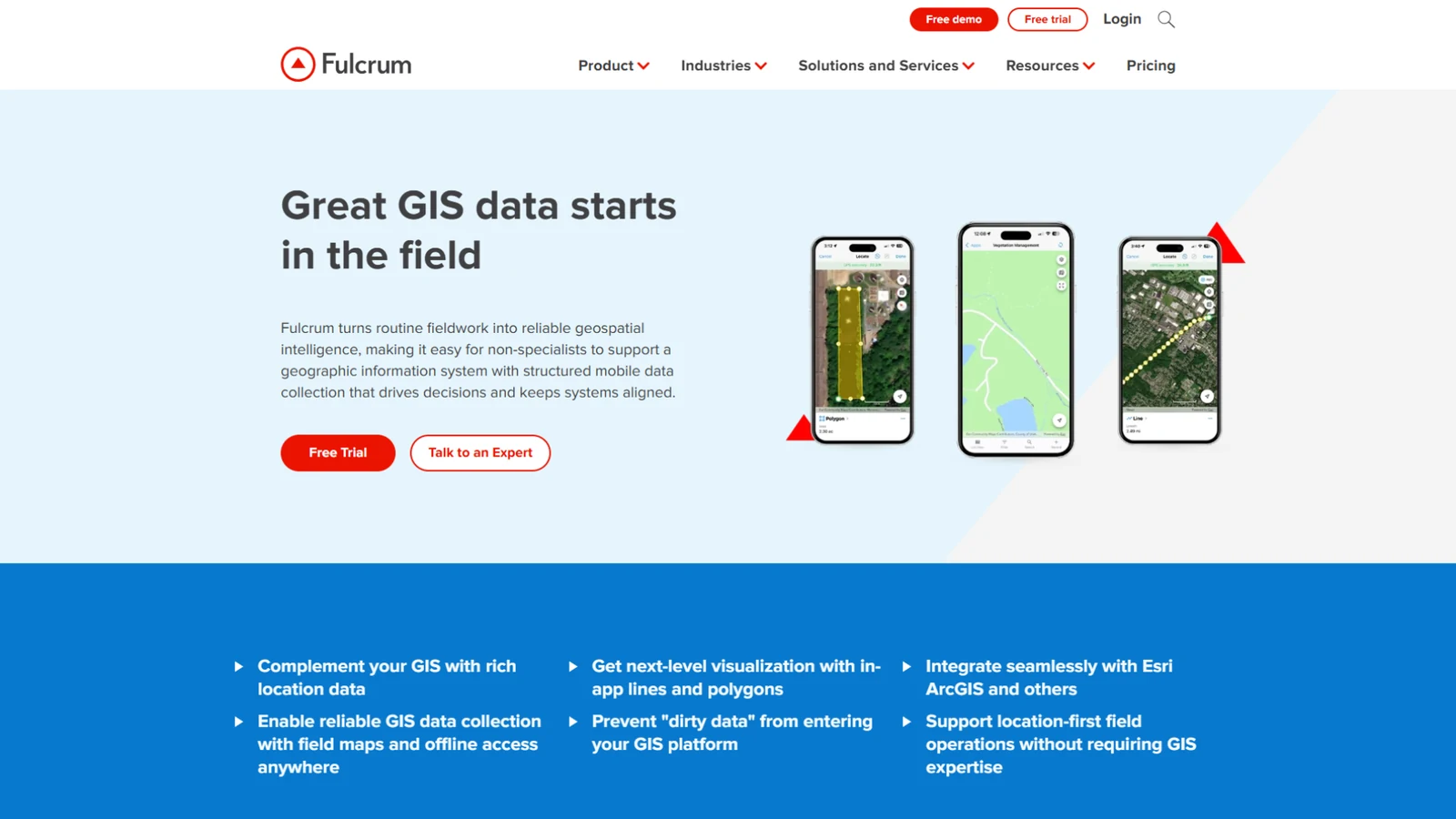
Fulcrum, developed by Spatial Networks, Inc., is a field inspection and operations platform. Where most survey tools treat location as one more question, Fulcrum builds the whole workflow around the map.
Best for: water and sanitation infrastructure checks, environmental monitoring, and asset audits where mapping is central to the work.
What stands out:
- Offline capture with photo, audio, video, barcode, QR code, and signature fields.
- Calculation and visibility logic, repeatable parent-child records, and record linking.
- Automatic geotagging, line and polygon capture, offline basemaps and ArcGIS Online integration.
Pricing: from Fulcrum's pricing page:
- Professional: $43 per user per month.
- Elite: $55 per user per month.
- Terms: every plan needs an annual subscription and at least five users, so the smallest Professional account costs about $2,580 a year.
Watch out for:
- Per-user pricing adds up quickly for large enumerator teams.
- It's designed for inspections, not household surveys or beneficiary case management.
How Much Does Mobile Data Collection Software Cost?
Anywhere from nothing to well over $1,000 a month. The pricing model matters more than the headline number, because it decides how the bill grows. Most NGO data collection tools use one of five models:
- Free for eligible organisations, with caps: KoboToolbox.
- Submission-based subscriptions: ODK Cloud, SurveyCTO and KoboToolbox's paid plans.
- User- or collector-based subscriptions: CommCare and Fulcrum.
- Free software with paid implementation: self-hosted ODK and DHIS2.
- Free hosted platform, with optional paid add-ons: mWater.
- Quote-based pricing: Relific Surve-R and most enterprise tiers.
The licence is rarely the whole cost. Budget also for:
- devices and mobile data
- training time
- server administration if you self-host
- per-message SMS and voice charges
- extra submission credits or storage once you pass a plan's limit
Here's what that looks like for a mid-sized programme: 30 enumerators submitting 8,000 records a month, at September 2026 list prices before taxes and discounts.
| Tool | Plan that fits | Approximate monthly cost |
|---|---|---|
| Relific Surve-R | Quote-based | On request |
| KoboToolbox (nonprofit) | Professional (25,000 submissions/month) | $129 to $159 |
| ODK Cloud | Standard (10,000 submissions/month) | $199 |
| SurveyCTO | Pro (10,000 submissions/month) | $315 to $350 |
| CommCare | Standard (50 users, unlimited submissions) | $100 to $120 |
| DHIS2 or self-hosted ODK | No licence | Hosting and administration costs only |
| mWater | Free platform | $0; optional Stellar support from $500/month |
| Fulcrum | Professional (30 users) | $1,290 |
The same programme can land in very different places depending on how a vendor counts usage. A tool priced per submission stays cheap for a small team sending lots of records, while a per-user tool gets expensive as soon as the team grows.
What Does India's DPDP Act Mean for NGO Field Data?
Under India's DPDP Act, 2023, the organisation that decides why and how beneficiary data is collected is accountable for protecting it, even when a different organisation does the collecting. For NGOs and their funders, that changes who carries the legal risk for a field survey.
Who is responsible for beneficiary data
- The Data Fiduciary. The Act defines a Data Fiduciary as anyone who decides the purpose and means of processing personal data, alone or together with others.
- Responsibility for processors. The Data Fiduciary stays responsible even for the processing that a Data Processor carries out on its behalf.
- In funded programmes. The funder or CSR team that specifies what data to collect often plays the fiduciary role. The implementing NGO may act as a processor or share the responsibility, depending on the arrangement.
Relific's guide to what the DPDP Act means for funders, CSR teams and NGOs walks through how this plays out in a CSR-funded health programme.
What the Act covers
- Paper records: the Act applies to personal data collected on paper once it's digitised.
- Children's data: processing data of anyone under 18 needs verifiable parental consent. The government's announcement of the Rules mentions limited exemptions for purposes such as healthcare, education and real-time safety, so check which apply before you design consent flows.
- Deletion: data must be erased once consent is withdrawn or the purpose has been served, unless another law requires it to be kept.
- Individuals' requests: people can ask to access, correct, update, or erase their data, and the Rules require a response within 90 days.
- Hosting location: the Act doesn't require local hosting by default. It lets the government restrict transfers to countries it notifies, and Significant Data Fiduciaries can face localisation requirements for specified data.
When the rules apply
The DPDP Rules were notified in November 2025 with an 18-month phased timeline. Most operational obligations take effect on 13 May 2027, including notice and consent, security safeguards, breach notification, children's data and individuals' rights.
Maximum penalties under the Act
| Breach | Maximum penalty |
|---|---|
| Failing to take reasonable security safeguards | ₹250 crore |
| Failing to notify the Data Protection Board or affected individuals of a breach | ₹200 crore |
| Breaching obligations on children's data | ₹200 crore |
| Any other breach of the Act or Rules | ₹50 crore |
Data protection checklist for any collection tool
Whichever tool you shortlist, check these seven things before you commit:
- Sensitive fields are flagged when the form is designed, not after data arrives.
- Data is encrypted at rest on the device and on the server, not only in transit.
- Consent, including parental consent for minors, is captured inside the form flow.
- A beneficiary's records can be erased across every form, with an audit trail.
- Access to sensitive fields is role-based, time-limited, and logged.
- Retention periods and deletion can be configured per project.
- The vendor will sign a data processing agreement, and you know where the data is hosted.
How to Maintain Data Quality in Mobile Surveys
Picking the right tool solves collection. Data quality still needs a few habits of its own:
- Validate at entry. Apply range checks and required fields across every form, not just the ones your most careful designer built.
- Guard against duplicates. Two enumerators can register the same household, and a failed sync can cause a resubmission. Case-based tools such as CommCare handle this better than survey-only tools.
- Check submissions daily in the first weeks. With a weekly review, a systematic error can run for days before anyone spots it.
- Version-control your forms. A mid-project change that nobody wrote down becomes a mystery gap in the data at evaluation time.
How to Choose and Roll Out a Data Collection App
Five decisions to make before you buy
- Name the project type first. A one-off survey, a case-managed programme, funded research, a health-system tie-in, an inspection workflow, and DPDP-sensitive CSR data each point to a different tool. Get this right, and most of the market drops out on its own.
- Price the tool at the volume you'll reach in a year. Run your pilot's numbers at ten times the volume before committing, because that's the bill you'll actually pay.
- Test offline sync and data protection in your own field conditions. A demo on office wifi tells you very little about a three-day trip without signal.
- Put the tool in front of real field staff. How enumerators react to the interface is worth more than any feature list.
- Plan how you'd leave. Check export formats and XLSForm compatibility now. Moving a live programme to a new platform mid-year is slow and expensive.
What your funders expect to see should shape the choice too. Relific's guide to grantee reporting requirements covers what foundations typically ask for.
Rollout steps that prevent early failure
- Pilot with the people who'll use it. Run the form with three to five field staff in a real village or ward before any wider launch. A form that makes sense to the person who designed it can confuse someone seeing it for the first time.
- Train on the device and rehearse failure. Have trainees fill in test forms on their own phones, including one where the signal is switched off halfway through. That way, the first time it happens isn't in a district they can't easily get back to.
- Give every enumerator a named contact for sync problems. A generic support email isn't enough. A field worker with nobody to call usually stops collecting for the rest of the day.
- Double the vendor's onboarding estimate. Vendor guides assume a comfort with the tool that a first-time field team doesn't have yet.
- Launch in one region first. The problems a ten-district rollout would surface all show up in the first district, at a fraction of the cost to fix.
Where to Start
No single tool wins on cost, connectivity, case tracking, and privacy for every programme. The right one depends on the work in front of you.
Pick the option closest to your project, run it through the data protection checklist, and put it in enumerators' hands for a week before you sign anything bigger. The field will tell you quickly whether it fits. Submission volumes, compliance obligations, and your team's feedback will show you when it's time to move up a tier.
From Field Data to Funder Reports
Collecting data is the first step. Someone still has to turn thousands of submissions into evidence a funder trusts, and that work is easier to plan before the first form goes out.
For the measurement side, Relific's M&E framework guide for NGOs covers indicators, data quality, and evaluation design. Its guide to mobile CSR data collection goes deeper on geo-tagged verification in the field.
If you'd like to see how Surve-R handles your own forms, from collection through to reporting in ProGran, you can book a demo.
Frequently Asked Questions
It depends on the project:
- India-based programmes handling DPDP-sensitive data: Relific Surve-R.
- Free nonprofit surveys: KoboToolbox.
- Repeat visits to the same people: CommCare.
- Funded research with audit tools and 24/7 support: SurveyCTO.
- Work inside national health systems: DHIS2.
- Free WASH and site monitoring: mWater.
At minimum: offline collection that holds up for days, skip logic and validation, GPS and photo capture, and multilingual forms. Programmes that revisit beneficiaries also need case tracking. Programmes handling personal data should check encryption, consent capture, deletion tools, and where data is hosted.
KoboToolbox's Community Plan is free for nonprofits, government agencies, UN organisations, and educational institutions, with 5,000 submissions a month and 1 GB of storage. ODK and DHIS2 are free open-source software, but you pay to host and run them.
Both use the XLSForm standard, so forms usually move between them. KoboToolbox gives nonprofits a free hosted server with a monthly submission cap and a visual form builder. ODK is self-hosted or paid through ODK Cloud, and its Entities feature supports longitudinal follow-up.
ODK is free, open source, and self-hosted, with community support unless you pay for ODK Cloud. SurveyCTO is a paid subscription that adds managed hosting, 24/7 expert support, data-quality tools, and SOC 2 compliance. SurveyCTO plans start at $225 a month billed annually.
CommCare is built around case management, with offline case tracking on every plan and case sharing from the Pro tier. SurveyCTO offers offline case management, ODK supports follow-up through Entities, and DHIS2 Tracker follows individuals within health programmes.
All eight tools can capture GPS locations. Fulcrum goes furthest on mapping, with line and polygon capture, offline basemaps, and ArcGIS Online integration. KoboToolbox lets you collect, map, and export GPS data on its free plan.
Yes. XLSForm-based tools such as KoboToolbox, ODK, and SurveyCTO let one form carry several languages. CommCare includes multi-language support on every plan, and DHIS2 supports translated interfaces. In India, plan translations into the languages your respondents actually speak, not just the state's official language.
Relific Surve-R, SurveyCTO Collect, and Fulcrum all have iOS apps. KoboToolbox supports iPhones through web forms. ODK Collect and CommCare's mobile app are built for Android, and both rely on browser-based forms for other devices.
Options are more limited without a dedicated SMS or voice tool. CommCare offers two-way SMS on its Advanced plan, and DHIS2's Android app can send data by SMS when there's no internet. For programmes that rely heavily on reaching basic-phone users, pair one of these with a dedicated SMS or IVR service.
As of September 2026 list prices, costs run from free (KoboToolbox for nonprofits, self-hosted ODK and DHIS2) to $100 to $700 a month for CommCare and SurveyCTO plans. mWater is free for unlimited use with optional paid add-ons, Fulcrum charges $43 per user a month with a five-user minimum, and Relific Surve-R is quote-based. Devices, training, and hosting are extra.
Under the DPDP Act, the Data Fiduciary is whoever decides the purpose and means of processing, alone or with others. In funded programmes, that's often the funder or CSR team, and sometimes the NGO as well. Most obligations apply from 13 May 2027.
They save real time at the drafting stage. Relific Surve-R builds a draft form, with fields, validation rules, and logic, from a plain-language description, and SurveyCTO offers AI tools for survey design and transcription. Someone who knows the programme should still review every draft and test it in the field before it goes live.