
Key Takeaways
- India's 2% CSR obligation is denominated in money. The notional value of employee volunteer time cannot be counted against it.
- MCA's 2021 CSR FAQs state that employee involvement in CSR projects cannot be monetised as CSR expenditure.
- The 2014 circular still cited for a "volunteer salary" exception was withdrawn three months after it was issued.
- What matters now is classification: CSR-function employee cost is capped overhead, project-delivery cost is uncapped project cost.
- Only activity-level hour records let you defend which side of that line a cost sits on.
- Volunteer data now reaches three readers: the CSR committee, the statutory auditor, and BRSR assurance for listed companies.
- Micro-volunteering is rising fast, and short one-off sessions are exactly where manual attendance capture fails.
- Buy on verified check-in, Schedule VII mapping, and April-March reporting. Rollouts fail on adoption, not features.
Open almost any employee volunteering dashboard from India, and there is a rupee figure near the top of the screen. 950 hours. ₹4.75 lakh of social impact. It looks like money, and it is formatted like money.
Under India's CSR law, it is not money, and it never becomes money.
The Ministry of Corporate Affairs put this beyond argument in its 2021 CSR FAQs: the involvement of employees in a company's CSR projects cannot be monetised and shown as CSR expenditure. Most Indian buying guides for this software category skip that entirely, and a few actively contradict it by citing a circular that was withdrawn in 2014.
So this guide starts from the law rather than the feature list. What the 2% actually counts, what it does not, where your hour records genuinely earn their keep, and which platforms fit which kind of programme.
What Is Employee Volunteering Software?
Employee volunteering software creates volunteering opportunities, manages enrolment, verifies attendance, computes hours from timestamps, and reports participation and impact. It replaces spreadsheets, WhatsApp threads, and folders of attendance photos with one record you can query and audit.
The mechanics are ordinary. A programme lead publishes an opportunity, employees enrol, attendance is captured on the day, hours compute, data rolls into dashboards. What changes is the discipline. Once an hour has to be recorded in a defined field rather than remembered in April, you have a continuous record instead of a pile of artefacts reassembled under deadline pressure.
Internationally, volunteering usually ships alongside workplace giving and grantmaking inside a broader suite. Relific's primer on what CSR software does and how to evaluate it covers that wider category. In India, the volunteering module carries statutory weight that global buyers rarely anticipate, and that is where the real decisions sit.
Do Employee Volunteer Hours Count Toward India's 2% CSR Spend?
No. Not as notional value, and not as a monetised in-kind contribution.
Section 135(5) of the Companies Act, 2013 requires eligible companies to spend at least 2% of average net profits. The obligation is measured in rupees actually disbursed. MCA's General Circular 14/2021 closes both routes in the same document. FAQ 3.12 confirms that CSR contributions cannot be in kind and monetised. FAQ 3.18 addresses volunteering head-on and answers with a single word: no, involvement of employees in CSR projects cannot be monetised. The Ministry goes on to encourage employee involvement warmly. It simply declines to price it.
When a platform reports ₹4.75 lakh of social impact from 950 hours, treat that as an engagement figure and an internal story. It is not spend you can set against your obligation, and presenting it that way is the sort of thing an auditor is trained to find.
The circular almost every Indian article gets wrong
Search this topic, and you will repeatedly meet the claim that MCA "clarified in 2014" that salaries paid to CSR staff and volunteers, proportionate to hours spent on CSR, can be factored into CSR project cost.
That clarification did exist. It was clause (iv) of General Circular 21/2014, dated 18 June 2014.
It survived three months. General Circular 36/2014, dated 17 September 2014, records that Rule 4(6) had been amended and that "clarification (iv) in General Circular No. 21 of 2014 dated 18.06.2014, stands omitted." Seven years later, General Circular 14/2021 superseded circulars 21/2014 and 36/2014 in full.
Anyone citing that 2014 clause today is relying on a provision that was pulled within a quarter and then superseded again. If it appears in your CSR policy note, your board deck or a vendor's compliance page, fix it before someone else finds it.
What the law does count
The live question is not whether hours convert to rupees. It is how employee cost is classified.
Rule 2(1)(b) of the Companies (CSR Policy) Rules, 2014 defines administrative overheads as expenses for the general management and administration of CSR functions, and expressly excludes expenses directly incurred for designing, implementing, monitoring and evaluating a particular CSR project. Rule 7(1) caps those overheads at 5% of total CSR expenditure for the financial year. MCA's worked example in FAQ 3.2 draws the line cleanly.
Cost | Classification | Cap |
|---|---|---|
Salary and training of employees working in the company's CSR division | Administrative overhead | 5% of total CSR expenditure |
Salary of school teachers and project staff on an education CSR project | Project cost | Uncapped |
Cost directly incurred on designing, implementing, monitoring or evaluating a specific project | Project cost | Uncapped |
Stationery, utilities, office supplies, legal expenses for the CSR function | Administrative overhead | 5% of total CSR expenditure |
Notional value of an employee's Saturday at a plantation drive | Not CSR expenditure at all | — |
Expenses an implementing agency incurs managing CSR activities | Cannot be claimed by the company | — |
A worked example, because this is where teams lose money
Take a manufacturer with a ₹2.5 crore CSR obligation for the year. Administrative overheads are capped at 5% of total CSR expenditure, so roughly ₹12.5 lakh. The company logs 2,400 volunteer hours across the year, and they fall into three very different buckets.
1,900 hours: employees at weekend drives: Tree planting, blood donation camps, mentoring sessions run with partner NGOs. Real engagement, real goodwill, and ₹0 against the 2%. Not monetisable in any form. What these hours produce is participation data for the board report and BRSR narrative, not spend.
380 hours: the two-person CSR team on general administration: Drafting the annual action plan, coordinating with implementing agencies, preparing the Board report and Form CSR-2. Proportionate salary cost here is an administrative overhead, competing for room under that ₹12.5 lakh ceiling alongside audit fees, travel and office costs.
120 hours: the same two people, on site, monitoring a specific school-infrastructure project: Rule 2(1)(b) pulls project design, implementation, monitoring and evaluation out of administrative overheads, so the proportionate cost of those hours belongs in project cost, which has no cap.
The interesting number is the 380 against the 120. Same two employees, same payroll line, different treatment, decided entirely by what they were doing on a given day. Without activity-level records, the whole salary line defaults into the capped bucket, and in a year with a tight overhead position that is a real cost. With records, the classification is defensible.
Two caveats worth stating plainly. This is a judgement your statutory auditor will test, so document the basis rather than the conclusion. And an activity designed exclusively for the benefit of your own employees is excluded from CSR entirely under Rule 2(1)(d)(iv), which means a staff wellness walkathon is not a CSR project however many hours it generates. Categorising at the point of creation, rather than in March, is what keeps that distinction clean.
Relific's practitioner guide on how to track volunteer hours for CSR reporting covers the record-keeping side in more detail.
Employee Volunteering Software at a glance
Platform | Origin | Best for | Section 135 fit | Pricing |
|---|---|---|---|---|
Voluntee-R by Relific | India | Compliant volunteering plus programme and impact reporting | Built for it: Schedule VII, FY reporting, audit trails, ISO 27001 | Quote / free trial |
Goodera | India-founded, US HQ | Fully managed, host-led events | Strong delivery; verify statutory reporting depth | Quote |
Metta Social | India | CSR, giving and volunteering bundle | India-native; good context fit | Quote |
SoulAce | India | NGO sourcing plus on-ground delivery | India-native; services-led | Quote |
iVolunteer | India | Opportunity supply and volunteer experience | Engagement-led; verify reporting | Quote/packages |
Benevity | Global | Large global enterprises | Configurable; may need supplementary tooling | Custom |
YourCause CSRconnect | Global | Combined giving and volunteering | Configurable | Custom |
Chezuba | Global / India | Accessible platform, broad catalogue | Verify categorisation depth | From ~$1/employee/month (G2) |
Best Employee Volunteering Software For Indian Companies In 2026
1. Voluntee-R by Relific: India-first compliance fit
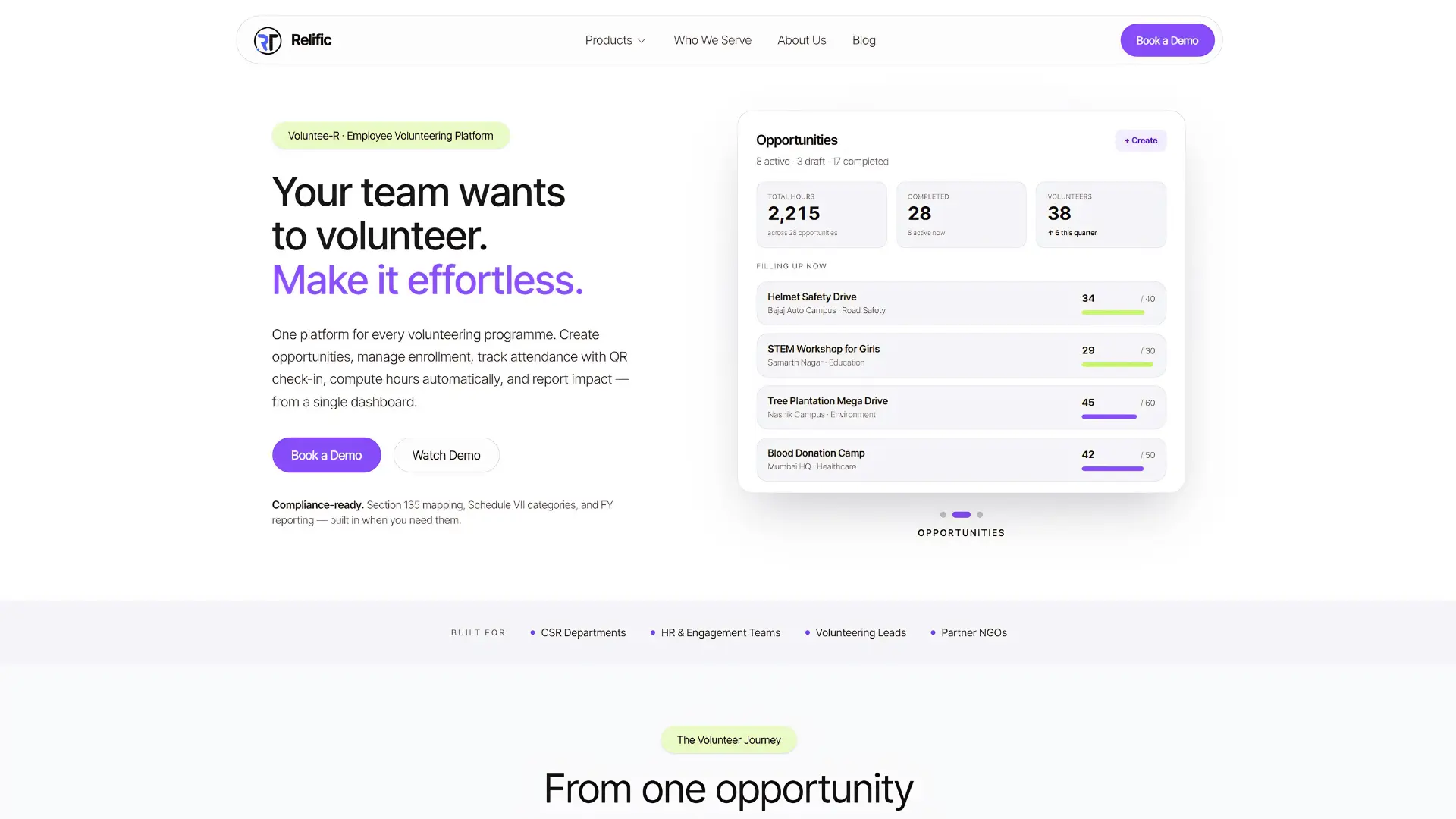
Voluntee-R was built around the Indian checklist rather than adapted to it. On event day, the lead displays a QR code, volunteers scan it, check-in and departure are recorded, and hours are computed from the timestamps. Every opportunity maps to one of 12 Schedule VII cause categories at the point of creation, roll-ups follow the April–March year, and participation is tracked organisation-wide with department-level breakdowns.
Social Impact Value runs at a configurable hourly rate, ₹500 by default, and the platform treats it as an engagement metric rather than statutory spend. Given everything above, that framing matters more than the calculation. Role-based permissions, approval workflows, and audit logging keep numbers traceable, with partner NGOs linked for the compliance trail. Relific holds ISO/IEC 27001:2022 certification with GDPR-aligned data handling, and its assistant, AI-R, drafts participation summaries for board review.
If your remit runs wider than volunteering, hours flow into ProGran as a recorded in-kind contribution against the programme, which is a stewardship and reporting record rather than monetised CSR expenditure, while Surve-R handles beneficiary outcome measurement.
Best for: Indian companies and foundations wanting compliant volunteering alongside programme and impact reporting in one system.
Watch-outs: If your main requirement is global donation matching across dozens of currencies and you have no India compliance obligation, a giving-first global suite covers more of that ground.
2. Goodera: Managed, Host-led volunteering
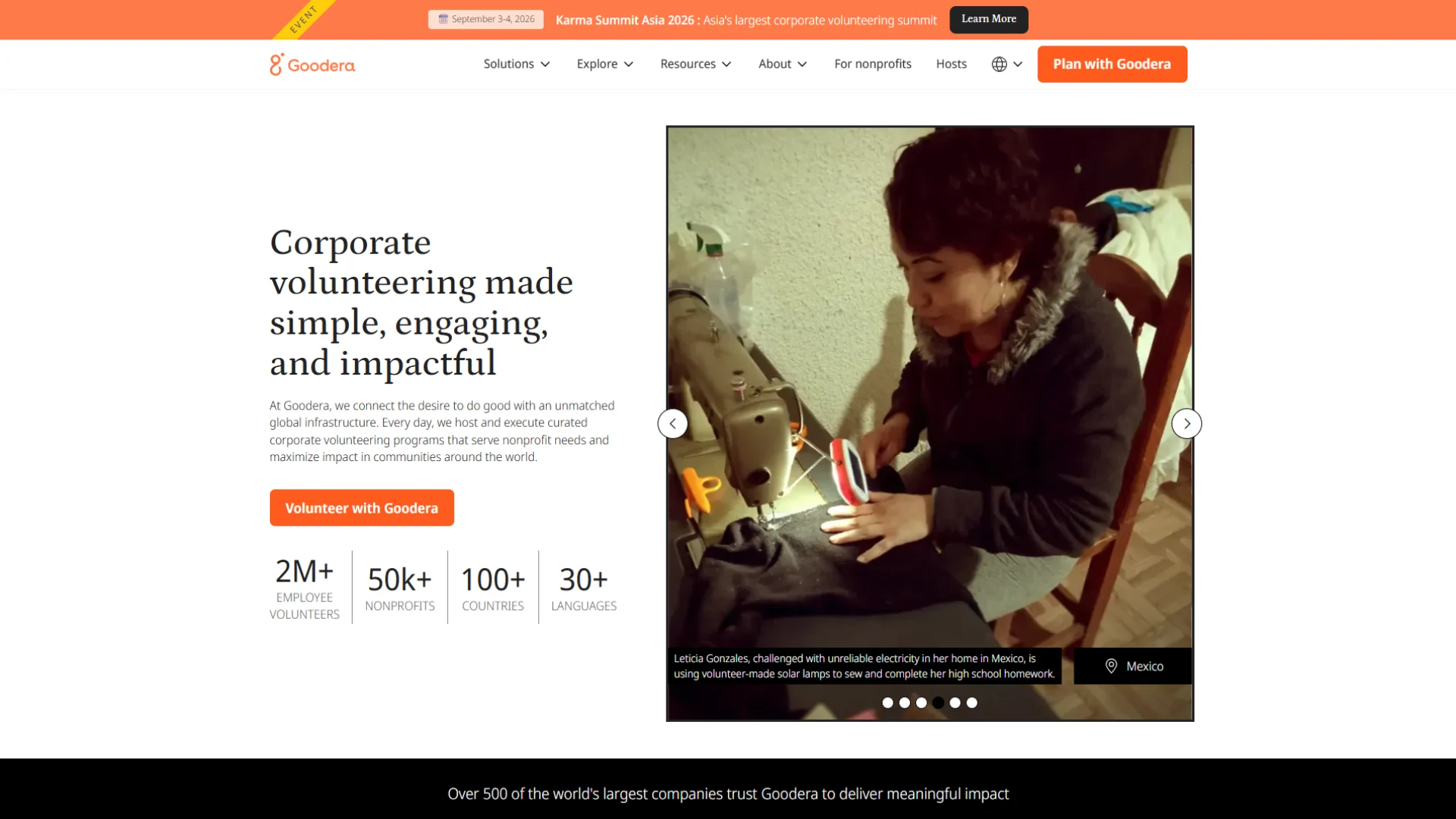
Goodera runs volunteering as a delivered service rather than a self-serve tool. It executes host-led experiences in 100+ countries, each event led by a trained Goodera emcee, and handles planning, host mapping, nonprofit alignment, materials and execution. The company reports 400+ customers including around 60 Fortune 500 firms, and says it engaged more than 450,000 volunteers across over 10,000 events in 2025. Indian-founded, now US-headquartered.
Best for: Teams who want events delivered end-to-end with minimal internal lift, particularly across time zones.
Watch-outs: A managed-service model is heavier and less configurable than a platform, and the value sits in the events rather than the compliance layer. Check Schedule VII categorisation depth and financial-year reporting if you file under Section 135.
3. Metta Social: India-native CSR and engagement suite
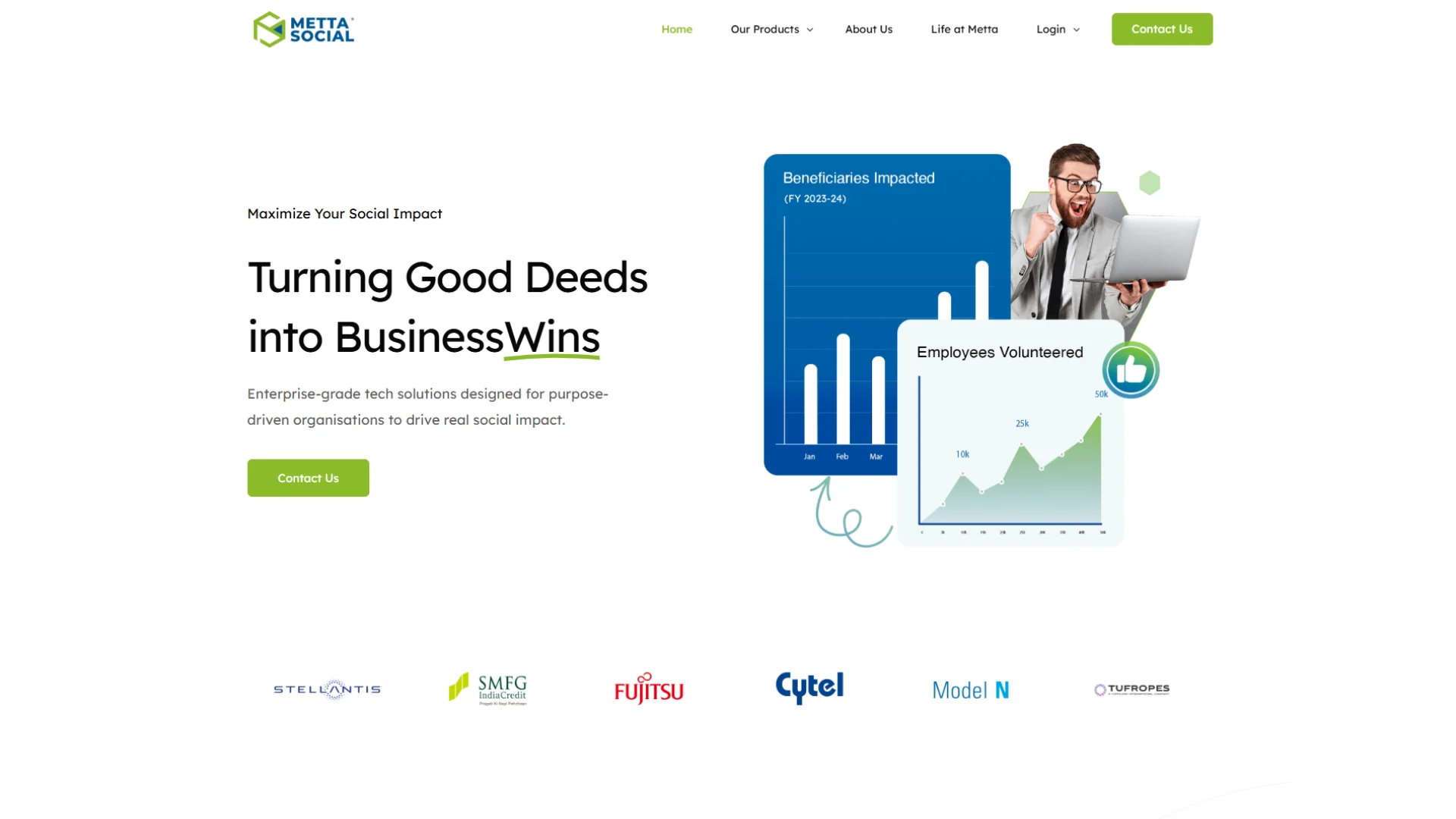
Pune-based Metta Social runs a modular suite: Socio-XN for CSR management, Engage-XN for employee volunteering, iGiv-XN for employee giving, Impact-XN for NGOs, and MSData-Co for field data. It operates in India, the Philippines, the UK, and Europe. Built in India, so the compliance context is understood, and a sensible fit where volunteering sits beside payroll giving and broader corporate citizenship work.
Best for: Indian companies wanting volunteering bundled with CSR management and employee giving.
Watch-outs: Broad suites can be shallow in any single module. Test the volunteering specifics against a dedicated tool, particularly verified attendance, department analytics and audit trail.
4. SoulAce: delivery partner with a platform attached
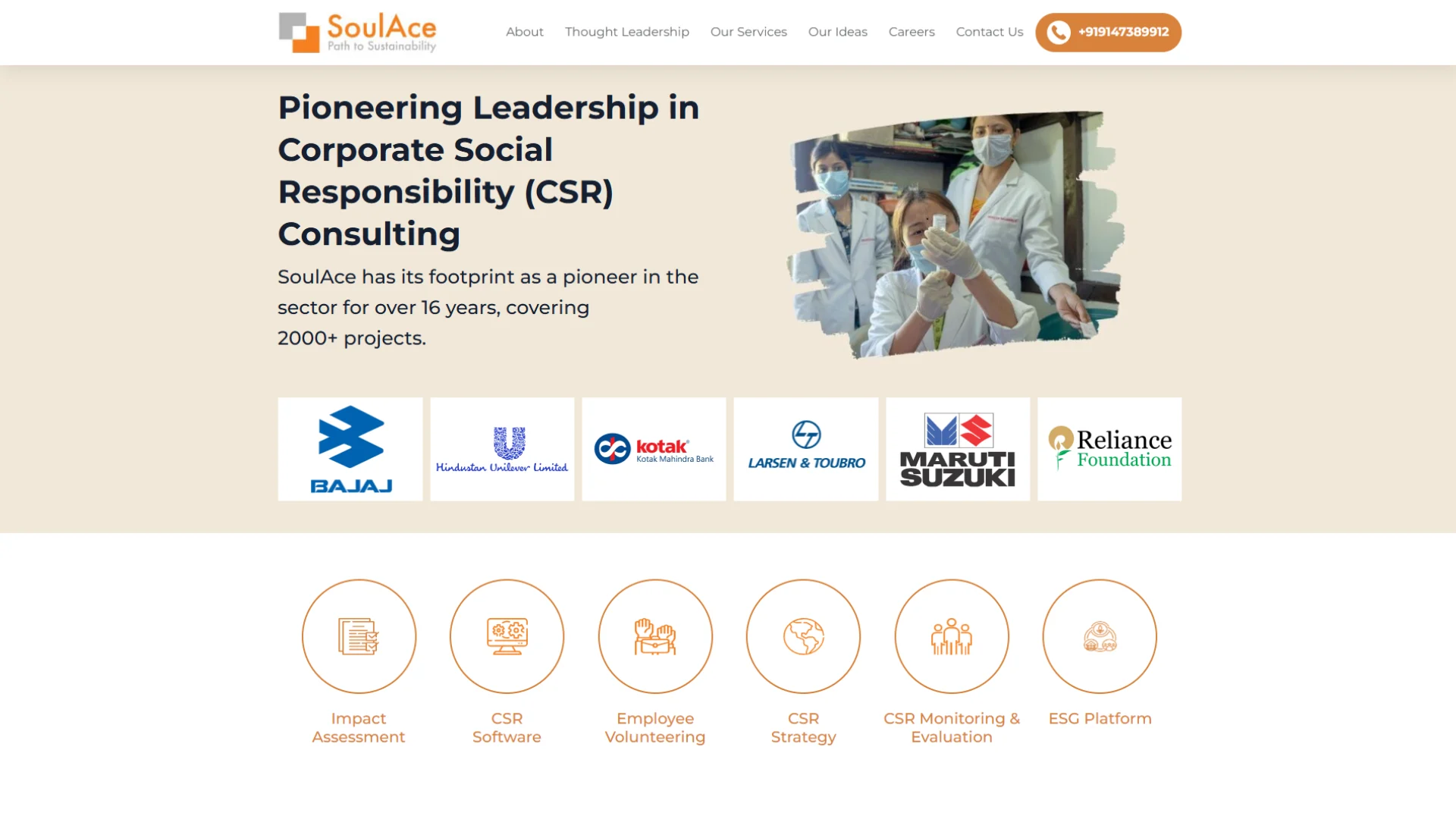
SoulAce has worked with Indian public and private sector enterprises on employee volunteering for over 15 years, pairing a grassroots NGO network with its own technology. It sits closer to a delivery partner than a pure SaaS product, which suits companies whose harder problem is sourcing credible implementation partners rather than building a dashboard. Relific has published a direct comparison of Relific and SoulAce for buyers weighing both.
Best for: Companies needing NGO sourcing and on-ground delivery alongside tracking.
Watch-outs: Evaluate the platform layer separately from the services layer, and confirm you retain your own data and audit trail if the relationship ends.
5. iVolunteer: opportunity supply and volunteer experience
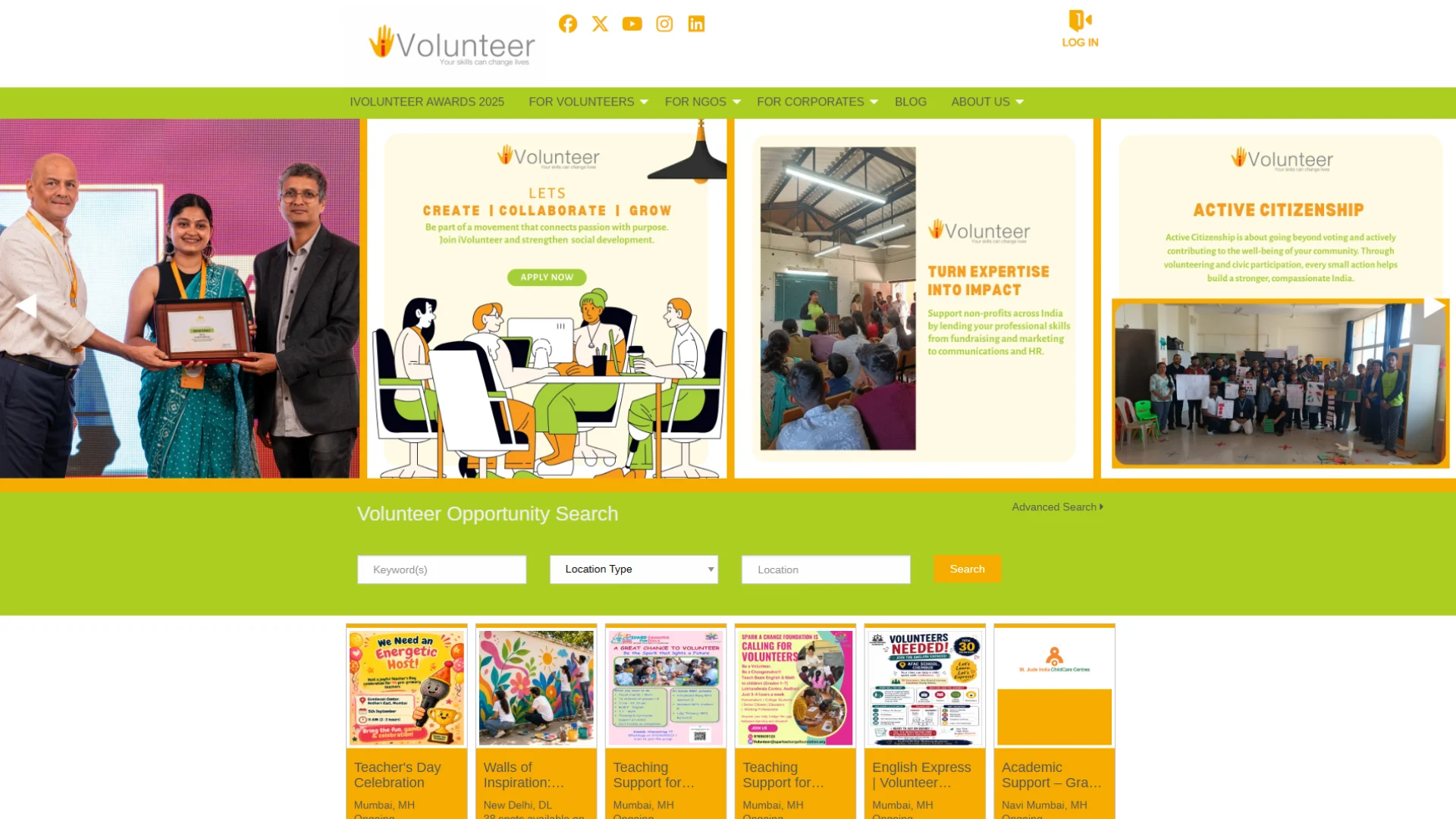
iVolunteer is among India's longest-running volunteer engagement organisations, with a large NGO partner network and packaged employee volunteering programmes sized from small teams up to conglomerates. Its strength is the supply and quality of opportunities rather than statutory reporting depth. Its market-position claims are self-described, so treat them as you would any vendor's.
Best for: Companies whose bottleneck is finding credible, varied opportunities rather than reporting them.
Watch-outs: Confirm what compliance-grade reporting you get out, and how attendance is verified at each event.
6. Benevity: the global enterprise standard
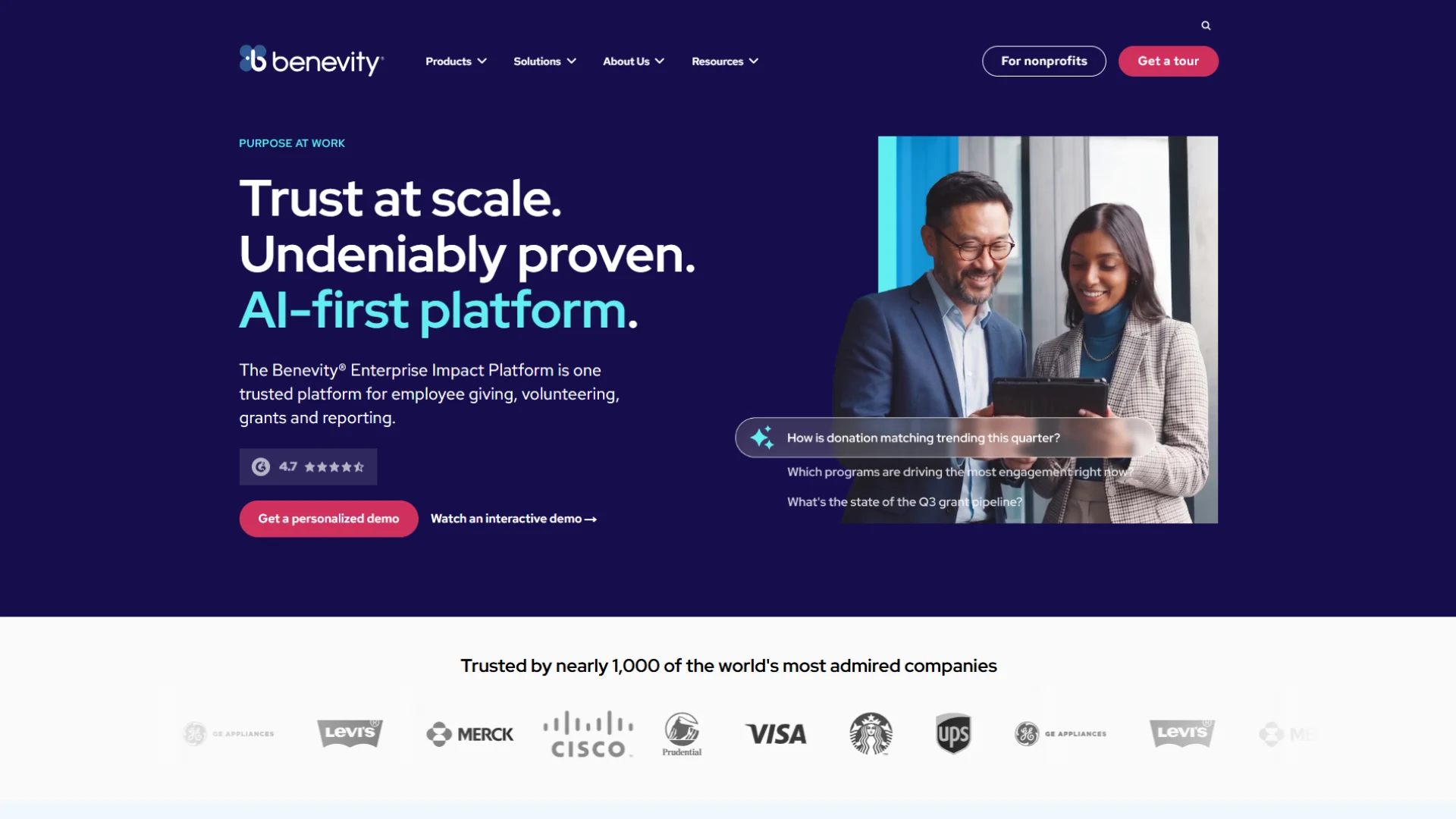
Benevity is the category leader in enterprise social impact software, having channelled more than $44 billion to over 560,000 nonprofits since 2008. Its volunteering module automates sign-ups and time tracking, supports volunteer grants, and reports engagement in real time. For a multinational already standardised on Benevity, extending into India is the path of least resistance.
One thing to know before you shortlist: Alaya, the employee engagement platform Benevity acquired in 2021, sunsets on 15 December 2026, with customers migrating to Benevity's main Employee Engagement platform. Several 2026 buying guides still list Alaya as a live standalone option. If yours does, it has not been checked this year.
Best for: Large global enterprises wanting one platform across every market.
Watch-outs: Enterprise-tier custom pricing, and India specifics such as Schedule VII tagging, CSR-2 detail and the April–March cycle typically need configuration or a supplementary tool. Some users report integration and data-sync friction.
7. YourCause CSRconnect by Blackbaud: giving, volunteering and grants together
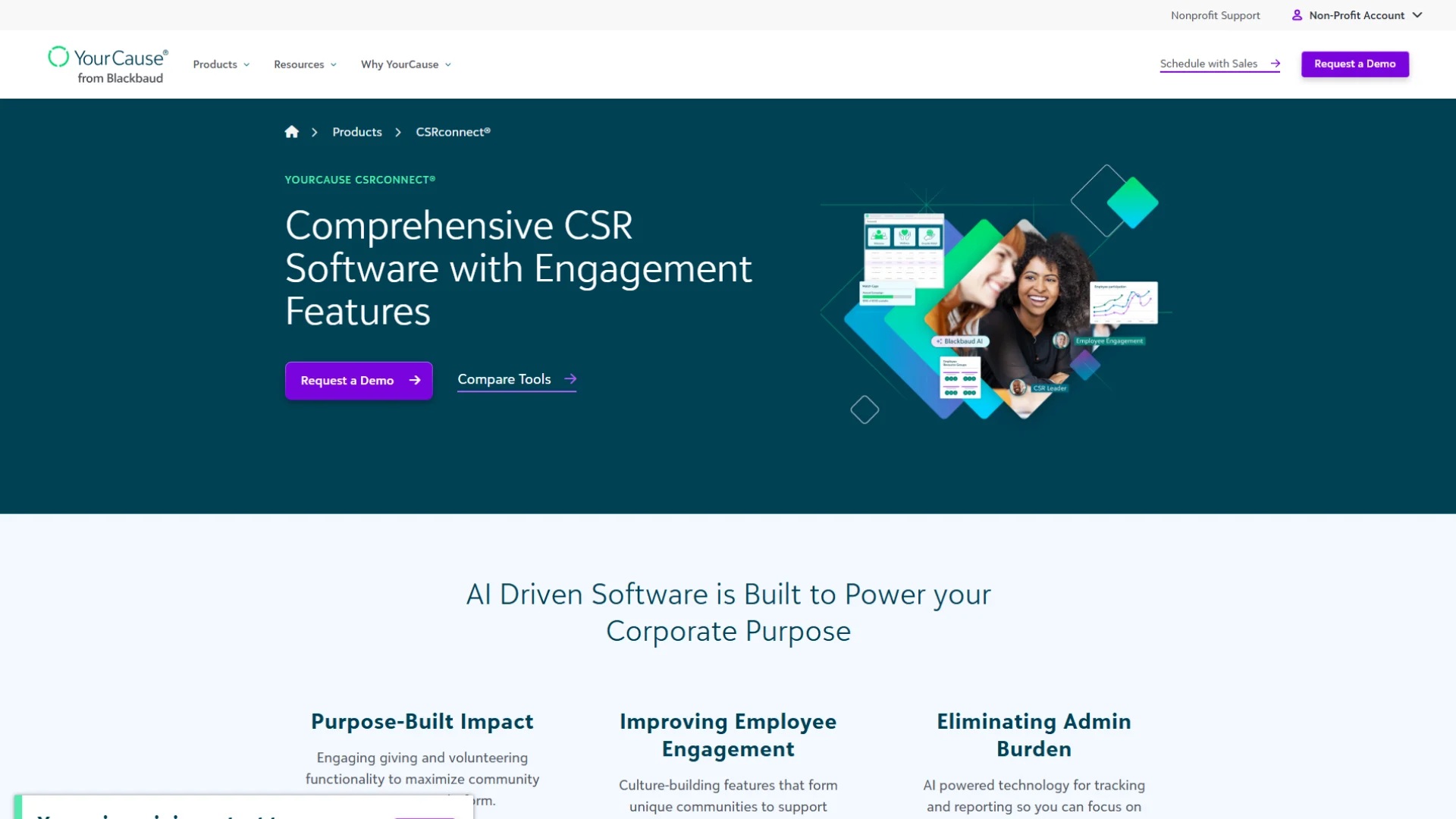
CSRconnect combines employee volunteering, giving, matching gifts and employee resource groups, with hour tracking for one-time, recurring and skills-based work, support for 26 languages, and AI-assisted reporting through Impact Edge. A mature full-suite option where giving and volunteering need to live under one roof.
Best for: Companies prioritising a combined giving-and-volunteering experience with deep reporting.
Watch-outs: Users at large organisations have described campaign configuration as needing meaningful time and internal expertise, so budget for admin enablement rather than assuming self-serve. Confirm Indian statutory reporting fit before committing.
8. Chezuba: accessible entry point with a broad catalogue
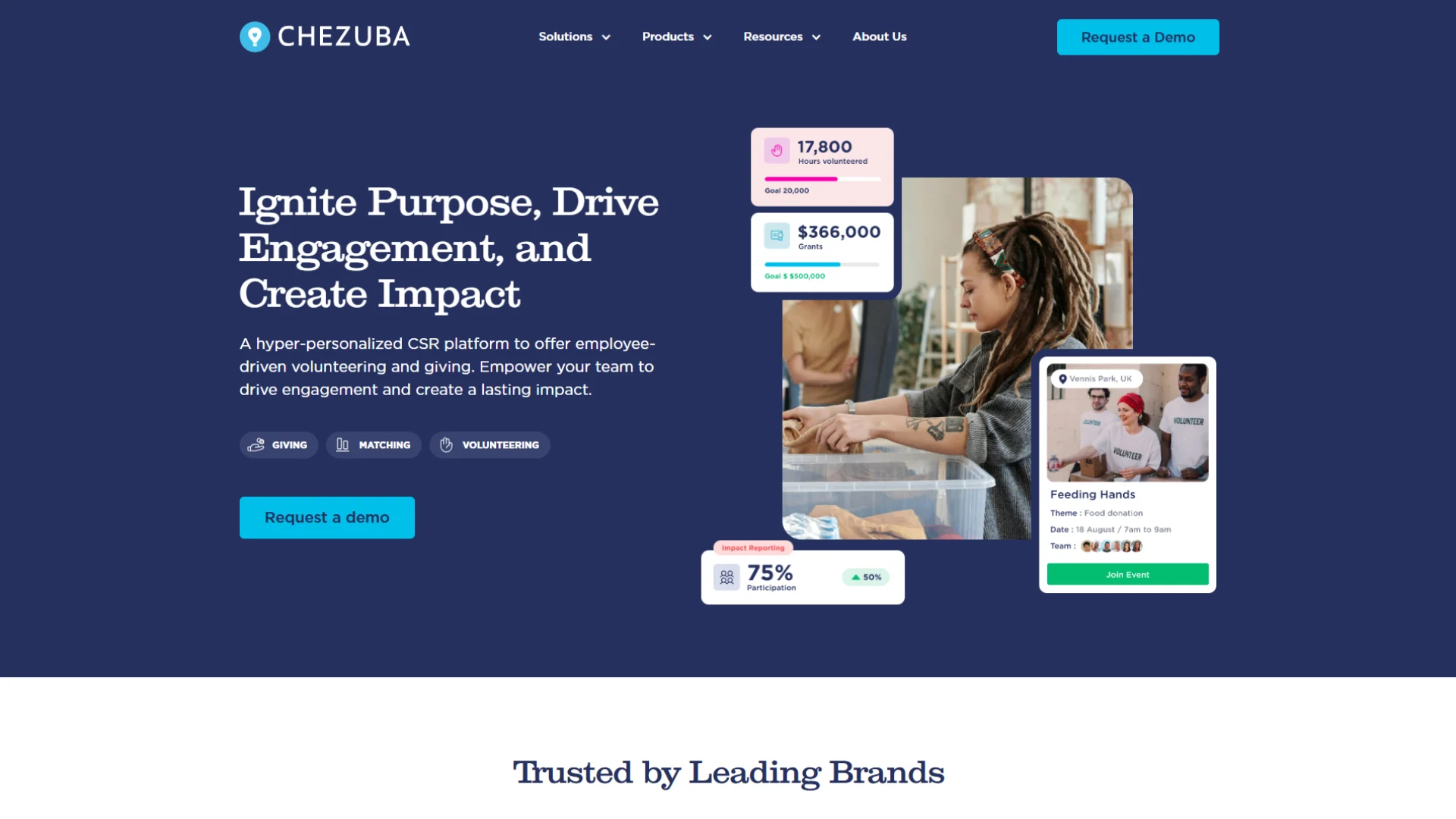
Chezuba supports volunteering discovery, participation and tracking across many countries, including skills-based and virtual formats, and is positioned toward affordability. It is one of the few in this list with public pricing signals: G2 lists plans starting around $1 per employee per month, with custom builds from roughly $5,000 a year. It has been used to source skill-based projects for large Indian programmes, including Tata's ProEngage.
Best for: Smaller teams and first programmes that need a wide opportunity catalogue without enterprise pricing.
Watch-outs: Confirm the depth of Schedule VII categorisation, verified attendance and audit trails before relying on it for Section 135 filing.
The Business Case, With The Caveats Intact
Budgets moved because the retention data held up.
Benevity's Talent Retention Study analysed more than 10.6 million platform users across over 400 companies and found a 52% lower turnover rate among newer employees, defined as 2.5 years' tenure or less, who took part in corporate purpose programmes. Read that next to Gallup's estimate that replacing one employee costs between one-half and two times annual salary, and the arithmetic gets attention in a CFO meeting.
Deloitte's June 2024 survey of 1,000 US office professionals found 95% thought it mattered that their employer had a positive community impact, and 87% treated workplace volunteer opportunities as a factor in staying or leaving.
Now the honest part, which most articles on this topic omit. The Benevity figure comes from one vendor's platform population, which skews toward companies already investing in purpose programmes, and it shows association rather than causation. The Deloitte sample is US office professionals. Both are useful for building a case. Neither is an Indian benchmark, and no credible Indian dataset of comparable scale currently exists. If you are presenting these numbers to an Indian board, present them as directional evidence from overseas, not as a forecast for your workforce. That framing survives the first sceptical question. The alternative does not.
The India Checklist For Evaluating Platforms
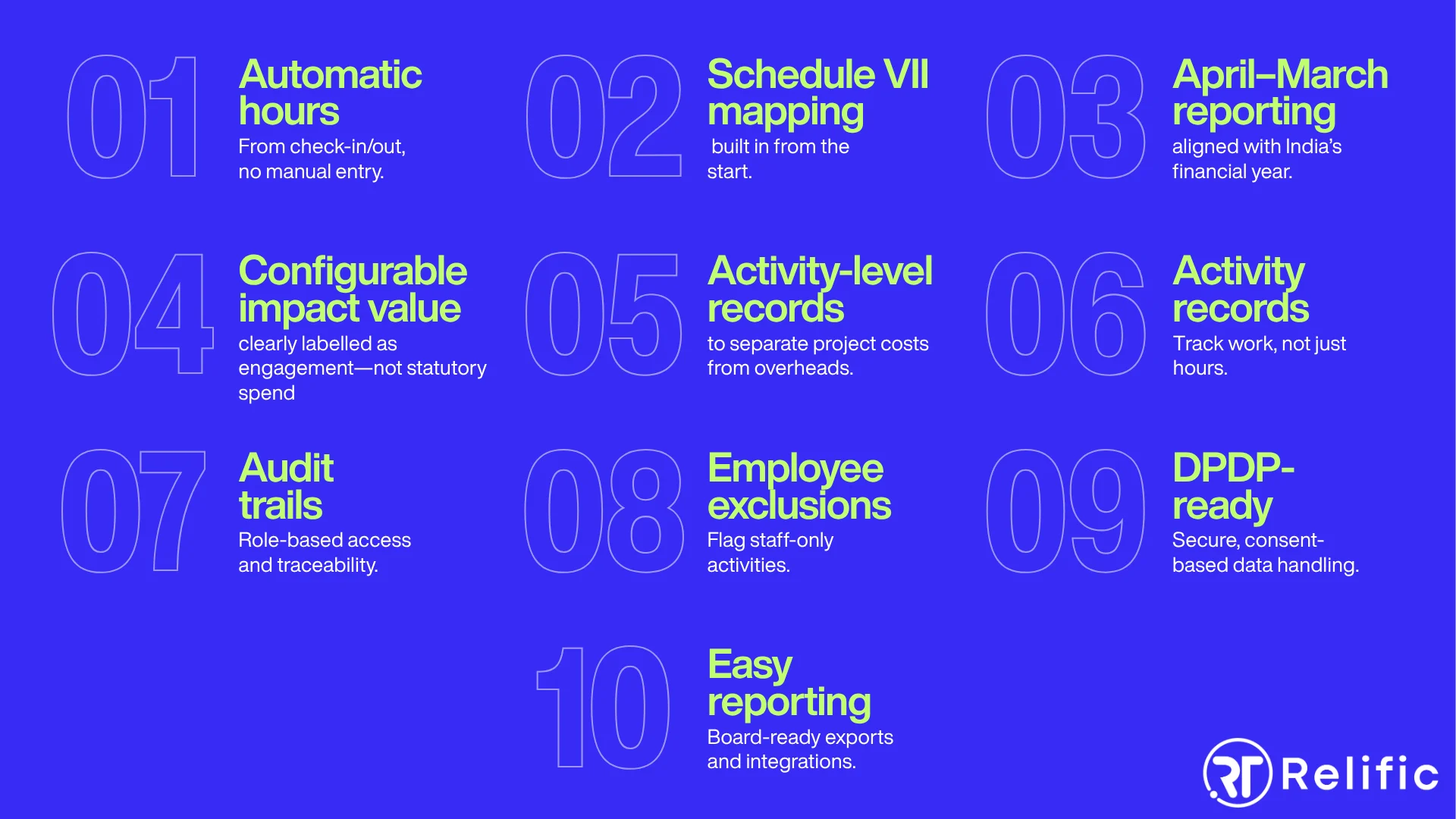
Global tools are usually strong on donation matching and thin on everything Section 135 requires. Test any platform against this before you commit.
- Verified check-in: QR or geo-tagged, so hours are timestamped rather than self-declared.
- Automatic hour computation from check-in and check-out, with no manual entry step in between.
- Schedule VII mapping at creation: Categorisation built into the opportunity, not retrofitted in March.
- April–March reporting: Not the January-to-December cycle inherited from a US product.
- Configurable impact value, correctly labelled: Any notional rate should be yours to set and framed as engagement, never as statutory spend.
- Activity-level records, not just totals: What each person did, not only how long they were there. This is what supports the project-cost versus overhead call.
- Role-based access and audit trails, so every number traces to who recorded it and when.
- Employee-benefit exclusion handling, so staff-only activities are flagged rather than counted.
- Certified security and DPDP-ready handling: ISO/IEC 27001 or equivalent, with consent, retention and deletion controls.
- Board-ready export and integration with your HR, finance and identity stack, and with programme data.
If you keep one row, keep the first. Without verified check-in, every total is an estimate, and estimates do not survive an audit.
How To Choose Without Overbuying
The failure modes are predictable: choosing on feature count, skipping the trial, underestimating change management. Work through these in order, because the sequence does more work than the list.
Name the dominant goal first: Employee engagement, statutory compliance, impact measurement, or an integrated system. This single decision removes most of the market.
Filter on four capabilities: Verified check-in, automatic hour computation, Schedule VII mapping at creation, April–March reporting. Ignore the long tail until these are settled.
Check it fits the stack: It has to work with the HR, finance and identity systems already running. Every manual export is a future error and a gap in the audit trail.
Test with real users: Move from demo to trial and put it in front of CSR, HR, finance and IT. If it is not intuitive, it goes unused, whatever the feature list promised.
Pressure-test the output, not the demo: Load a real programme, run a real report, then ask whether that report answers an auditor's question about how the 5% overhead line was arrived at. This is where polished demos and working software separate.
Evaluate the vendor: Onboarding quality, support responsiveness, and a roadmap that tracks shifting SEBI and MCA requirements matter as much as today's features.
Roll out in stages: One region or function, refine the workflow, then scale. Staged rollouts surface problems while they are still cheap and build the internal trust that drives adoption.
The software is rarely why a rollout fails. Adoption is.
Common Tracking Mistakes
- Treating notional impact value as CSR spend. It is an engagement figure and never satisfies the 2%.
- Citing withdrawn circulars. The 2014 volunteer-salary clause was omitted in September 2014 and superseded in 2021.
- Relying on self-reported hours. Without verified check-in, every total is an estimate.
- Recording duration without activity. Hours alone cannot support the project-cost versus overhead classification.
- Skipping Schedule VII mapping at creation. Untagged activities mean retrofitting categories under year-end pressure.
- Counting employee-only activities. Anything designed solely for staff and their families is excluded under Rule 2(1)(d)(iv).
- Losing the audit trail. An untraceable number becomes a liability the moment it is questioned.
- Drifting across the April boundary. Multi-day events and the financial-year cut-off are where totals quietly double-count.
- Ignoring DPDP obligations. Volunteer records are employee personal data, with consent and retention duties attached.
Where This Leaves Indian CSR And HR Teams
Employee volunteering in India now sits inside a statutory regime and shows up in board reviews, ESG disclosures and audit questions. Spreadsheets record activity. They cannot prove it.
No software changes what the law counts. Nothing makes the notional value of volunteer time eligible against your 2%, and a vendor implying otherwise is selling you a compliance risk with a dashboard on top. What the right platform does is narrower and considerably more useful: it makes hours verifiable, categorisation clean at the point of entry, and the record defensible when a CSR committee, a statutory auditor or an assurance provider asks how you know.
To see how verified hours, Schedule VII categories and financial-year reports line up in one place, you can book a Voluntee-R demo or start a free trial.
Frequently Asked Questions
No. The notional value of volunteer time is not recognised toward the Section 135 obligation, and MCA's 2021 CSR FAQs state that employee involvement in CSR projects cannot be monetised. What can be classified is actual employee cost. CSR-division salaries fall under administrative overheads, capped at 5% of total CSR expenditure, while cost directly attributable to designing, implementing, monitoring or evaluating a project sits in uncapped project cost.
It was true for three months in 2014 and is not true now. Clause (iv) of General Circular 21/2014 said so on 18 June 2014, General Circular 36/2014 omitted it on 17 September 2014, and General Circular 14/2021 superseded both.
It depends on the dominant need. For Section 135 compliance with verified hours and financial-year reporting, an India-first platform such as Voluntee-R by Relific fits closely. For fully managed events, Goodera. For a multinational already standardised globally, Benevity or YourCause CSRconnect. For a small first programme on a tight budget, Chezuba. Feature count is a poor tiebreaker; adoption and reporting output are better ones.
Capture them at the event with verified check-in, QR or geo-tagged, and compute hours from the timestamps. Record what the person did as well as how long they were there, because activity is what supports the cost classification later.
Volunteer identity and department, activity and partner organisation, Schedule VII category, verified check-in and check-out times, location, approval status and financial year. Hours should be derived from timestamps rather than typed in.
Indirectly. There is no mandatory volunteer-hours line in BRSR, and volunteer hours are not a BRSR Core KPI. Community engagement and CSR detail sit within BRSR's Principle 8 disclosures, and with BRSR Core assurance reaching the top 1,000 listed entities from FY2026-27, structured records make those social disclosures far easier to support.
No. Complexity justifies the investment, not headcount. One annual drive is manageable on a spreadsheet. Volunteering across multiple campuses, partners and Schedule VII categories, with BRSR duties attached, outgrows manual tracking inside a year.
Yes. It holds employee personal data, often including location and photographs. The DPDP Rules were notified in November 2025, and full substantive compliance is due by 13 May 2027, so consent, retention limits, security safeguards and breach reporting all apply.