
Key Takeaways
- Misalignment is the real burden. A short report asking for custom, untracked metrics takes longer to complete than a multi-page narrative that mirrors a nonprofit’s existing workflow.
- Activities are not outcomes. Good reporting measures what actually changed, anchoring results to a predefined theory of change rather than just counting how many sessions were run.
- Compliance is a design constraint. As of June 2026, India's FCRA 2.0 mandates exact activity, location, and project-wise spend mapping. Foundations funding Indian NGOs must align their reporting with these rules to prevent duplicate work.
- Technology solves the extraction problem. Moving from static PDF uploads to structured, field-level data collection using platforms like Relific turns reports into aggregatable portfolio insights.
- Standardisation reduces friction. Trust-based philanthropy is driving the adoption of shared, universal reporting formats across multiple funders.
Ask ten grantees what they think of a foundation’s reporting process, and you will hear the same exhausted sigh: it takes too much time for too little value. Ask ten program officers, and the response flips: we need the data to know the funding actually did something.
Both sides are right. That inherent tension is why designing a grant report is one of the most consequential operational decisions a philanthropic foundation makes.
For decades, foundations built reporting templates the way governments build tax forms, adding a new field every time a board member or program officer wanted a specific data point. The result is a compounding administrative tax. Grantees spend weeks reconstructing data they have already reported to three other funders in three completely different formats.
While the philanthropic sector has made measurable progress in reducing this friction, cutting the word count is not enough. Fixing grantee reporting requires a fundamental shift in what funders ask for, how they collect it, and the technology they use to manage it.
What Is Grantee Reporting Burden?
Grantee reporting burden refers to the administrative friction, staff time, and operational costs required for a nonprofit to fulfil a funder's post-award data requirements. It typically occurs when funders demand bespoke formats, irrelevant data points, or a reporting cadence that doesn't match the grant's size.
The Centre for Effective Philanthropy (CEP) has been tracking this issue closely. According to their Nonprofit Voice Project data, 65% of nonprofits note that their funders have made commitments to streamline requirements. Time spent on reporting has trended downward since 2020.
However, this burden is rarely distributed evenly. A well-resourced nonprofit with a dedicated grants manager can muscle through a clunky reporting cycle. A grassroots organisation of five people cannot. Heavy, customised reporting requirements disproportionately penalise smaller, under-resourced groups, diverting critical staff hours away from actual program delivery.
What Foundations Should Actually Ask For
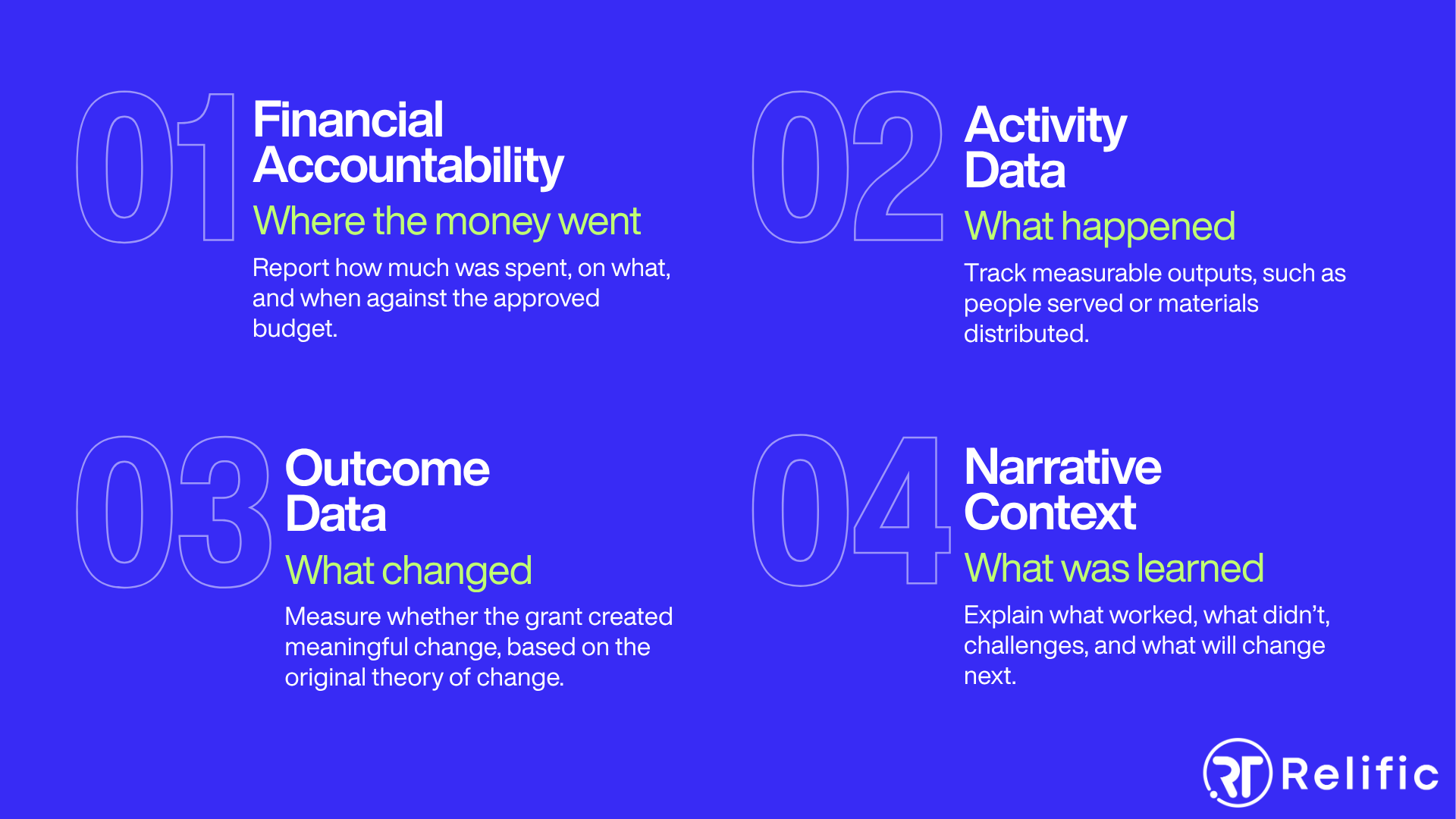
Strip away the philanthropic jargon, and an effective grantee reporting framework requires only four specific categories of information.
1. Financial Accountability (Where the money went)
This is the non-negotiable core of any grant report. Regulators and foundation boards require basic fund utilisation data: the exact amount spent, against which approved budget line, during what specific period.
2. Activity Data (What actually happened)
These are the quantifiable outputs of the grant. How many people were served? How many training materials were distributed? Foundations frequently over-collect in this category because activities are easy to count, even though they rarely indicate actual impact.
3. Outcome Data (What changed)
This is the most valuable and difficult layer of reporting. Did the funded activity actually move the needle? To measure this accurately, outcomes must be tied to a theory of change established at the start of the grant, not invented retroactively when the report is due.
4. Narrative Context (What was learned)
Trust-based funders heavily prioritise this qualitative layer. What assumptions proved incorrect? What operational hurdles appeared? What will the grantee do differently next quarter? Good grant reports create a safe space for course correction, rather than treating the narrative section as a PR exercise where the grantee only lists successes.
The Proportionality Rule
The most common mistake funders make is requiring all four layers with equal intensity, regardless of context. A $5,000 rapid-response grant does not require the same quarterly scrutiny as a three-year, $500,000 general operating grant. Treating them identically is bad grantmaking.
Measuring What Matters: Moving From Activities To Outcomes
The single most impactful upgrade a foundation can make is shifting its reporting gravity from activities to outcomes.
"We ran 40 literacy workshops" is an activity. It is easy to verify, but it reveals nothing about effectiveness. "70 out of 100 participants improved their reading comprehension by two grade levels" is an outcome.
One structured method to quantify this shift is Social Return on Investment (SROI). While the baseline formula is straightforward (Net Present Value of Outcomes divided by Total Investment), the discipline behind it requires mapping inputs to exact outcomes before the grant even begins. You can review a complete walkthrough of this methodology in Relific's How to Measure Social Return on Investment (SROI): The 2026 Guide.
The India Context: How FCRA 2.0 Forces A Reporting Redesign
For foundations operating in or funding organisations within India, reporting requirements cannot be designed in a vacuum. The regulatory environment has fundamentally shifted.
The Foreign Contribution (Regulation) Amendment Rules, 2026, notified on June 22, 2026, introduce aggressive new compliance mandates for Indian NGOs. The revised annual return (Form FC-4) now requires organisations to map every single project, activity, and operating location directly to exact expenditures, including specific asset purchases and administrative overhead. Furthermore, the rules mandate tracking ultimate donor details and enforcing a minimum utilisation threshold of ₹10 lakh to prove "reasonable activity".
For foundations, this is a hard design constraint. If your foundation's grant report requires activity-level, location-tagged financial data, you are asking for the same data the grantee must now produce for the government. Aligning your internal reporting fields with FC-4 requirements actively reduces the grantee's total compliance burden. Asking them to slice that same financial data in a different, bespoke format actively hurts them.
How Technology Fixes The Reporting Equation
Reporting friction is rarely just a design flaw; it is usually an infrastructure failure. Even a perfectly designed grant report creates massive administrative drag if it has to be submitted as an email attachment and manually re-keyed into a spreadsheet.
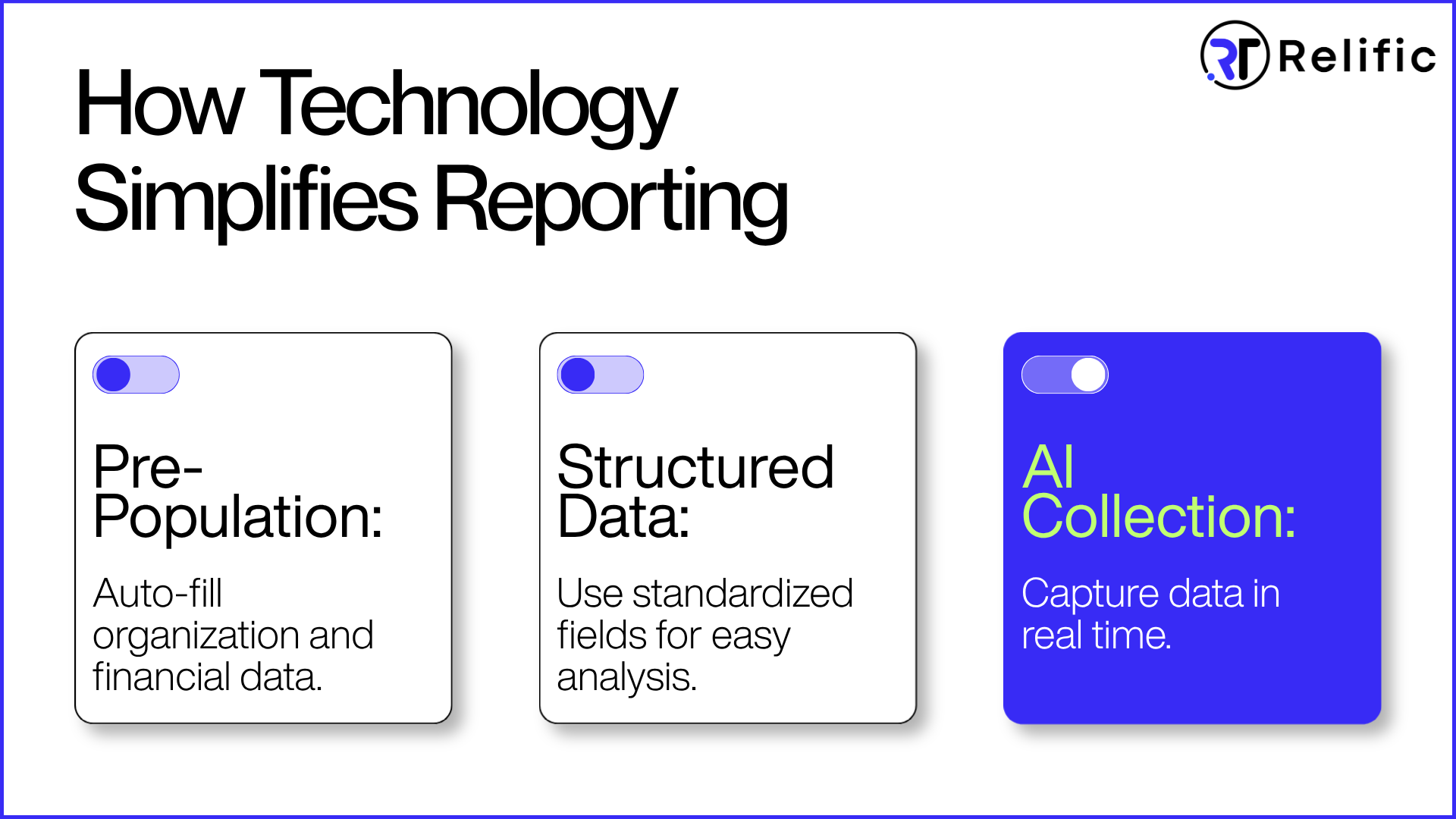
Modern grant-management technology removes this friction in three ways:
- Pre-population: Integrating with external vetting databases (like Candid GuideStar) allows platforms to pull an organization's basic profile and financial history automatically, killing duplicate data entry.
- Structured data: Collecting data in structured fields rather than free-text PDFs means the report instantly becomes an aggregatable dataset. Funders can instantly spot portfolio-wide trends without manual extraction.
- AI-assisted field collection: Instead of grantees reconstructing data six months later, field-level tools capture activity data as it happens at the point of service delivery.
This operational reality is exactly why Relific built its suite of tools.
- Surve-R captures structured field data accurately in real-time.
- Volunte-R coordinates volunteer efforts and automatically tracks contribution hours and field activity data as they happen.
- ProGran manages the complete program and grant lifecycle. When run through a unified system, a grantee’s reporting ceases to be a retroactive administrative chore; it simply becomes a byproduct of the work they are already doing.
Standardising Without Flattening
One of the clearest shifts in modern philanthropy is the move toward shared reporting formats.
Instead of a bespoke form for every grant, progressive funders are adopting unified templates. The Women’s Foundation of Minnesota introduced a single annual grant report in 2025 used by every grantee-partner. At a broader level, initiatives like Minnesota's Common Grant Working Group allow nonprofits to submit standardised data across multiple state funders.
Standardisation works because it stops grantees from rebuilding their data from scratch every cycle. When nonprofits know exactly what questions are coming, they can build their internal tracking systems to match.
A Funder’s Reporting Checklist
Before finalising your next reporting cycle, audit your framework against these criteria:
- Right-sized: Do the requirements scale appropriately with the grant's size and duration?
- Consistent: Does the foundation use one core reporting format across its entire portfolio?
- Anchored: Are outcomes measured against a theory of change established before the money moved?
- Aligned: Does the report ask for data the grantee already tracks in their own internal systems?
- Structured: Is data collected in aggregatable platform fields, rather than static PDF uploads?
- Compliant: Does the data structure respect local regulatory burdens (such as FCRA 2.0 for Indian NGOs)?
Conclusion
Redesigning grantee reporting is ultimately about aligning intent with infrastructure. Foundations do not have to choose between operational rigour and respecting grantee capacity they simply need to stop asking for custom data that serves neither side. By anchoring requirements to clear theories of change, aligning formats with local regulatory realities like FCRA 2.0, and adopting modern tools that collect structured data at the point of service, funders can eliminate administrative drag while gathering far richer portfolio insights.
When a grant report reflects how a nonprofit actually operates rather than forcing them to reconstruct their work for a bespoke form, reporting ceases to be an administrative tax. It becomes what it was always meant to be: a shared mechanism for learning, course correction, and driving measurable impact.
Frequently Asked Questions
A grantee report is a formal update a nonprofit submits to a funding organisation, detailing how grant funds were spent, what activities took place, and what outcomes were achieved during a specific period.
Asking for custom metrics the grantee does not already track internally. This forces nonprofits to invent new measurement systems and divert staff time just to satisfy a funder's form, which is the primary source of reporting burden.
Reporting cadence should match the grant size and risk profile. Rapid-response or micro-grants typically require only a single closing report. Multi-year operating grants benefit from annual check-ins rather than burdensome quarterly updates.
Notified in June 2026, the FCRA 2.0 amendments require Indian NGOs to provide highly granular data in their Form FC-4 annual returns. This includes mapping exact expenditures to specific project activities and geographic locations, reporting ultimate donor details, and detailing immovable asset purchases.
Activities are the outputs of a program (e.g., meals served, workshops hosted, trees planted). Outcomes are the actual changes resulting from those activities (e.g., improved health metrics, job placements, increased local biodiversity).
Modern grant management systems eliminate duplicate manual entry through database integrations, replace static PDF uploads with structured data fields, and capture programmatic data at the point of service delivery so it does not have to be reconstructed months later.
Trust-based philanthropy shifts the reporting dynamic from strict compliance to mutual learning. It advocates for streamlined, standardised formats, accepting reports the grantee has already written for other funders, and focusing conversations on challenges and learnings rather than just proving success.