
Key Takeaways
- Form CSR-1 registers an entity with MCA as a CSR implementing agency; companies need its CSR Registration Number to route projects through it.
- Eligible entities: Section 8 companies, registered public trusts and societies holding 80G plus 12A or 10(23C); government-established entities; and statutory bodies.
- Independent NGOs need three years' track record in similar activities, which differs from being three years old; entities established by companies or governments are exempt.
- The rules set no validity period for the CSR Registration Number, but eligibility fails if the underlying 12A, 10(23C) or 80G status lapses.
- MCA takes CSR-1 on file based on statements by the applicant and certifying professional; registration is not due diligence on capacity.
- Since 14 July 2025, the revised CSR-1 captures the exact tax category, directors or trustees, and key office-bearers; MCA says existing registrants need not re-file.
- NGO Darpan is not required for CSR-1, and the form has no Darpan field; its Unique ID matters mainly for government grants.
- From 1 April 2026, 12A and 80G became sections 332 and 354; earlier approvals continue, though the CSR Rules still cite the 1961 Act.
A CSR Registration Number looks like CSR00001263. The rules do not provide for an inspection or a hearing before one is issued: under Rule 4(2)(c) of the Companies (CSR Policy) Rules, 2014, the MCA system generates the number automatically when Form CSR-1 is submitted. The revised form says it is taken on file "based on statement of correctness given by the authorised person and professional".
That design matters because of how much money moves through the entities holding these numbers. In a February 2026 written reply to the Rajya Sabha, the Ministry of Corporate Affairs reported CSR expenditure of ₹34,908.75 crore for FY 2023-24, based on company filings in the MCA21 registry; that was the latest financial year in the reply. On how that money is routed, the most recent government figure we found is older: in a November 2021 Lok Sabha reply, MCA said its analysis of filings showed roughly 60% of CSR spending going through implementing agencies rather than being spent by companies directly.
Put those facts together and the weak point becomes clear. Some NGOs present their registration as a credential. Some CSR teams treat it as proof that a partner has been vetted. It is neither. The number records that an entity declared itself eligible and a practising professional certified that declaration. Whether the entity is still eligible today, and whether it can deliver a particular project, are separate questions that the registration does not answer.
This guide covers both sides. It explains what an NGO needs to register, what changed with the July 2025 form and the Income-tax Act, 2025, where NGO Darpan fits, and how a company should check a partner before money moves.
Quick Answer: What Does an NGO Need for Form CSR-1 Registration?
An entity must first qualify under Rule 4(1) of the Companies (CSR Policy) Rules, 2014, in one of three ways:
- A charitable entity with tax approvals. This means a Section 8 company, registered public trust, or registered society holding 80G approval plus either 12A registration or a 10(23C) exemption. It must also have been established by a company, or have at least three years' track record in similar activities.
- A government-established entity. This means a Section 8 company, trust, or society set up by the Central or a State Government.
- A statutory body. This means a body constituted under an Act of Parliament or a State legislature to undertake Schedule VII activities.
The entity then files e-form CSR-1 on the MCA portal. The form is digitally signed by an authorised office-bearer and certified by a Chartered Accountant, Company Secretary, or Cost Accountant in whole-time practice. The system generates a unique CSR Registration Number. NGO Darpan registration is not a condition.
What Is Form CSR-1?
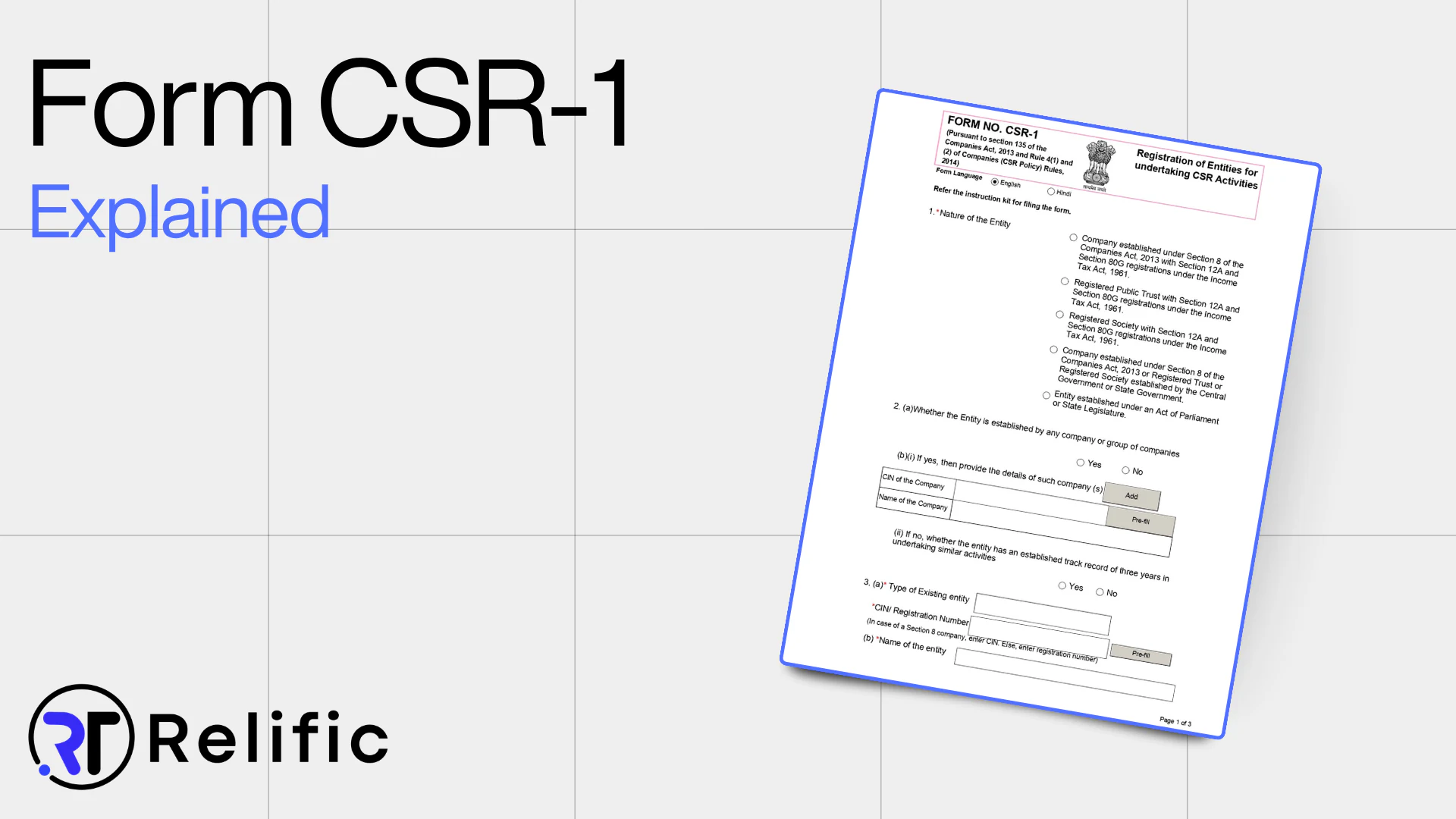
Form CSR-1 is the Ministry of Corporate Affairs e-form through which an entity registers with the Central Government to undertake CSR activities on behalf of companies covered by Section 135 of the Companies Act, 2013. Registration has been mandatory since 1 April 2021 under Rule 4(2).
Rule 4(2) sets three requirements. First, the entity must file the form electronically with the Registrar. Second, the form must be signed by the entity and digitally verified by a CA, CS, or Cost Accountant in practice. Third, the system generates a unique CSR Registration Number on submission.
The number then follows the agency into its funders' paperwork. For example, the FY 2024-25 CSR annual action plan of Deloitte Financial Advisory Services India lists each implementing agency's CSR Registration Number next to the project it runs.
Three things CSR-1 is not:
- Not a tax registration. That is 12A (now section 332) or 80G (now section 354).
- Not a licence to raise money from the public.
- Not evidence of performance.
What Does a CSR Registration Number Actually Prove?
It proves an entity declared a Rule 4(1) category, disclosed its governing office-bearers, and had a practising professional certify those particulars from its records. It does not prove capacity, financial health, current tax standing, or relevant experience.
MCA's reasons for the register are modest. In its FAQs on CSR (General Circular No. 14/2021), the Ministry said companies struggled to identify suitable implementing agencies. It said registering them on MCA21 would create a database companies could use and add accountability and transparency to implementation. By 31 October 2021, seven months after registration became mandatory, 17,130 agencies had registered, according to the same November 2021 Lok Sabha reply.
The certifying professional carries real responsibility. On the form, they certify that they verified the particulars and attachments from original or certified records, and they accept liability under Section 448 of the Companies Act for wrong certification. But the evidence behind some declarations never reaches the MCA. The form's only attachments are the certificate of registration and PAN. A "yes" to the three-year track-record question is not accompanied by supporting documents.
The CSR-1 Eligibility Stack
It helps to think of eligibility as five layers. The first four are legal. The fifth is the one funders actually care about, and no government form tests it.
|
Layer |
Question it answers |
Legal source |
What CSR-1 does with it |
|
1. Legal form |
Section 8 company, registered public trust, registered society, government-established entity or statutory body? |
Rule 4(1) |
Declared on the form and professionally certified |
|
2. Tax standing |
80G plus 12A or 10(23C), where required? |
Rule 4(1)(a) and (d) |
Declared at filing; the rules provide no later re-check |
|
3. Provenance or track record |
Established by a company, or three years in similar activities? |
Rule 4(1)(a) and (d) |
Declared as yes or no; no supporting attachment |
|
4. Registration |
Is the entity on MCA's record? |
Rule 4(2) |
This is the output: the CSR Registration Number |
|
5. Capacity |
Can it deliver this project, at this scale, with auditable evidence? |
The Board's duty under Rule 4(5) |
Not addressed |
Who Needs CSR-1 Registration, and Who Doesn't?
Any entity implementing CSR projects on a company's behalf needs CSR-1. A company implementing a project itself does not. The edge cases are where most of the confusion lies.
|
Situation |
CSR-1 needed? |
Basis |
|
NGO (trust, society or Section 8 company) implementing a company-funded CSR project |
Yes |
Rule 4(2); MCA FAQ 5.6 |
|
A company's own foundation, set up singly or with other companies |
Yes; no track record required, but tax conditions apply |
Rule 4(1)(a) |
|
Section 8 company, trust or society established by the Central or a State Government |
Yes; 12A and 80G not required |
Rule 4(1)(b); MCA FAQ 5.3 |
|
Statutory body constituted under an Act of Parliament or State legislature to undertake Schedule VII activities |
Yes |
Rule 4(1)(c) and its Explanation |
|
Company implementing a project directly |
No |
MCA FAQ 5.8 |
|
Contribution to a fund listed in Schedule VII, such as PM CARES or Swachh Bharat Kosh |
Not applicable; this is a separate mode of CSR spending, not implementation through an agency |
MCA FAQs 3.14 and 3.15 |
|
International organisation, meaning one notified under the United Nations (Privileges and Immunities) Act, 1947 |
Cannot be an implementing agency; can be engaged for design, monitoring and evaluation, or capacity building |
Rules 2(1)(g) and 4(3); MCA FAQs 5.9 and 5.10 |
|
LLP, for-profit firm, or unregistered trust or society |
Not eligible; these forms are not listed in Rule 4(1) |
Rule 4(1) |
|
Not-for-profit issuing a zero-coupon, zero-principal (ZCZP) instrument on a Social Stock Exchange |
Unsettled; see the 2026 section below |
Rule 4A(4) |
For trusts in states where registering a public trust is not compulsory, MCA's FAQ 5.4 says a trust registered under the Income Tax Act counts as a "registered public trust" for Rule 4(1).
Eligibility Under Rule 4(1): The Four Categories
The current text of Rule 4(1) dates from the Companies (CSR Policy) Amendment Rules, 2022. That amendment added the section 10(23C) exemption as an alternative to 12A registration.
|
Rule 4(1) category |
Eligible legal forms |
Tax condition |
Track record |
|
(a) Established by a company, singly or with other companies |
Section 8 company, registered public trust, registered society |
80G approval plus 12A registration or 10(23C) exemption |
Not required |
|
(b) Established by the Central or a State Government |
Section 8 company, registered trust, registered society |
Not required |
Not required |
|
(c) Statutory body |
Body constituted under an Act of Parliament or State legislature to undertake Schedule VII activities |
Not required |
Not required |
|
(d) Independent entity |
Section 8 company, registered public trust, registered society |
80G approval plus 12A registration or 10(23C) exemption |
At least three years in undertaking similar activities |
A note on the 10(23C) route. Rule 4(1) can be read as not requiring 80G for an entity relying on a 10(23C) exemption. The revised e-form removes that ambiguity in practice: every non-government category it offers pairs 80G approval with either 12A or 10(23C).
A note on MCA's 2021 FAQs. FAQ 5.3 says Section 8 companies, trusts, and societies need both 12A and 80G, except government-established entities. It was issued in August 2021, before the 2022 amendment added the 10(23C) alternative. Read it alongside the current rule.
"Similar activities" is the clause people skip.
Rule 4(1)(d) does not ask whether an NGO is three years old. It asks for an established track record of at least three years in undertaking similar activities. Age and relevant experience are different things, and a registered NGO's experience in one field doesn't automatically carry over to another.
Illustrative example 1: an independent education trust: A trust registered in 2018 holds 12AB registration and 80G approval, and has run remedial-learning centres since 2019. It fits category (d) and can register. Two years later, a company asks it to build and run a rural drinking-water scheme. The trust's CSR Registration Number doesn't change. But whether it has three years in "similar activities" for water infrastructure is now a fair question for the funder's CSR Committee. Relific's Schedule VII activities guide is a useful reference when mapping which kinds of work sit together.
Illustrative example 2: a new corporate foundation: A listed company incorporates a Section 8 foundation in FY 2025-26 to run its skilling programmes. Category (a) requires no track record, so the foundation can register without three years of history. It must still hold its tax approvals and disclose the CIN of the company that established it. New organisations may begin with provisional registration or approval under income-tax law; section 332(8) of the Income-tax Act, 2025 provides for provisional registration where an applicant's activities have not yet commenced. The CSR Rules do not say whether provisional status satisfies Rule 4(1), so the certifying professional should take and document a position before signing.
The Income-tax Act, 2025: what changed for 12A and 80G
The Income-tax Act, 2025 came into force on 1 April 2026 and repealed the 1961 Act. Four points matter for CSR-1:
- The section numbers moved: The registration formerly under section 12A is now under section 332, and 80G approval is now under section 354. The Centre for Advancement of Philanthropy notes that orders granting, rejecting, or cancelling these are issued in the new Form 107.
- Existing approvals carry over: Section 536(2)(j) deems approvals and registrations granted under the repealed Act to have been granted under the corresponding provisions of the new Act, so far as they are not inconsistent with it.
- The CSR Rules have not been updated: Rule 4(1) and the revised CSR-1 form still refer to sections 12A, 80G and 10(23C) of the Income Tax Act, 1961. We found no MCA notification changing those references as of this update. Under section 8 of the General Clauses Act, 1897, a reference to a repealed provision is generally read as a reference to the provision that re-enacts it, unless a different intention appears.
- The practical consequence: An NGO approved after April 2026 will hold section 332 and 354 orders while the CSR framework speaks of 12A and 80G. Certifying professionals and funders should record that mapping in their files rather than treating the mismatch as a defect.
What Changed in the Revised e-Form CSR-1 (July 2025)?
MCA substituted the form through the Companies (CSR Policy) Amendment Rules, 2025 (G.S.R. 452(E), dated 7 July 2025), with effect from 14 July 2025. The revised form is filed as a web form on the MCA portal rather than a downloadable PDF, as India Briefing reported.
According to the Gazette text of the revised form, it now captures the following:
|
Part of the form |
What the applicant provides |
|
Nature of the entity |
One of eight defined categories. Six pair a legal form with a tax status (for example, "Registered society, registered under section 12A and approved under section 80G"). The other two cover government-established entities and statutory bodies. |
|
Provenance |
Whether a company or group of companies established the entity (with CIN and name of each); if not, a yes/no on a three-year track record in similar activities |
|
Entity details |
Type, CIN or registration number, name, date of incorporation, address, email verified by OTP, and PAN |
|
Office-bearers |
Directors or board of trustees, plus the chairman, CEO, secretary or authorised representatives, each with designation, DIN or PAN, and email |
|
Attachments |
Certificate of registration and PAN of the entity |
|
Declaration |
The signatory's authorisation by resolution, with resolution number and date |
|
Digital signature |
One director (Section 8 company); a trustee or CEO (registered public trust); the chairperson, CEO or secretary (registered society); or an authorised representative (statutory body) |
|
Professional certification |
A CA, CS or Cost Accountant in whole-time practice, with membership and certificate-of-practice numbers, accepting liability under Section 448 for wrong certification |
Do NGOs registered before July 2025 need to re-file? No. MCA stated on its official X account that entities already holding a valid registration number need not reapply. The revised form applies to new or unregistered implementing agencies.
A myth worth correcting. Some online commentary described July 2025 as the moment only NGOs with 12A and 80G became eligible to implement CSR. The tax condition had already been part of Rule 4(1) since the January 2021 amendments, and MCA's August 2021 FAQs spelt it out. What changed in 2025 was the form: applicants must now name the exact legal-form and tax-status combination they rely on. Government-established entities and statutory bodies remain outside the tax condition.
Documents and Details Checklist for NGOs
Before the form is opened, make sure the name, address, and PAN match across the registration certificate, tax approvals, and PAN card. Where they don't, prepare a documented explanation.
|
Document or detail |
Why it's needed |
Check before filing |
|
Certificate of registration: trust deed or registration, society certificate, or Section 8 incorporation certificate |
Mandatory attachment; establishes legal form |
Name and address match PAN and tax orders |
|
PAN of the entity |
Mandatory attachment and field |
PAN issued in the entity's current legal name |
|
80G approval, plus 12A/12AB registration or 10(23C) approval, or section 332 and 354 orders from April 2026 |
Determines which "nature of entity" option you can truthfully select; the certifier verifies it from records |
Valid today and through your likely project period; note whether it is provisional |
|
Board or trustee resolution authorising the signatory |
The declaration requires its number and date |
Names the person who will actually sign |
|
Digital signature certificate of the signatory |
Mandatory |
Signatory's role matches the entity type |
|
DIN or PAN, designation and email of every director, trustee and key office-bearer |
Mandatory disclosure |
Current board list; resigned members removed |
|
Entity email that can receive an OTP |
Email verification during filing |
An address the organisation will still control in future |
|
CIN and name of the establishing company or companies |
Category (a) entities only |
Every co-founding company included |
|
Track-record file: annual reports, audited accounts, project completion reports |
Category (d) only; not uploaded, but the certifier verifies from records |
Covers the same kind of activity you will implement |
|
Engagement of a practising CA, CS or Cost Accountant |
Mandatory certification |
Professional is in whole-time practice and has reviewed the track-record file |
How to File Form CSR-1: Step by Step
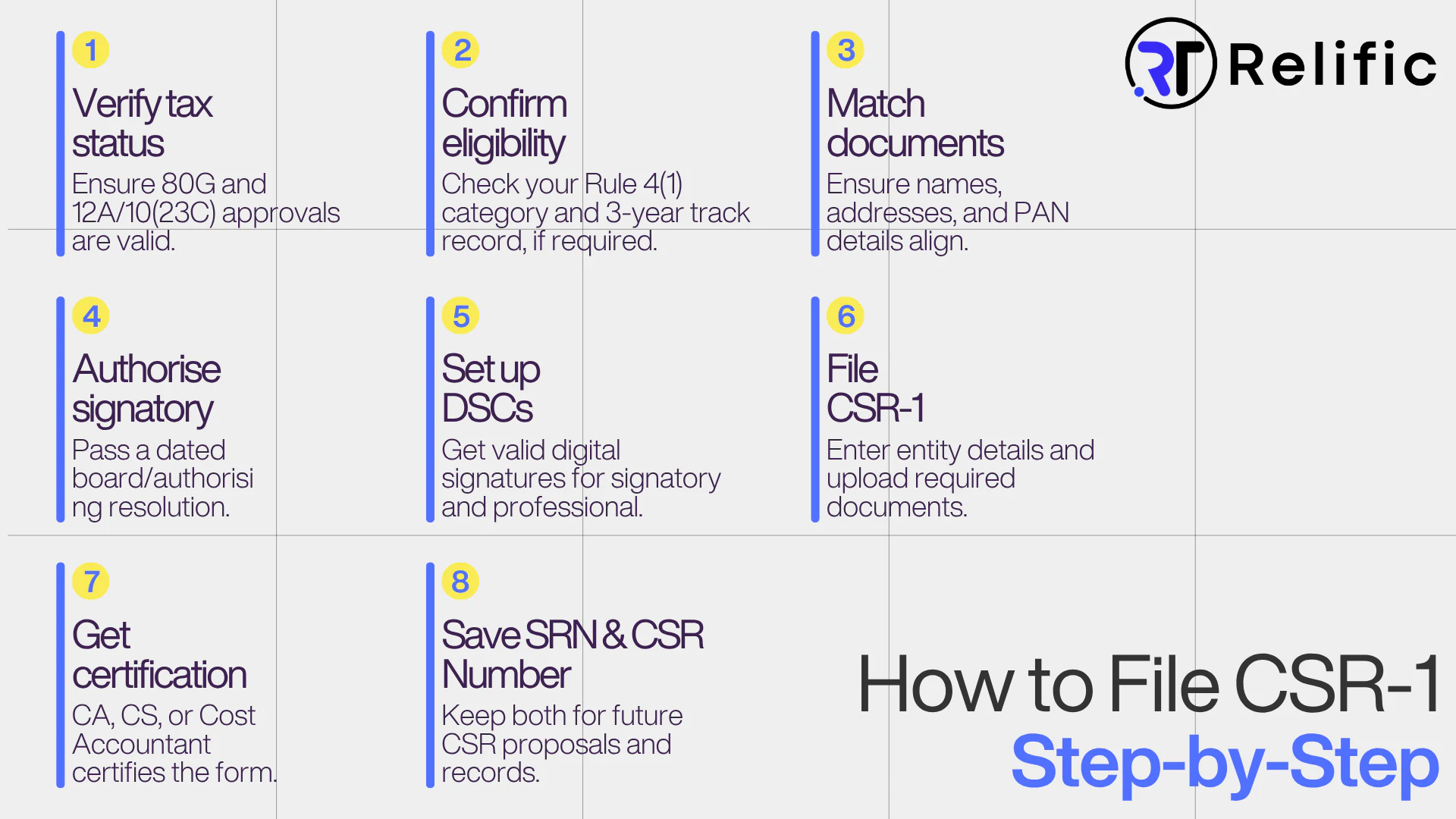
- Settle tax standing first: Confirm your 80G approval and your 12A or 10(23C) status (or section 332 and 354 orders) are valid. If renewal is close, complete it before filing. A registration built on an approval about to expire is technically valid but fragile.
- Confirm your Rule 4(1) category: Decide whether you are a company-established, government-established, statutory, or independent entity. If independent, confirm three years' track record in the activities you plan to implement.
- Reconcile identity documents: Align name, address, and PAN across the registration certificate, tax orders, and PAN card.
- Pass the authorising resolution: Record a numbered, dated resolution naming the signatory.
- Set up digital signatures: The signatory and the certifying professional both need valid DSCs on the MCA portal.
- Complete the web form: Enter the entity category, provenance, entity details and office-bearers, then attach the registration certificate and PAN.
- Obtain professional certification: The CA, CS or Cost Accountant verifies the particulars against original or certified records and certifies the form.
- Submit and keep the SRN: The Service Request Number is your reference for correspondence with MCA.
- Record the CSR Registration Number exactly: Rule 4(2)(c) provides for automatic generation on submission. Use the number in every proposal, agreement, and invoice, and keep the SRN alongside it.
Fees and timing:
The rules prescribe neither a processing period nor, in the CSR-1 provisions themselves, a fee. Check the MCA portal for any government fee at the time of filing, and budget separately for professional certification. The time that needs planning is usually the preparation: resolutions, DSCs, and reconciled documents.
After registration:
MCA's National CSR eXchange Portal is an e-marketplace where implementing agencies can list projects and companies can look for partners. It is optional, but it is where some companies begin their search.
NGO Darpan vs Form CSR-1: Which One Do You Need?
They are separate registrations with different owners and purposes. Form CSR-1 is a statutory requirement for implementing company CSR projects. NGO Darpan is a NITI Aayog platform whose Unique ID many government ministries require for grant applications. The CSR Rules do not mention Darpan, and the revised CSR-1 form has no field for a Darpan ID.
The National Government Services Portal describes NGO Darpan as an interface between voluntary organisations and government ministries and departments. Individual ministries make it a gateway. The Ministry of Tribal Affairs, for example, requires NGOs to register on NGO Darpan and obtain a Unique ID before registering on its own grants portal.
|
Dimension |
Form CSR-1 |
NGO Darpan |
12A/80G (sections 332/354 from April 2026) |
National CSR eXchange Portal |
|
Run by |
Ministry of Corporate Affairs |
NITI Aayog with the National Informatics Centre |
Income Tax Department |
Ministry of Corporate Affairs |
|
Basis |
Rule 4(2), Companies (CSR Policy) Rules, 2014 |
Requirement set by ministries for their grant schemes |
Income-tax Act |
Voluntary platform |
|
What it enables |
Implementing CSR projects for companies |
Applying to many government grant schemes |
Tax exemption for the NGO and deductions for donors; a CSR-1 eligibility condition for most NGOs |
Visibility to companies seeking projects |
|
Needed for CSR-1? |
Not applicable |
No |
Yes, for categories (a) and (d) |
No |
|
Time-bound? |
No validity period in the rules |
Profile details need upkeep |
Yes; registrations and approvals carry fixed validity periods |
Profile needs upkeep |
Recommendation: an NGO working with both government and corporate funders should hold both registrations. Nothing stops a company from asking for a Darpan ID in its own due diligence, even though the law doesn't require it for CSR-1.
Does CSR-1 Registration Expire?
No validity period applies to the CSR Registration Number, but eligibility can lapse. Rule 4(2) sets no expiry or renewal. Rule 4(1), however, is a continuing condition: the Board must ensure CSR activities are undertaken through entities that meet it. Eligibility is therefore tested whenever a company engages an agency, not only on the day the number was issued.
The simplest way to hold this in mind: the number is static; eligibility is dynamic.
|
Event after registration |
CSR Registration Number |
Rule 4(1) eligibility |
What to do |
|
80G approval or 12A/section 332 registration reaches the end of its validity without renewal |
Unchanged |
Fails for categories (a) and (d) |
Renew well before expiry; inform active funders |
|
Tax registration or approval is cancelled |
Unchanged |
Fails for categories (a) and (d) |
Stop accepting new CSR mandates until resolved; disclose to funders |
|
Trustees, directors or CEO change |
Unchanged |
Not directly affected |
Keep governance records current; funders will compare names |
|
Entity moves into a new thematic area |
Unchanged |
Raises the "similar activities" question for category (d) |
Document relevant experience before bidding |
|
Legal name or registered address changes |
Unchanged |
Not directly affected |
Keep a reconciliation note linking old and new details |
Validity periods are set out in the table in section 332(3) of the Income-tax Act, 2025. Provisional registration, for an applicant whose activities have not commenced, is valid for three tax years. Regular registration is generally valid for five tax years, rising to ten on renewal or conversion where the organisation's total income did not exceed ₹5 crore in each of the two preceding tax years. For NGOs, the fix is a compliance calendar with every approval's expiry date on it. For companies, it is re-checking before each disbursement, not once at onboarding.
For CSR Teams: How to Verify an Implementing Partner Before You Disburse
Check registration, category, current tax standing, governance, relevant track record, utilisation evidence and asset ownership, and repeat the tax and evidence checks before every tranche.
The legal anchor is Rule 4(5). It requires the Board to satisfy itself that disbursed funds were used for the approved purposes and in the approved manner, and requires the CFO, or whoever is responsible for financial management, to certify this. MCA's FAQ 7.4 explains why timing matters: "mere disbursal of funds for implementation of a project does not amount to spending" unless the agency utilises the whole amount.
|
# |
Check |
How |
Red flag |
|
1 |
Registration is real |
Ask for the SRN and registration confirmation; match number, legal name and PAN against the registration certificate and PAN card |
Name on the registration differs from the grant agreement |
|
2 |
Category fits |
Identify which Rule 4(1) category the agency registered under |
Independent NGO with under three years of relevant work |
|
3 |
Tax standing is current |
Confirm 80G plus 12A or 10(23C), or section 332 and 354 orders, are valid for the project period; diarise expiry dates |
Approval expires mid-project |
|
4 |
Governance matches |
Compare the office-bearers disclosed on CSR-1 with current records; check for conflicts with company insiders |
Trustees related to the company's decision-makers |
|
5 |
Relevant track record |
Ask for three years of evidence in activities similar to this project |
Experience only in unrelated Schedule VII areas |
|
6 |
Utilisation evidence |
Agree upfront what accompanies each tranche: utilisation certificates, field records, photographs, attendance |
Requests for the full grant upfront |
|
7 |
Asset ownership |
If the project creates a capital asset, confirm the intended holder qualifies under Rule 7(4) |
Asset to be held by an entity lacking charitable objects or a CSR Registration Number |
The National CSR eXchange Portal can be one reference point for check 1. MCA's own portal disclaimer says the Ministry does not verify the data companies and agencies submit, so it cannot replace the other checks.
Check 7 is easy to miss. Under Rule 7(4), a capital asset created with CSR funds must be held by one of three kinds of holders:
- a Section 8 company, registered public trust or registered society that has charitable objects and a CSR Registration Number;
- beneficiaries of the project, as self-help groups, collectives or entities; or
- a public authority.
CSR-1 status therefore matters for who can own what a project builds, not only for who can implement it.
Three numbers worth tracking across a partner portfolio:
- the share of active partners whose tax approvals remain valid through their project end date;
- the share of tranches released with complete utilisation evidence attached;
- how many days before a scheduled release your team learns that a partner's approval has lapsed.
These are suggested management indicators, not regulatory requirements. Relific's guide to choosing CSR software discusses how teams build partner checks into their broader compliance workflow.
Illustrative example 3: a partner's approval lapses mid-grant. A company approves a two-year ongoing project with a category (d) society and releases the first tranche in April. Before the January tranche, a check shows the society's 80G approval has expired, and renewal is pending. The CSR Registration Number is unchanged, but the Board's comfort under Rule 4(5) and the CFO's certification now rest on an agency whose Rule 4(1) status is uncertain. The prudent course is to hold the tranche, record the position with the company secretary, and resume once renewal is confirmed.
What Happens If a Company Uses an Unregistered or Ineligible Agency?
The rules don't set a separate penalty for this, but the consequences can be significant. Rule 4(1) says the Board shall ensure CSR activities are undertaken by the company itself or through the listed entities. MCA's FAQ 5.6 says every such entity must register on MCA21 to undertake CSR on a company's behalf.
Our interpretation: spending routed through an entity outside Rule 4(1), or one that never registered, is at risk of not counting as CSR expenditure. If it doesn't count, the company may have spent less than its Section 135(5) obligation. Unspent amounts must then be transferred to an Unspent CSR Account or a Schedule VII fund within the statutory timelines.
MCA's FAQ 8.1 describes the penalty for failing to make those transfers under Section 135(7):
- for the company: twice the amount required to be transferred, or ₹1 crore, whichever is less;
- for every officer in default: one-tenth of that amount, or ₹2 lakh, whichever is less.
Contraventions of other CSR provisions fall under Section 134(8) or the general penalty in Section 450, per FAQ 8.4. Treat this as a reason to get the check right, and confirm your specific position with your company secretary.
Common Mistakes, and How to Fix Them
NGOs
- Treating CSR-1 as a fundraising credential. The register is not selective: by October 2021 alone, more than 17,000 agencies had joined it. Evidence of results is what distinguishes you.
- Filing on an approval about to expire. Renew first, then register.
- Letting documents drift apart. Update PAN and registration records after any change of name or address.
- Stretching "similar activities". An overstated track record exposes your certifying professional under Section 448 and your organisation's reputation with funders.
- Confusing Darpan with CSR-1. A Darpan ID does not make you eligible for company CSR, and not having one does not disqualify you.
Companies
- Checking once at onboarding. Eligibility is dynamic. Build the tax-standing check into every tranche approval.
- Equating registration with due diligence. The form is taken on file on the strength of the applicant's and professional's statements. Your Board carries the Rule 4(5) duty.
- Releasing full grants upfront. Disbursal is not spending. Tie releases to utilisation evidence.
- Ignoring Rule 7(4). Decide who will hold any capital asset before the project starts.
- Engaging an international organisation as implementer. Rule 4(3) confines international organisations to design, monitoring and evaluation, and capacity building.
What's Changing in 2026
CSR through the Social Stock Exchange (Rule 4A)
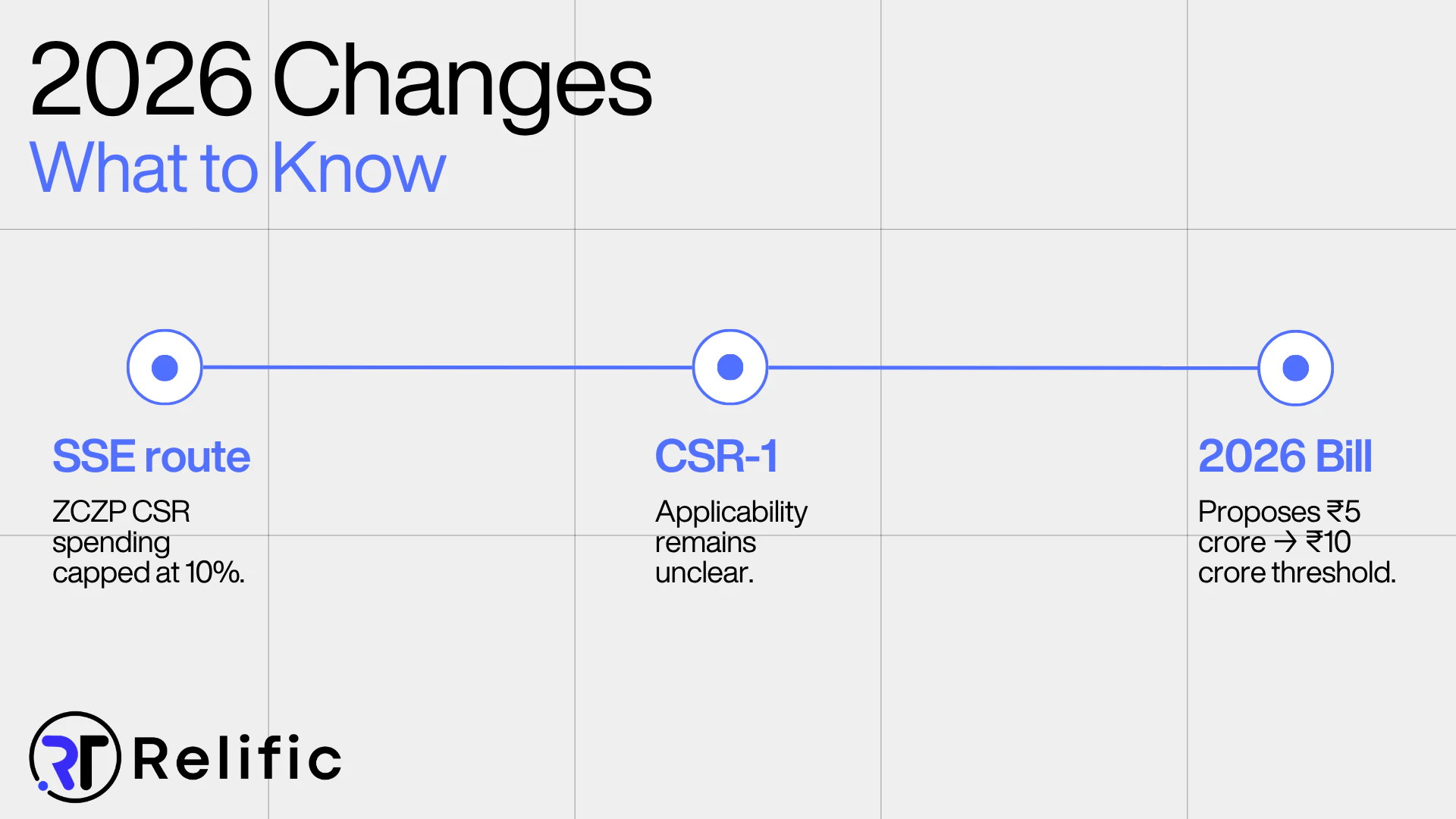
On 27 May 2026, MCA added item (xiii) to Schedule VII and inserted Rule 4A. The change lets companies undertake CSR by subscribing to zero-coupon, zero-principal (ZCZP) instruments issued by not-for-profit organisations registered on a Social Stock Exchange. Under the consolidated rules:
- spending through this route is capped at 10% of the company's total CSR expenditure for the year;
- the subscribing company is exempt from impact assessment for projects funded this way;
- the issuing organisation must complete its project within three succeeding financial years.
Rule 4A(4) applies Rule 4 to this route except sub-rules (5) and (6), and this is where commentary diverges. In the current Rule 4, sub-rule (5) is the Board's satisfaction and the CFO's certification on utilisation, and sub-rule (6) is monitoring of ongoing projects. CSR-1 registration sits in sub-rule (2), which Rule 4A does not exclude.
Our reading: on the plain text, CSR-1 still applies to a ZCZP-issuing organisation. At least one practitioner article concludes the opposite, describing sub-rules (5) and (6) as the CSR-1 provisions. Until MCA clarifies, a CSR team using this route should ask whether the issuing organisation holds a CSR Registration Number. An organisation planning a ZCZP issue should consider registering.
The Corporate Laws (Amendment) Bill, 2026
The Corporate Laws (Amendment) Bill, 2026 was introduced in the Lok Sabha on 23 March 2026 and referred to a Joint Parliamentary Committee. It proposes raising the net-profit threshold for CSR applicability from ₹5 crore to ₹10 crore, or another prescribed sum, and letting government to exempt companies meeting prescribed conditions. At the time of this update, PRS lists it as a Bill, not an Act.
Our analysis: if enacted, fewer mid-sized companies would carry a CSR mandate. Smaller NGOs that depend on those companies could face more competition for each mandate, which makes clean, current eligibility records more valuable.
Where Software Helps, and Where It Doesn't
The registration check itself doesn't need software. Opening a certificate, matching a PAN, and noting an expiry date takes minutes. A CSR team funding two or three partners can run the whole protocol above from a checklist and a shared calendar.
The difficulty grows with the portfolio. Across a dozen partners in several states, the recurring work is keeping three things connected:
- which partner is funded for which project;
- what evidence arrived before each release;
- who approved it, and when.
When those live in separate spreadsheets and email threads, the risk is that a lapsed approval or a missing utilisation record surfaces at year-end. That is when the annual CSR report and the CFO's certification fall due, well after the tranche that should have waited.
That operational gap is what Relific's products address. According to Relific's website:
- ProGran manages programme budgets and Section 135 compliance tracking. It offers multi-level approval chains for form submissions, budget changes and programme milestones, configurable by role and hierarchy. A CSR team can write a partner-eligibility sign-off into a milestone approval, so the check is recorded as part of the approval rather than left to memory. ProGran also lists utilisation certificates among its donor-ready exports and says it auto-populates Form CSR-2.
- Surve-R collects field data offline on mobile, with GPS, photos and signatures, and feeds submissions into ProGran's KPIs and budgets. For implementing partners, structured field records of this kind are what turn "three years in similar activities" into evidence a funder can inspect. Relific's field guide to social impact measurement covers how to design that evidence from the start.
- Across the platform, Relific lists role-based access and full audit trails. These matter when someone later asks who approved a release, and on what evidence.
Neither product decides whether an NGO meets Rule 4(1). That remains a human judgement. What structured workflows change is whether the check happens every time, and whether the evidence behind it can be found.
What to Do Next
If you run an NGO, work in this order:
- Settle and diarise your tax approvals.
- Reconcile your identity documents.
- File CSR-1 with a professional who genuinely reviews your track-record file.
- List on the National CSR eXchange Portal if you want corporate visibility.
- Register on NGO Darpan if you work with government.
After that, keep every layer of the eligibility stack current. The number won't remind you when an approval lapses.
If you lead a CSR team, treat the CSR Registration Number as an identifier, not an endorsement. Write the seven checks into partner onboarding, repeat the tax-standing and utilisation checks before every tranche, and settle asset ownership under Rule 7(4) before a project begins. For the vocabulary your board papers will use, see Relific's CSR and impact measurement glossary.
Frequently Asked Questions
Yes, for any NGO implementing CSR projects on a company's behalf. Rule 4(2) has required registration since 1 April 2021. It is not needed when a company implements a project directly.
Not if it is a Section 8 company, trust, or society relying on categories (a) or (d). Those categories require 80G approval plus 12A or 10(23C). Only government-established entities and statutory bodies register without tax approvals.
The form's attachments are the certificate of registration and the entity's PAN. You also need valid tax approvals, a numbered authorising resolution, DSCs, DIN or PAN for directors or trustees and key office-bearers, and certification by a practising CA, CS or Cost Accountant.
No. The CSR Rules don't mention NGO Darpan, and the revised CSR-1 form has no Darpan field. Many government ministries require a Darpan Unique ID for their grant schemes.
A new entity established by a company or a government needs no track record. An independent NGO needs at least three years' track record in activities similar to those it will implement, plus 80G and 12A or 10(23C).
The rules set no validity period for the CSR Registration Number. The tax registrations and approvals it depends on are time-bound, so an NGO can fall outside Rule 4(1) while its number stays unchanged.
No. MCA has stated that entities already holding a valid CSR Registration Number are not required to reapply. The revised form applies to new or unregistered agencies.
The rules prescribe no processing period. Rule 4(2)(c) provides for the number to be generated automatically on submission. Most of the time goes into preparation: resolutions, DSCs, reconciled documents, and professional certification.
A Chartered Accountant, Company Secretary, or Cost Accountant in whole-time practice. They certify that the particulars were verified from the entity's records and accept liability under Section 448 for wrong certification.
Ask for the SRN and registration confirmation, and match the number, legal name, and PAN against the registration certificate and PAN card. Then check that tax approvals are current and office-bearers match. Registration alone doesn't establish capacity.
Yes, if the foundation is a Section 8 company, registered public trust, or registered society with 80G and 12A or 10(23C). Category (a) requires no track record, but the foundation must still file CSR-1.
From 1 April 2026, Section 12A became Section 332 and Section 80G became Section 354, and earlier approvals are deemed to continue. The CSR Rules still cite the 1961 Act, so certifiers and funders should record the mapping between old and new sections.