
We have spent twenty years, maybe more, building better and better tools to describe problems. We've refined our M&E frameworks. We've trained entire teams on data collection. We've built dashboards that can tell you, with impressive granularity, exactly how many children in a given district are reading below grade level, or how many women skipped their second prenatal checkup.
What we still cannot tell you, with enough confidence, is whether our interventions are actually changing those numbers or whether we are funding beautiful reports about irreversible conditions.
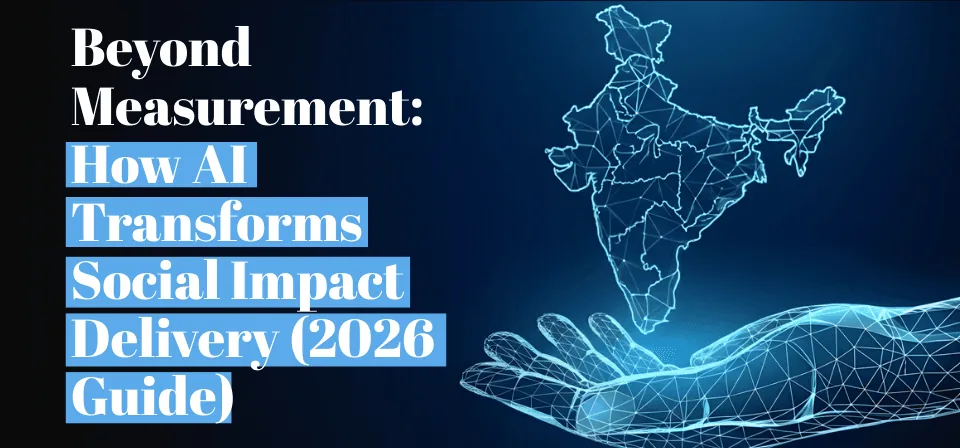
This is where Relific stands firm on a belief that shapes everything we build: technology's highest contribution to the social sector is not the measurement of impact. It is the delivery of it.
Defining AI-Powered Social Impact AI-Powered Social Impact is the use of artificial intelligence technologies, specifically Large Language Models (LLMs), predictive analytics, and computer vision to directly deliver or enhance social services like education, healthcare, and financial literacy, rather than solely using data for compliance and reporting.
Why AI in the Social Sector Means More Than Better Dashboards
There's a pattern I've noticed in development sector conversations about technology. They almost always end up in the same place: Better dashboards. Richer analytics. Stronger M&E. These are real problems worth solving. But they share a quiet assumption that technology's role is to stand at a distance and observe what humans are doing. To count the work, not do it.
AI, specifically the kind built on large language models and adaptive systems, doesn't fit that role. It doesn't want to sit outside the intervention and watch. It can be the intervention. The same system that tells you a student is struggling can be the one helping her work through it, right now, in her language, at her pace.
That's not a technical upgrade. It's a different question entirely about what we expect technology to contribute.
What Is Bloom's 2-Sigma Problem, And How Does AI Finally Solve It?
There's a piece of education research from 1984 that, once you read it, you can't unsee.
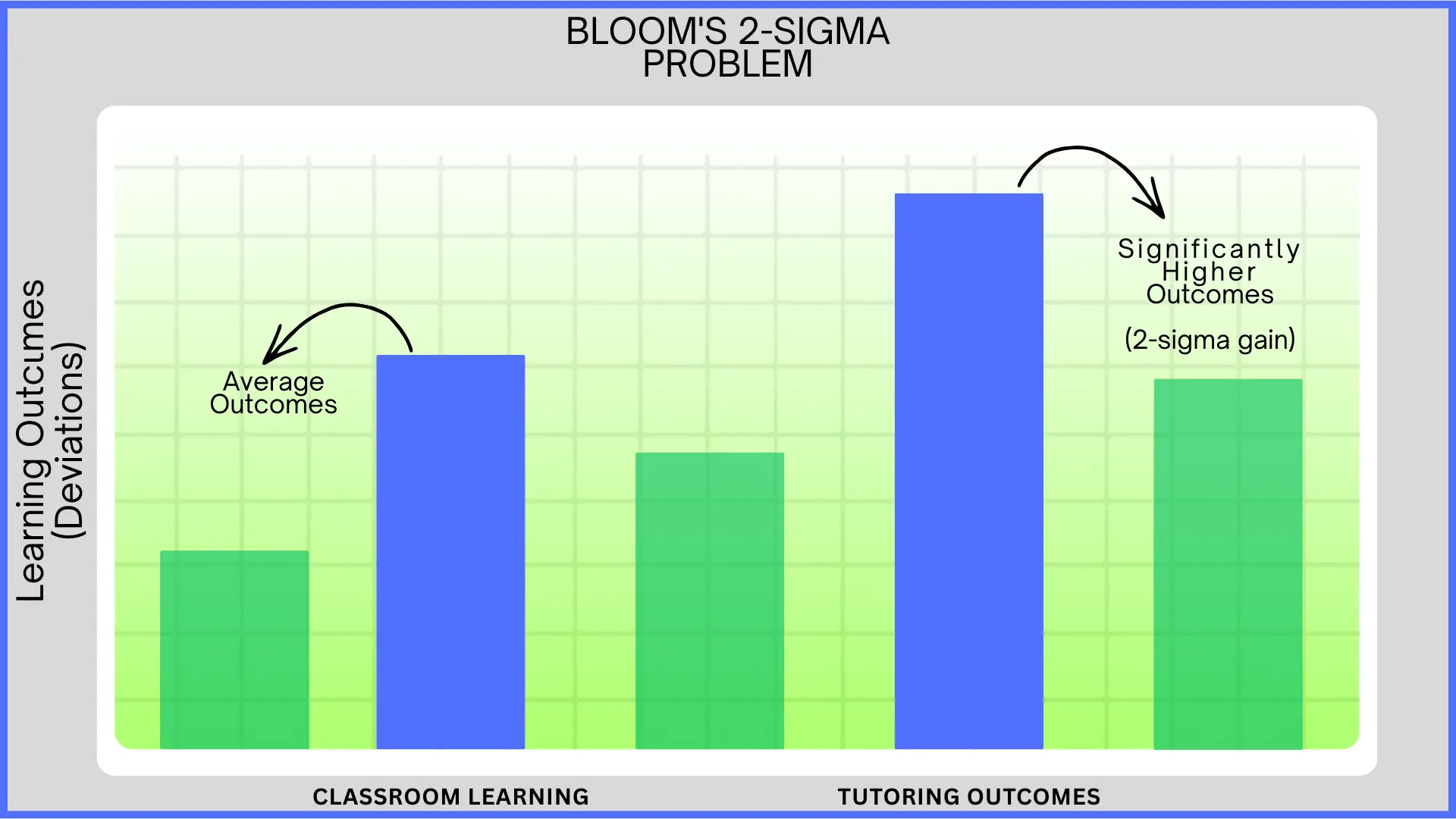
Benjamin Bloom, one of the most respected education researchers of the 20th century, ran a study comparing students who received one-on-one tutoring against students in conventional classrooms. The tutored students performed two full standard deviations better. To put that in plain terms: the average tutored student outperformed 98% of their peers in a regular classroom setting.
He called this the 2-Sigma Problem. Not because the finding was in doubt, but because the solution seemed impossible. Everyone already knew that personalised, one-on-one instruction worked. The problem was that you couldn't put a human tutor next to every child. The economics were absurd. In a country like India, with 260 million children in government schools and teacher-student ratios that make individual attention structurally impossible, Bloom's finding was essentially a beautiful, useless truth.
Until large language models crossed a capability threshold that changed what's actually buildable.
I want to be careful here, because this is the point where these conversations usually go sideways. This is not about replacing teachers. That framing is both wrong and counterproductive. A good teacher paired with an intelligent tutoring assistant is a better teacher freed from the grinding cognitive labour of baseline instruction to focus on the parts of education that require a human: relationship, motivation, and seeing a child clearly. The AI handles what it's good at. The teacher handles what only humans can do.
What changes is the cost curve. Once the intelligence layer exists, reaching 50,000 students instead of 5,000 wouldn't require ten times the budget. It requires better infrastructure and honest design work.
Why India Is the Most Important Test Case for AI-Powered Social Impact
Every country has gaps in education quality, healthcare access, and agricultural productivity. But India has something most don't: the gaps and the infrastructure coexisting in the same geography, often in the same district.
That combination of serious unmet need sitting alongside significant digital investment is precisely what makes India the defining case for AI-powered social impact. Not a case study in what might work someday, but a live opportunity to connect what has already been built to what is now possible.
The Numbers That Should Have Changed But Haven't
Start with education, because the data is unambiguous and the implications are hard to ignore.
What ASER 2024 actually tells us:
- Roughly 25% of rural children cannot read a basic paragraph, not a complex text, a basic paragraph
- More than 50% of Class 5 students cannot perform the arithmetic that their grade level requires
- These outcomes have remained stubbornly flat across a decade of enrollment growth, device distribution, and curriculum reform.
The instinctive response from funders and program teams has been to treat this as an access problem. More devices. Better content. Stronger digital literacy modules. These investments were not wrong, but they were solving for the wrong constraint.
The constraint was never the device. It was always the intelligence on top of it.
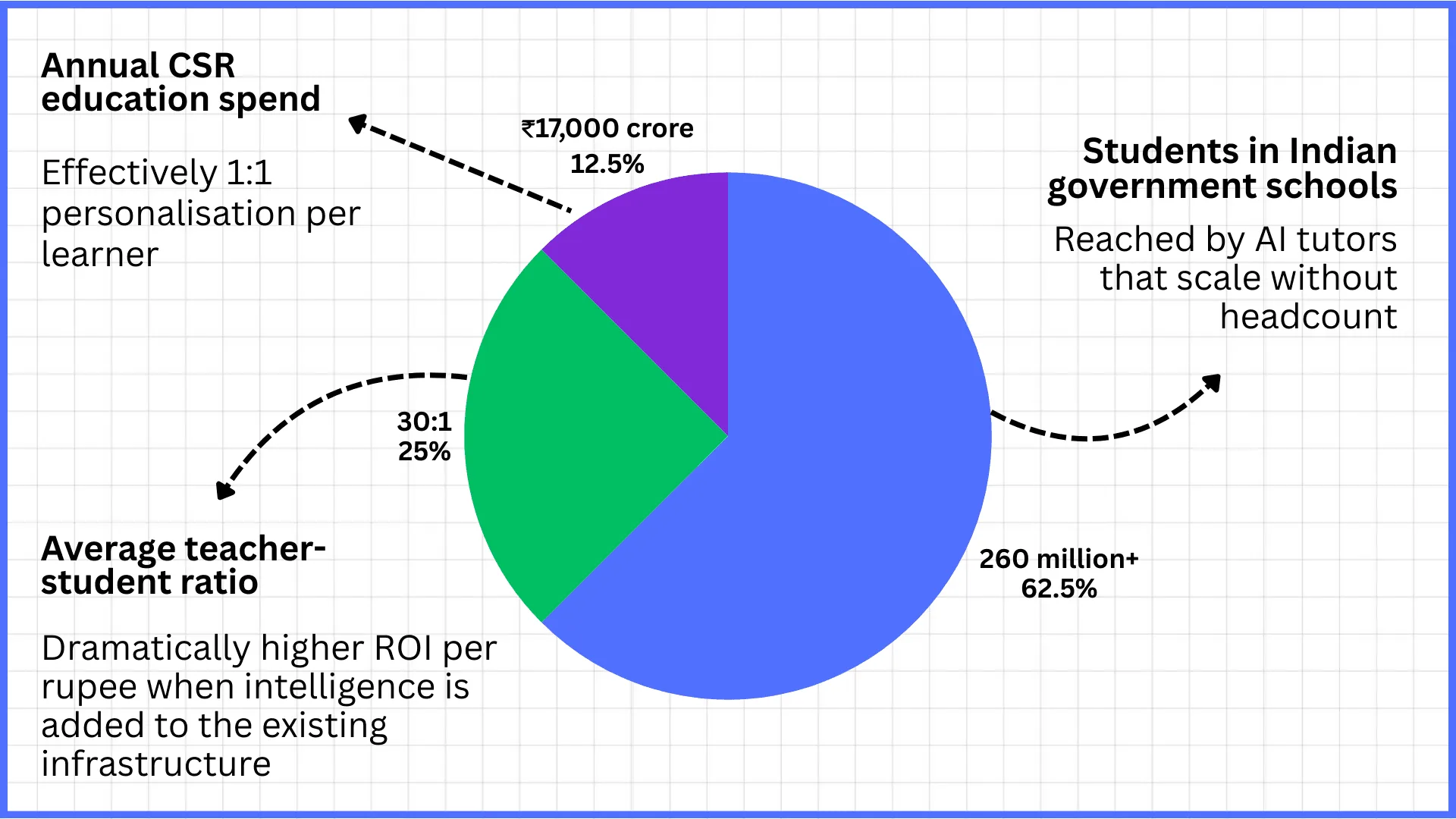
The structural reality inside government schools:
| Metric | The Ground Reality | What AI Makes Possible |
|---|---|---|
| Students in Indian government schools | 260 million+ | Reached by AI tutors that scale without headcount |
| Average teacher-student ratio | 30:1 | Effectively 1:1 personalisation per learner |
| Annual CSR education spend | ~₹17,000 crore | Dramatically higher ROI per rupee when intelligence is added to existing infrastructure |
A 30:1 ratio is not a resource problem that more teachers alone can solve. At that ratio, a teacher giving each child just two minutes of individual attention in a class period has already used the entire hour. Personalisation, the thing that actually moves learning outcomes, is structurally impossible under those conditions.
This is not a criticism of teachers. It is a description of a system that was never designed to deliver the quality it's being asked to deliver.
The Bridge Is Shorter Than the Sector Thinks
Here is what the development sector often gets wrong about AI implementation: it imagines it requires starting over. New platforms, new procurement cycles, new infrastructure, new training programs for field staff.
In most cases, it doesn't. The foundation is already there.
What already exists in the field:
- Tablets and smartphones are provisioned to schools through CSR and government programs
- Computer labs running digital literacy modules in thousands of government schools
- Connectivity that, while uneven, has improved significantly across Tier 2, 3, and rural geographies
- Field staff and teachers who are increasingly comfortable with device-based tools
What's missing is a single layer, and it's the one that changes everything:
- A tablet running static educational PDFs → could become an adaptive AI tutor that knows the child's current level and adjusts in real time
- A computer lab delivering pre-recorded video content → could become a personalised learning environment where each student gets instruction in their own language, at their own pace.
- A digital literacy program that ends when the module does → could become a continuous learning relationship that evolves as the student does
The device is already in the student's hands. The connectivity is increasingly reliable. The CSR investment has already been made.
The missing piece is not hardware. It is not a budget. It is the willingness to add the intelligence layer on top of infrastructure that's already been paid for and to take seriously what that layer can actually do for a child who has never had access to anything resembling personalised instruction.
What Does Responsible AI Mean for Rural Communities? Three Non-Negotiables
Most responsible AI conversations happen in comfortable rooms between people who will never be on the receiving end of a bad AI decision. That needs to change when the user is a pregnant woman in rural Jharkhand or a farmer in Marathwada deciding what to plant this season based on advice from a system someone else built and deployed.
The stakes here are not abstract. So the guardrails can't be either.
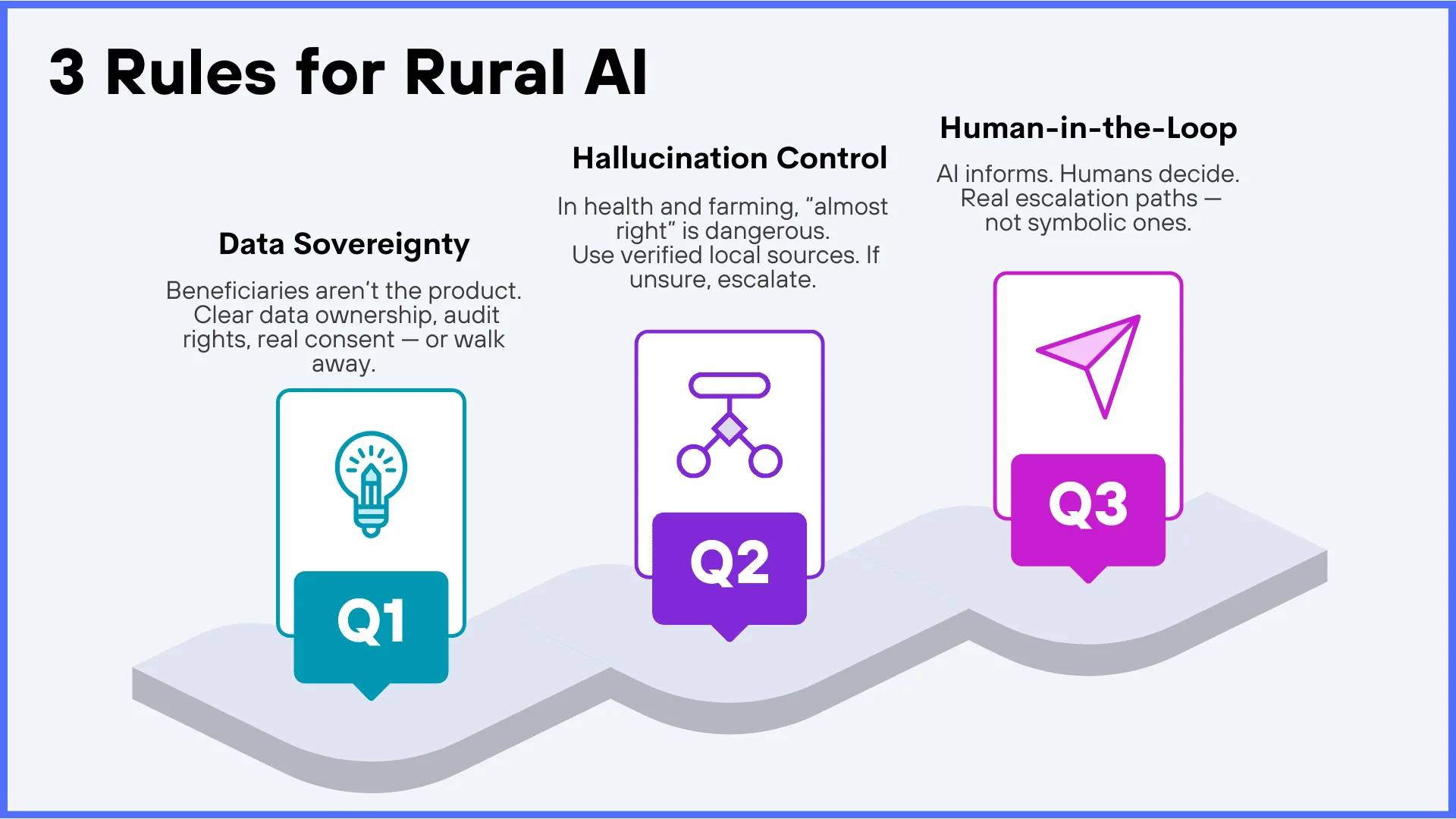
Three things we consider non-negotiable, not as values to display on a website, but as decisions that have to be made before the system is built:
1. Data Sovereignty: The People Being Served Are Not the Product
- Rural communities generating health, learning, and livelihood data through these programs shouldn't be quietly funding someone else's model improvements
- Before signing any vendor contract, ask plainly: Where does beneficiary data go? Who owns what the model learns from it? Can we audit that?
- If the answer is vague or defensive, you have your answer
- Consent means something in a language the beneficiary actually speaks, not buried in a terms document nobody reads
2. Hallucination Management: In This Context, "Close Enough" Isn't
- An AI that confidently gives wrong medical or agricultural advice doesn't produce a bad user experience; it produces a bad outcome for a real person
- The fix is architectural, not cosmetic: systems must draw from verified, localised knowledge bases, government crop manuals, state health protocols, scheme documentation, not general internet training
- And when the system genuinely doesn't know? It should say so, clearly, and route to someone who does
- Quiet failures are the ones that do the most damage
3. Human-in-the-Loop: AI Should Inform the Decision, Not Make It
- Any output that could meaningfully affect someone's health, income, or safety needs a real escalation path to a human, not a nominal one that gets skipped when things get busy
- Field workers need to be trained to push back on the AI when something feels off, not just to trust it because it sounds confident
- The moment escalation becomes the harder option, the system stops being human-in-the-loop and starts being autonomous with paperwork
The organisations that take these seriously now won't just avoid harm, they'll build the kind of trust that makes communities actually use these tools. And that trust, once earned, is what makes scaling possible.
Responsible AI at the last mile isn't a constraint on doing good work. It's what separates good work from the other kind.
How to Implement AI in CSR Programs: A Practical Framework for NGOs and Foundations
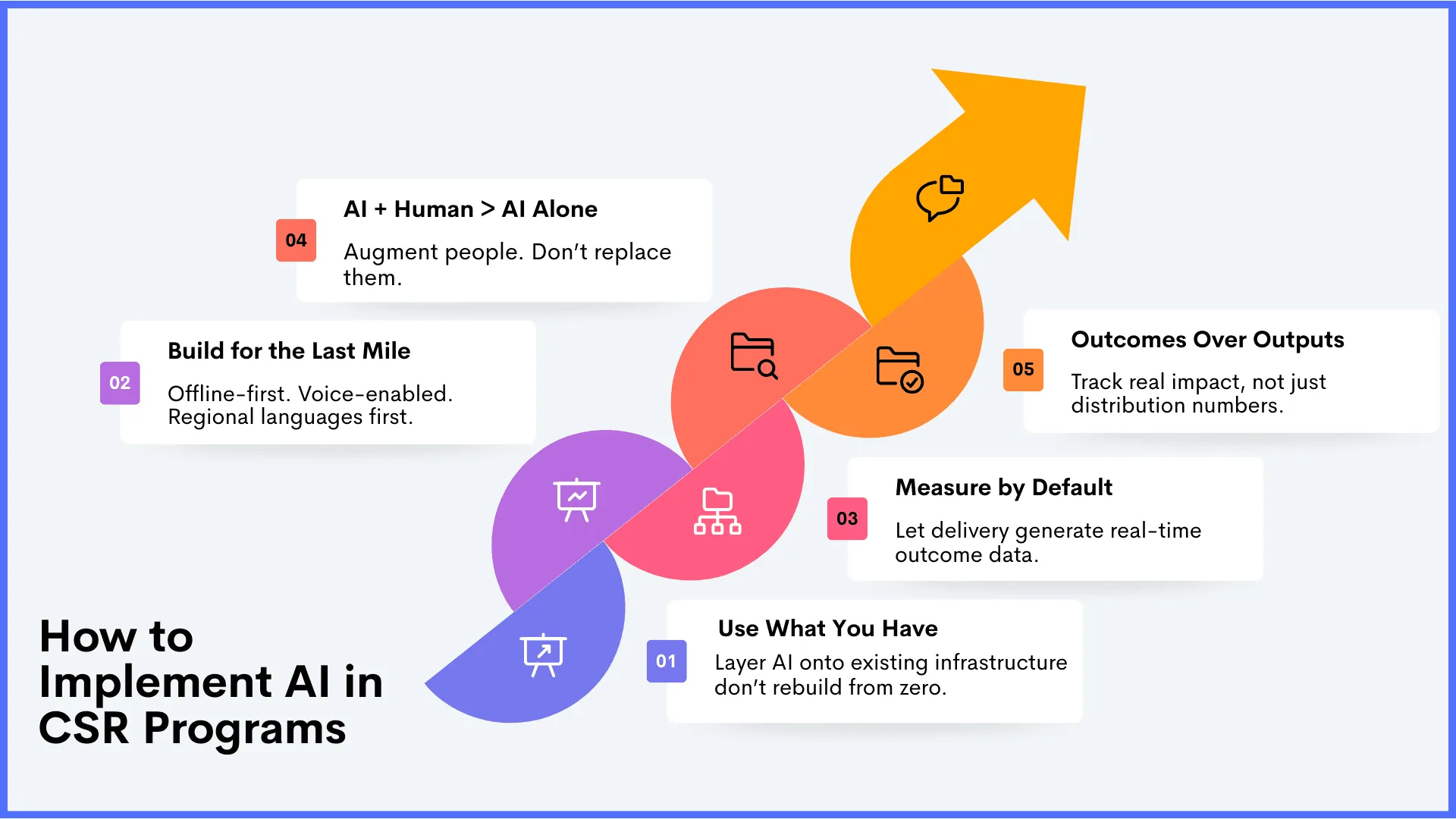
Enthusiasm for AI in the impact sector is no longer the problem. Sloppy implementation is. The organisations that will look back on this period as a turning point are the ones that slow down enough to get the foundation right. Here's what that looks like in practice:
1. Start With What You Already Have
The most common mistake is treating AI as a greenfield project when it isn't. If your program already has devices in the field, connectivity infrastructure, or a digitally oriented field team, you have a foundation. The incremental cost of adding an intelligence layer on top of existing infrastructure is a fraction of what was spent building it. Start there, not from scratch.
2. Design for the Hardest User First, Not the Easiest
If your AI solution only works with a stable 4G connection and a smartphone-literate user, it doesn't work at the last mile; it works in a city. Offline-first architecture, voice interfaces, and genuine regional language support aren't accessibility features. They're the baseline requirements for any deployment that claims to serve rural India. Build for Gondi and Bhojpuri speakers first. The rest will follow.
3. Let Measurement Come From the Delivery, Not After It
One of the quiet advantages of AI-powered delivery is that data generation is built in. The system tutoring a student would be the same system tracking whether comprehension is improving. You stop needing a separate M&E exercise six months later to find out if the program worked. Real-time outcome data stops being a funder ask and starts being a natural output of how the program runs.
4. Pair AI With People, Not Instead of Them
The implementations that fail almost always share the same design flaw: they removed the human. The ones that work treat AI as what it actually is, a tool that makes a skilled person more effective, not a replacement for one. A teacher with an intelligent tutoring assistant would reach more children more deeply than either does alone. That framing should drive every deployment decision.
5. Move From Counting Outputs to Owning Outcomes
Funders and regulators are increasingly asking harder questions, not how many tablets were distributed, but how much learning actually happened. AI makes that shift from output metrics to outcome metrics not just possible but inevitable. Organisations that get ahead of this now won't just satisfy future reporting requirements. They'll have the evidence base to make a genuinely compelling case for what their programs produce.
What Relific Is Building Toward
We started Relific because we believed the sector deserved tools that were genuinely built for it, not enterprise software repurposed for NGOs, not consumer apps with a "social impact" label applied at the end.
What that means in practice is building systems where measurement and delivery aren't separate workflows. Where a program can track learning gains in real time because the AI tutoring the student is the same system generating the outcome data. Where a health worker's AI copilot is pulling from verified, localised health guidelines, not general internet training, because in healthcare, "mostly right" has consequences.
We're not the only ones working on this. But we do think the organisations that treat AI as an active program component rather than a passive reporting layer will build something meaningfully different from what has existed before.
The impact sector has earned the right to be measured rigorously. The next step is being just as rigorous about what we actually deliver.
Conclusion
Before your next program design cycle, sit with this honestly:
What does your technology do when no one is submitting a report?
If the answer is nothing, that's not a minor gap. That's the whole problem. The programs that define the next decade won't be remembered for their dashboards. They'll be remembered for putting real learning support in a child's hands, real decision-making tools in a health worker's pocket, and real guidance in a farmer's language at the moment it mattered.
The infrastructure is largely there. The intelligence layer is not. That's the gap worth closing and the only one that actually moves outcomes. We built Relific for exactly this moment. Not to add another reporting tool to an already crowded stack, but to build systems where delivery and measurement are the same thing, where the AI teaching a student is the same system tracking whether she's learning.
The impact sector has spent a generation getting rigorous about measurement. It's time to be just as rigorous about delivery. That's the work we're here to do. If it's the conversation you're ready to have, let's talk.
Faqs
No, and programs designed around that assumption consistently fail. The implementations that work treat AI as what it actually is: a force multiplier for skilled humans, not a substitute for them. An ASHA with an AI copilot can manage her caseload more accurately and catch early warning signs she might otherwise miss. A teacher supported by an AI tutoring system can focus on what only humans do well: motivation, mentorship, and seeing the whole child. The AI handles scale. The human handles depth.
In 1984, Benjamin Bloom demonstrated that students receiving one-on-one tutoring consistently outperformed classroom peers by two standard deviations, placing them above 98% of their classmates. The problem was never the finding. It was the economics. You cannot staff a personal tutor for every child in every government school. AI could change this by delivering adaptive, personalised instruction at effectively zero marginal cost per additional student. The 2-Sigma outcome may become achievable at the government school scale for the first time.
Agentic AI moves beyond "chatting" to "acting." It can autonomously help a farmer apply for a government subsidy or schedule a follow-up appointment for a pregnant woman after detecting an anomaly in her health data.
We use Retrieval-Augmented Generation (RAG). This ensures the AI only pulls information from verified, localised datasets (like government crop manuals or WHO protocols) rather than relying solely on general internet data, which minimises the risk of "hallucinations."
Yes. Modern impact-tech utilises "Edge AI" and offline-first LLMs that can be stored locally on a device, syncing with the cloud only when a signal is available, ensuring the "intelligence layer" remains accessible in the most remote villages.
Traditional programs offer static content (videos/PDFs) that the user must navigate alone. AI-powered delivery is dynamic and conversational; it learns the user’s specific pace, answers questions in local dialects, and provides proactive guidance, acting more like a mentor than a library.
Move from "Output Metrics" (number of tablets distributed) to "Outcome Metrics" (real-time learning gains, reduction in maternal mortality, or yield increases). AI allows for continuous data streams that provide a much more accurate picture of actual behavioural change.
Start with an Impact Audit: Identify which program area has the highest human-to-beneficiary ratio (like tutoring). Then, layer an AI assistant onto your existing digital infrastructure to augment those human workers, rather than building an entirely new platform from scratch.