

Written by Manjunatha Thyagaraj, founder of Relific Technologies and a leading voice on technology-driven social impact.
1. The New Mandate: Why CSR Objectives Are Non-Negotiable
Here's something that caught me off guard: Companies with solid CSR frameworks didn't just survive the pandemic; they outperformed their competitors, with sustainable equity funds exceeding traditional peer funds by a median total return of 4.3 percentage points in 2020 (Source: Morgan Stanley Institute for Sustainable Investing, 2020). And no, it wasn't luck. They had simply built something meaningful before the crisis hit.
Look, I get it. When you're running a business, CSR can feel like just another compliance checkbox. Another report to file. Another meeting to schedule. I've been there, and I've watched too many companies approach it exactly that way.
That's actually why I started Relific Technologies. After years of seeing businesses treat social responsibility like a burden they had to bear, I realised there was a massive disconnect. What if, instead of seeing CSR as something we have to do, we saw it as something that could actually help us grow?
I'm Manjunatha Thyagaraj, and over the past several years, I've worked with everyone from scrappy startups to Fortune 500 giants across India. What I've learned is this: when you approach CSR strategically, not as an afterthought, it stops being about regulatory compliance and starts being about creating real value. For your community, yes, but also for your business.
The companies that figured this out? They're the ones thriving right now. Because measurable social impact isn't just the right thing to do. It turns out, it's also one of the smartest business decisions you can make.
1.1 The Great Shift: From Philanthropic Goals to Mandatory CSR Objectives

You know, what I've seen is that most business leaders in 2025 are still thinking about CSR, you know, giving back with a mindset that's easily fifteen years out of date. And that disconnect is costing them in ways they haven't even begun to measure.
Is the era of writing a check to a local charity and calling it CSR? That's over. What we're experiencing isn't just an evolution; it's a complete reimagining of how business and society need to intersect.
Consider what's happened in India alone. When Section 135 of the Companies Act made CSR mandatory in 2014, companies were required to spend at least 2% of their average net profits on social initiatives.
Forget the jargon for a second. The data from the Ministry of Corporate Affairs (MCA) and subsequent analysis show that the money companies are dedicating to social good has soared. By last year (FY 2023-24), they put nearly ₹35,000 crore toward it, and this year, it's heading past ₹38,000 crore. This isn't just a bump in charity; it means big business is fundamentally changing how they spend their main capital and what they believe their role in society actually is.
And what's really striking is that this whole change isn't running on good intentions; it's being forced by three powerful pressures (people, planet, profit) that businesses just can't wish away. They are completely and fundamentally reshaping the entire corporate world."
1.2 ESG Requirements That Actually Matter to Your Bottom Line
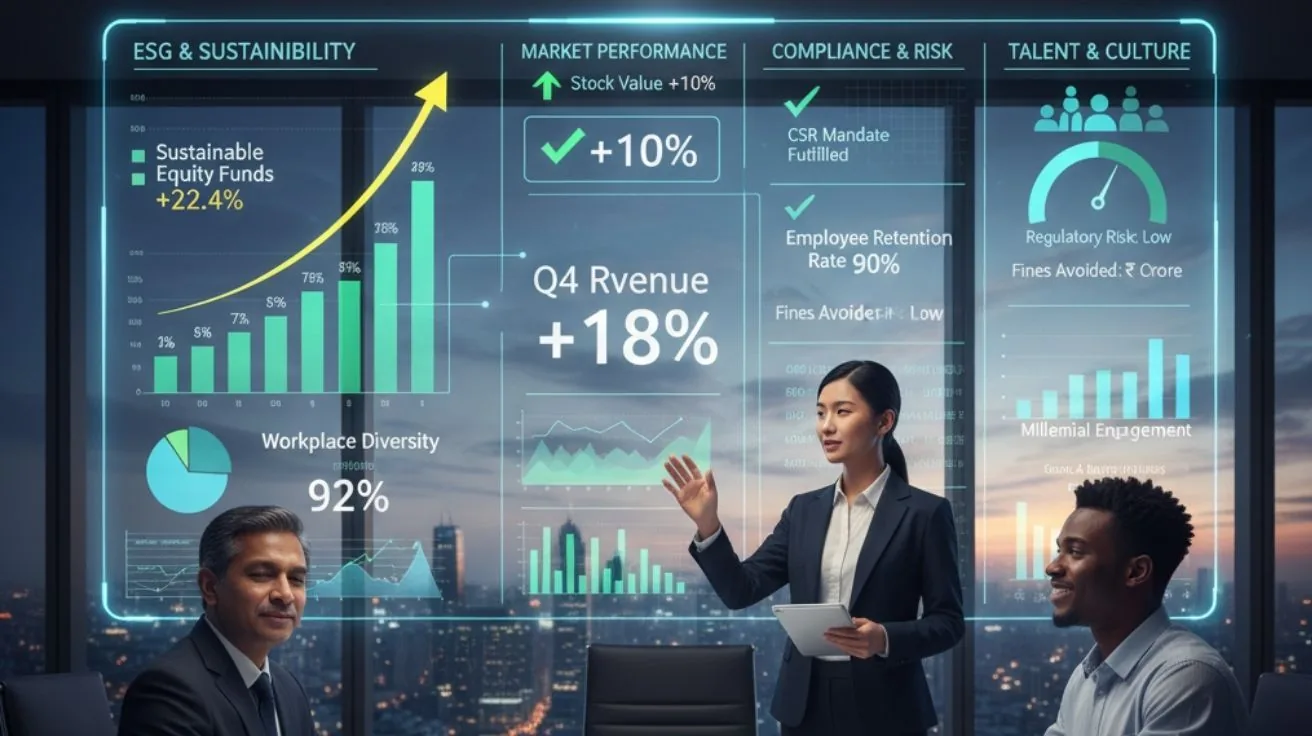
Institutional investors, the ones managing trillions in assets, have stopped treating ESG performance as a nice-to-have. During the market turbulence of 2020, sustainable equity funds demonstrated this clearly. According to Morningstar, 11 of 12 sustainable index funds outperformed the S&P 500 index fund, with an average return of 22.4% compared to the S&P 500's 18.4%. Your CSR performance isn't separate from your market valuation anymore; it's woven into how investors assess your company's resilience and long-term viability.
1.2.1 Regulatory Frameworks That Have Teeth
India was the first to make CSR a hard law, but the real shocker is the penalty: companies now face fines up to ₹1 crore, or even double the unspent CSR amount. This isn't a suggestion anymore; it's a serious legal risk that directly hits your bottom line and can truly mess with your business."
1.2.2 A Talent Market That's Making Choices
Here's where it gets personal for every organisation. A PwC study found that 88% of millennials said they were looking for an employer with CSR values that reflected their own, and 86% said they would consider leaving an employer if they found their CSR values to be lacking. Think about that. In today's war for talent, your approach to social impact isn't just about recruitment; it's about retention, engagement, and whether your best people will still be there next year.
"I see this confusion all the time. Companies are just checking the CSR box for the government, then they stand there scratching their heads, wondering why the best people won't work for them, or why their investors are suddenly demanding straight answers about the future. The two things are totally connected.
So, look, this isn't about being a saint. It's about finally admitting that the rules of the business world have completely changed. The companies that get this and adapt aren't just being nice; they are setting themselves up to win. They're positioning themselves to thrive in a market that is now built to reward real, long-term commitment to everyone they affect, not just short-sighted returns for shareholders.
1.3 The Paradigm Shift That Changes Everything
Let me paint you a picture of where we've been and where we're heading:
| Old Model | Current Reality | Future-Proof Strategy |
|---|---|---|
| From Philanthropy (Goodwill) | To Strategic Necessity (Risk Mitigation) | To Competitive Advantage (Value Creation) |
| Companies donated surplus profits to causes, often disconnected from core business. Nice photo ops, minimal impact, zero strategy. | CSR acts as a corporate safety net—essential but defensive. It manages risks, ensures compliance, and meets stakeholder expectations. | CSR becomes a driver of innovation, market expansion, talent attraction, and sustainable value creation. |
As Anand Mahindra captured this shift perfectly when he said,
"CSR and sustainability are not things you do after you make profits. The next generation of business opportunities will come from opportunities that draw from the very conception of the project."
And he's absolutely right.
The question isn't whether you should take CSR seriously; that ship has sailed. The question is whether you'll approach it as a compliance burden or transform it into your next competitive edge. The businesses that truly get this aren't just hitting that minimum 2% mark; they're actually re-thinking what it means to succeed in a world that's all tangled up.
Ready to stop treating CSR like a simple donation and start using it as your smartest business tool? Let's dive in."
1.4 What You'll Learn in This Guide
- What is Corporate Social Responsibility: Modern definition, types, and the Carroll Pyramid reimagined
- Why CSR Matters: Data-driven business case for financial performance, risk mitigation, and talent retention
- The Carroll Pyramid Reimagined: 5 Types of Corporate Responsibility
- 6 Core CSR Objectives: Financial resilience, brand protection, talent acquisition, supply chain diligence, innovation, and license to operate
- CSR Software & Automation: Tools for compliance tracking and impact reporting
- Common Compliance Pitfalls: Mistakes causing audit failures and how to avoid them
2. What is Corporate Social Responsibility? (The Evolved Definition)

Corporate Social Responsibility (CSR) is a strategic framework where companies integrate social and environmental objectives into their core business operations and decision-making processes.
- From Voluntary Goodwill to Strategic Imperative: The definition of CSR has undergone a fundamental transformation. What began as voluntary philanthropy has evolved into a comprehensive enterprise risk management and value creation framework. As Niall Fitzgerald, Former CEO of Unilever, said,
"Corporate social responsibility is a hard-edged business decision. Not because it is a nice thing to do or because people are forcing us to do it... because it is good for our business."
- Classical CSR (Pre-2010s): Traditional CSR was primarily about self-regulating companies voluntarily going beyond legal compliance to contribute to societal good. The focus was on reputation management and moral obligation, often disconnected from core business operations.
- Modern Strategic CSR (2025): Today's CSR operates as an integrated system for measuring and managing a company's non-financial impact. It directly addresses the "Social" component of ESG (Environmental, Social, and Governance) standards, making it central to:
-
- Enterprise risk management
-
- Investor relations and capital access
-
- Talent acquisition and retention
-
- Supply chain resilience
-
- Long-term competitive advantage
This perspective emphasises that effective CSR treats social impact not as an expenditure, but as a strategic investment in:
- Resilience: Better risk management during crises
- Talent: Attracting and retaining values-aligned employees
- Capital: Lower cost of capital through improved ESG ratings
- Growth: Unlocking new markets and innovation opportunities
The Three Pillars of Modern CSR are:
- People: Employee welfare, community development, human rights in supply chains
- Planet: Environmental sustainability, climate action, resource efficiency
- Profit: Long-term value creation, ethical governance, stakeholder returns
When these three pillars align, CSR transforms from a compliance checkbox into a driver of sustainable competitive advantage.
Key Difference: Today's CSR is about zeroing in on what truly matters for your business - spotting the social and environmental challenges that shape your bottom line and the real value you bring to people who count on you. At Relific Technologies, we see CSR differently: it's not just writing checks; it's about reimagining how you do business so that caring for the planet and people becomes second nature. It's about being savvy enough to transform must-do requirements into advantages that help you stand out in the crowd.
- The Indian Context: Mandatory CSR Under India's Companies Act 2013, qualifying companies need to put at least 2% of their average net profits from the past three years toward CSR initiatives. This makes India the first country to write CSR spending into law, shifting it from something companies could choose to do into something they're expected to do as part of good governance.
2.1 What CSR Is NOT: Common Misconceptions
Understanding strategic CSR requires distinguishing it from superficial practices:
- Not Just Charity: One-off donations or surplus profit distribution without measurable, long-term impact linked to the company's value chain or specific social problems.
- Not PR or Marketing: Initiatives designed primarily for brand awareness or media coverage, lacking authentic commitment and transparent outcome reporting. CSR is not a marketing expense; it's a strategic investment.
- Not Greenwashing: Misleading stakeholders about environmental or social performance. Authentic CSR requires rigorous data, third-party verification, and transparent reporting to build credibility.
- What CSR Actually Is: A business model where sustainability and responsibility are embedded in operations, governance, supply chains, and product development, creating measurable value for both society and shareholders.
3. The Carroll Pyramid Reimagined: 5 Types of Corporate Responsibility
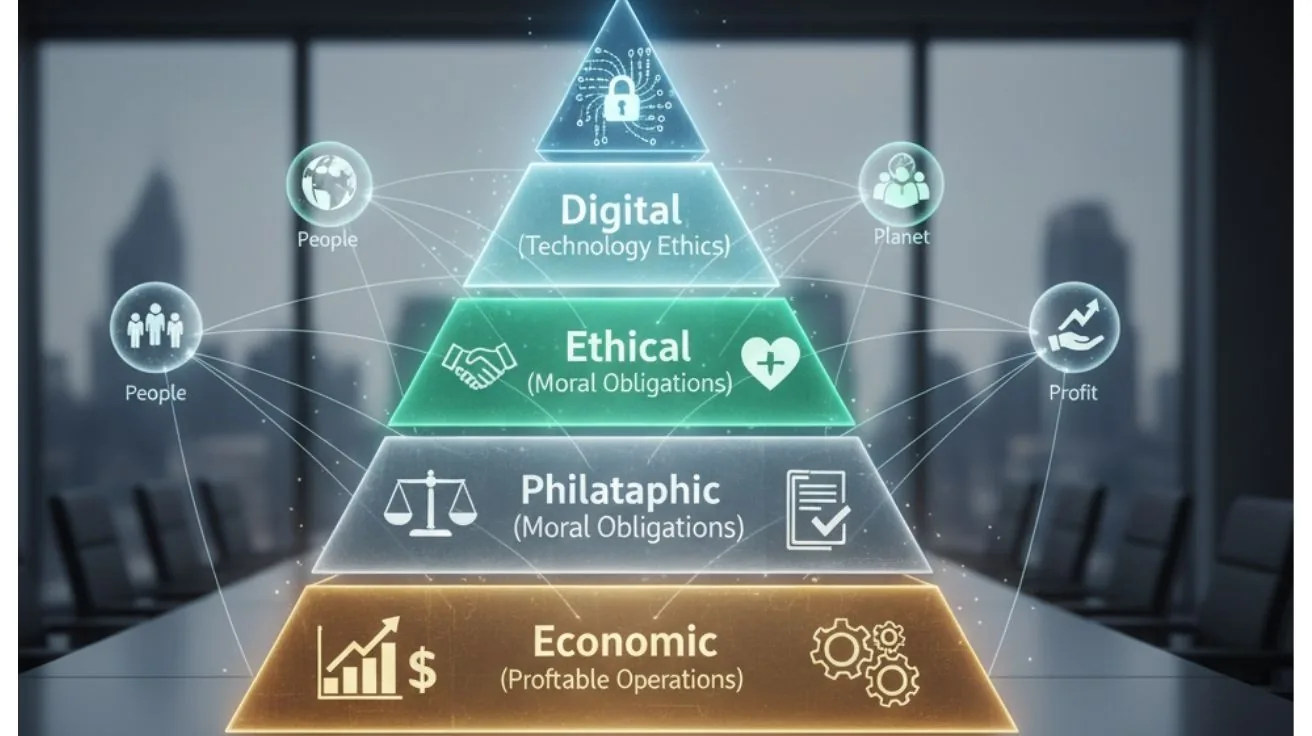
Carroll's Pyramid has evolved to include five key corporate responsibilities: Economic, Legal, Ethical, Philanthropic, and a critical newcomer for modern businesses, Digital Responsibility. When you bring all five together, they create a sustainable model that genuinely balances People, Planet, and Profit.
- Economic (profitable operations),
- Legal (regulatory compliance),
- Ethical (moral obligations beyond law),
- Philanthropic (strategic community investment),
- Digital (technology ethics).
3.1 Why the Framework Needed an Update
When Archie Carroll introduced his CSR Pyramid back in 1991, social media wasn't even a thing. Nobody was talking about algorithmic bias, massive data breaches, or AI governance because they didn't need to. The world has shifted dramatically since then, and what people expect from businesses has shifted right along with it.
Carroll's original four-layer model was revolutionary when it came out. But let's be honest, today's world asks for more from companies. We've added a fifth pillar, Digital Responsibility, and it's not just following a trend. Tech companies today have a massive influence over our privacy, how we access information, and even how democracy functions.
The entire structure is underpinned by the ultimate objective: Everything rests on the Three Core Pillars: People, Planet, Profit. When these align, you don't just have a profitable company; you have a sustainable business model that can weather crises and attract the talent and capital needed to grow.
3.2 The 5 Types of Corporate Responsibility (And Why Each One Matters)
Here's how the framework breaks down, not as abstract theory, but as practical categories that shape how you operate:
| Responsibility Type | What It Means | Why It Matters to Your Business |
|---|---|---|
| Economic | The Foundation | Be profitable while creating shared value; without this, nothing else is possible. |
| Legal | The Non-Negotiables | Comply with all regulations; violations destroy trust and invite penalties. |
| Ethical | The Differentiator | Do what's right even when no one's watching. This is what builds a lasting reputation. |
| Philanthropic | The Amplifier | Invest strategically in communities; done right, it drives both social and business impact. |
| Digital | The Modern Mandate | Ensure ethical use of data and technology; ignore this and face regulatory and reputational disaster. |
3.2.1. Economic Responsibility: The Foundation You Can't Skip
The Reality: You can't run a real CSR program if your company is hemorrhaging money. Economic viability isn't a nice-to-have; it's what makes everything else possible. But here's where today's thinking breaks from the old playbook: profit isn't the endgame anymore; it's the fuel for creating something bigger. Companies that get this aren't stuck choosing between profit and purpose; they're building models where both feed into each other.
The Classic Debate
"There is one and only one social responsibility of business to use its resources and engage in activities designed to increase its profits so long as it stays within the rules of the game, which is to say, engages in open and free competition without deception or fraud." — Milton Friedman, Economist.
Friedman wasn't wrong about profitability being essential. Where the modern view differs is in how you generate those profits. Strategic CSR recognises that creating social and environmental value isn't separate from economic performance; it's increasingly central to it.
What This Looks Like in Practice:What This Looks Like in Practice:
- A solar company profits while reducing carbon emissions.
- A bank makes money by expanding financial literacy in underserved communities.
- A tech firm builds sustainable revenue through accessibility features that serve disabled users.
3.2.2. Legal Responsibility: The Baseline That's Not Negotiable
The Reality: Compliance isn't glamorous, but violations can destroy decades of trust in minutes.
This layer covers everything written into law: consumer protection, labour standards, environmental regulations, tax obligations, and, in India specifically, that mandatory 2% CSR spending requirement under Section 135 of the Companies Act.
Why Companies Still Get This Wrong
Legal compliance sounds simple enough, but here's the thing 40% of companies still fail CSR audits. The usual culprits? Treating compliance like a one-and-done checklist, not keeping up when regulations change, and assuming that if something's legal, it must be ethical. Spoiler: it's not.
The Cost of Failure:
- In India, non-compliance with CSR mandates can result in penalties up to ₹1 crore or twice the amount required to be transferred to CSR funds.
- Reputational damage that takes years to repair.
- Loss of investor confidence as ESG ratings plummet.
"It is not good enough to do what the law says. We need to be at the forefront of these [social responsibility] issues." — Anders Dahlvig, Former CEO, IKEA
3.2.3. Ethical Responsibility: Where Trust Is Actually Built
The Reality: This is where character meets commerce. Ethical responsibility covers everything society expects but hasn't yet codified into law.
It's the space between "What can we get away with?" and "What should we do?" And increasingly, it's where competitive advantage lives.
Why This Is the Differentiator
Legal compliance makes you acceptable. Ethical leadership makes you preferred. Consider:
- Paying fair wages even when minimum wage laws set a lower bar.
- Ensuring supply chain transparency when you could legally obscure it.
- Promoting genuine diversity and inclusion beyond token representation.
- Refusing profitable contracts that conflict with your stated values.
The Business Case for Going Beyond Legal
Companies operating at this level report:
- 25-30% lower employee turnover (people want to work for ethical employers).
- Premium pricing power (consumers pay more for brands they trust).
- Reduced regulatory risk (ethical companies are rarely caught off-guard by new laws).
3.2.4. Philanthropic Responsibility: From Check-Writing to Strategic Impact
The Reality: This isn't about writing checks to feel good. Modern philanthropic responsibility means making strategic, measurable investments that create scalable impact.
The Evolution
- Old model: Donate surplus profits to local charities.
- New model: Align giving with core business capabilities to maximise impact.
The difference? A pharmaceutical company doesn't just donate money for healthcare; it provides medical training, supplies, and expertise. A technology company doesn't just fund schools, it builds digital literacy programs that prepare students for jobs in its industry.
What Strategic Philanthropy Looks Like
Take the example of a bank fulfilling India's mandatory 2% CSR requirement. It could:
- ❌ Checkbox approach: Fund a random educational NGO with no connection to banking.
- ✅ Strategic approach: Train village women in financial literacy, helping them start businesses while building future customers.
The second approach creates:
- Measurable social impact (women's economic empowerment).
- Business value (expanded customer base, reduced credit risk).
- Authentic storytelling (real outcomes, not manufactured goodwill).
3.2.5. Digital Responsibility: The Pillar We Can No Longer Ignore
The Reality: We added this fifth pillar because technology companies now shape society in ways that were unimaginable when Carroll created his original framework.
Why This Matters Now
Think about the power tech companies wield today:
- Algorithms determine what news you see.
- AI systems decide who gets job interviews.
- Data collection practices impact personal privacy daily.
- Digital access determines economic opportunity.
This isn't theoretical; these issues create material business risks:
- Data breaches that cost millions and destroy reputation.
- Algorithmic bias lawsuits.
- Regulatory crackdowns on privacy violations (like GDPR or India's upcoming data protection laws).
- Consumer backlash against unethical AI use.
Core Focus Areas:
- Data Ethics & Privacy: How you collect, store, and use customer data.
- Algorithmic Accountability: Ensuring AI systems don't perpetuate bias.
- Digital Inclusion: Bridging the technology access gap.
- AI Governance: Responsible development and deployment of AI tools.
The Indian Digital Mandate: A Case Study in Systemic Risk
To understand why this matters so much, look at India's FinTech and digital lending boom. In a country that built massive systems like Aadhaar for digital identity and UPI for payments, the sheer amount of personal and financial data moving around every day creates some serious systemic risk.
A failure in Digital Responsibility by just one predatory digital lending app misusing contact lists or charging hidden, exorbitant fees doesn't only hurt one person. It chips away at public trust in the entire digital finance ecosystem.
This is precisely why the Reserve Bank of India (RBI) has had to intervene with stringent mandates, such as the Digital Lending Directions (2022). These rules force companies to:
- Store all customer data solely on servers located in India (Data Localisation).
- Collect data only on a strict 'need-based' principle with explicit, prior customer consent.
- Be transparent by issuing a mandatory ‘Key Fact Statement’ (KFS) before disbursing a loan.
The RBI's action shows that for India's digital giants, data responsibility is not a voluntary ethical choice; it is a regulatory precondition to maintain financial stability and protect millions of financially vulnerable citizens. Get these rules wrong, and you don’t just face lawsuits, you lose the License to Operate in India's most critical growth sectors.
Real-World Example A tech company building an AI recruitment tool faces digital responsibility questions at every stage: Does the algorithm discriminate based on gender or ethnicity? Is candidate data secured properly? Can the system's decisions be explained and audited? Get these wrong, and you don't just face lawsuits, you lose access to talent who refuse to work for ethically careless companies.
3.3 The Integration Challenge: Making All Five Work Together
Here's the uncomfortable truth: most companies are good at one or two of these, mediocre at another two, and completely ignore the fifth.
The companies that thrive? They integrate all five into a coherent strategy where:
- Economic viability funds ethical and philanthropic initiatives.
- Legal compliance is the floor, not the ceiling.
- Ethical behaviour becomes a competitive differentiator.
- Philanthropy aligns with business capabilities.
- Digital responsibility is embedded in product development from day one.
"CSR isn't a particular programme, it's what we do every day, maximising positive impact and minimising negative impact." — Responsible Business Summit 2013
That's the goal: moving from CSR as a separate initiative to responsibility as simply how you do business.
Key Takeaway: The evolved Carroll Pyramid isn't a theoretical framework; it's a practical roadmap for building a business that's profitable, compliant, ethical, impactful, and prepared for the digital age. Companies that master all five types don't just avoid risks; they unlock competitive advantages their peers can't match.
4. The 6 Core Objectives of Corporate Social Responsibility: From Compliance to Competitive Advantage

The six core CSR objectives are:
- Financial Resilience and Access to Capital
- Brand and Reputation Protection
- Talent Acquisition and Retention
- Supply Chain Due Diligence
- Innovation and Growth Enablement
- License to Operate and Community Trust
Each objective delivers measurable business value beyond regulatory compliance, from lowering capital costs to driving revenue growth. Most CSR objectives I see in annual reports are vague aspirations that sound good but mean nothing. "Contribute to society." "Be a responsible corporate citizen." "Create shared value."
These aren't objectives. They're platitudes.
Real CSR objectives are specific, measurable, and directly tied to business outcomes. They answer the question: "What competitive advantage does this create?" Because if your CSR program isn't creating strategic value, you're just burning money to make stakeholders feel good.
4.1 Strategic Objective 1: Financial Resilience and Access to Capital
The Goal: Improve credit ratings and lower your cost of capital by demonstrating strong ESG performance that reduces lenders' and investors' risk exposure.
4.1.1 Why This Matters
Here's something most CFOs don't realise: your ESG performance is already priced into your debt. Banks and institutional lenders now routinely incorporate ESG risk assessments into credit decisions. Strong ESG performance signals lower credit risk, often leading to better loan terms and lower borrowing costs. ** Companies with poor ESG profiles face:**
- Higher interest rates on corporate debt
- Restricted access to certain capital markets
- Increased scrutiny from credit rating agencies
- Limited investor base as sustainable funds exclude them
4.1.2 Case Study: Green Bonds Transform Capital Markets
When Axis Bank issued India's first green bond in 2019, something interesting happened. The ₹600 crore (approximately $80 million) bond was oversubscribed, attracting significantly lower interest rates than conventional bonds of similar tenure.
Why? Because green bonds signal three things to investors:
- Commitment to environmental standards that reduce long-term operational risk
- Transparent use of proceeds with third-party verification and annual impact reporting
- Access to a growing pool of ESG-focused capital seeking these specific instruments
Since then, Indian companies have issued over ₹15,000 crores in green bonds. The market isn't growing because companies are altruistic; it's growing because the economics work. Green bonds consistently achieve:
- 10-25 basis points lower yields than comparable conventional bonds
- Faster subscription and broader investor base
- Enhanced credit ratings reflecting lower environmental risk
Key Actionable Takeaway:
If your company meets the eligibility criteria, explore green or sustainability-linked financing. The cost savings aren't hypothetical; they show up on your balance sheet.
4.2 Strategic Objective 2: Brand and Reputation Protection
The Goal: Build trust and brand equity through authentic, transparent communication about your social and environmental practices, creating a reputation that acts as insurance during inevitable crises.
Why This Matters
"It takes 20 years to build a reputation and five minutes to ruin it. If you think about that, you'll do things differently." — Warren Buffett.
Brand value makes up over 80% of most companies' market capitalisation, yet it's the most fragile asset on your balance sheet. A single social media storm, environmental disaster, or labour scandal can evaporate billions in market value overnight.
Strong CSR doesn't just protect against these risks; it creates reputational capital you can draw on when things go wrong. Companies with established trust recover faster from crises because stakeholders give them the benefit of the doubt.
Key Actionable Takeaway:
- Measure Your Reputational Capital: Implement a simple Reputation Scorecard that tracks media sentiment and crisis recovery time.
- Prioritise Transparency: Report on failures and challenges, not just successes. Authenticity builds trust faster than perfection.
4.3 Strategic Objective 3: Talent Acquisition and Retention
The Goal: Align corporate values with employee expectations to win the war for talent. Deloitte Global's 2025 Gen Z and Millennial Survey found that roughly nine in 10 Gen Zs (89%) and millennials (92%) consider a sense of purpose to be important to their job satisfaction and well-being.
The business case for this objective is brutally simple: talent is now your limiting factor for growth, and values alignment is the price of admission.
Deloitte's 2024 survey found that 45% of millennials have rejected a potential employer because of their values and beliefs, and 90% agree that working for a company that shares their values is important for workplace satisfaction.
The cost of ignoring this?
- 20-30% higher employee turnover (each replacement costs 50-200% of annual salary)
- Difficulty filling critical roles as top candidates choose values-aligned competitors
- Lower productivity from disengaged employees
- Weaker employer brand requiring higher compensation to attract talent
"In my view, the successful companies of the future will be those that integrate business and employees' personal values. The best people want to do work that contributes to society with a company whose values they share, where their actions count and their views matter." — Jeroen van der Veer, Committee of Managing Directors, Shell
Key Actionable Takeaway:
Survey your workforce on CSR priorities. If there's misalignment between what employees value and where you invest CSR resources, you're creating retention risk.
4.4 Strategic Objective 4: Supply Chain Due Diligence
The Goal: Ensure ethical governance, human rights standards, and environmental practices deep within your supply chain to eliminate catastrophic legal and reputational risks.
Here's the uncomfortable truth: you own the problems in your supply chain. When a tier-3 supplier in your manufacturing chain uses forced labour, or dumps toxic waste into a river, or operates an unsafe factory that collapses, you don't get to say "we didn't know."
Consumers, regulators, and investors hold you accountable for conditions throughout your value chain. And they're right to. You chose those suppliers. You benefited from their low costs. You own the outcomes.
The risks of ignoring supply chain CSR are existential:
- Legal exposure: Modern slavery laws in the UK, Australia, and California create criminal liability
- Reputation destruction: One viral video of child labour can crater decades of brand equity
- Operational disruption: Supplier facilities shut down by regulators halt your entire production
- Investor flight: ESG funds divest from companies with supply chain controversies
Key Actionable Takeaway:
Implement a Tiered Visibility Audit focusing on high-risk, lower-tier suppliers (Tiers 2 and 3), where most human rights and environmental violations hide. Mandate a Supplier Code of Conduct that requires third-party social and environmental verification, linking compliance directly to contract renewal and pricing terms to ensure accountability deep within your value chain.
4.5 Strategic Objective 5: Innovation and Growth Enablement
The Goal: Use sustainability challenges as catalysts to drive new market opportunities, develop innovative products, achieve resource efficiency, and create circular business models that competitors can't replicate.
Why This Matters
Most companies see sustainability as a constraint: regulations to comply with, costs to minimise, stakeholders to appease. The smartest companies see it as an opportunity: unmet market needs, innovation drivers, competitive moats, and new revenue streams.
"Corporate social responsibility is not just about managing, reducing, and avoiding risk; it is about creating opportunities, generating improved performance, making money, and leaving the risks far behind." — Sunil Misser, Head of Global Sustainability Practice, PwC
The innovation opportunities in sustainability are massive:
- Circular economy business models (product-as-service, remanufacturing)
- Resource efficiency is driving cost reduction and competitive advantage
- Sustainable products capturing premium pricing and growing market segments
- New markets unlocked by solving social problems (financial inclusion, healthcare access, clean energy)
Examples of CSR-driven innovation creating competitive advantage:
- Tesla: Built an entire automotive empire by making electric vehicles desirable
- Patagonia: Created premium pricing power through environmental commitments
- IKEA: Achieved massive cost savings while improving sustainability (LED lights, renewable energy, circular design)
- Novo Nordisk: Expanded market access by making insulin affordable in developing countries
Your Action Item: Identify your biggest sustainability constraints (resource scarcity, waste, emissions). Now ask: "How could solving this unlock new markets or a competitive advantage?" That's where innovation lives.
4.6 Strategic Objective 6: License to Operate and Community Trust
The Goal: Secure the "social license," the informal but critical permission from local communities, governments, and civil society needed for continuous operations, expansion, or resource extraction.
4.6.1 Why This Matters
Legal licenses get you started. Social license keeps you operating.
This is especially critical for:
- Mining and extractive industries (operating on community lands)
- Manufacturing (needing community acceptance of environmental impact)
- Infrastructure projects (requiring local support for expansion)
- Any business in communities with a strong activist presence or environmental sensitivity
Lose your social license, and you face:
- Project delays costing millions per day
- Forced shutdowns by local authorities responding to community pressure
- Violent protests and worker safety threats
- Permanent exclusion from operating in entire regions
4.6.2 Case Study: Tata Group's Century of Community Investment
The Tata Group has operated in India for over 150 years across industries from steel to IT to automotive. Their secret to longevity? Deep, authentic community engagement that precedes and outlasts any single project.
The Tata Approach:
When Tata Steel built operations in Jamshedpur, they didn't just build factories. They built:
- Complete city infrastructure: roads, water systems, electricity grid
- Educational institutions: schools, technical colleges, adult literacy programs
- Healthcare facilities: hospitals and clinics serving the entire community
- Cultural centres: libraries, sports facilities, community gathering spaces
- Long-term employment: prioritising local hiring and training
The Results:
Jamshedpur became known as "Tatanagar" (Tata's city). The community didn't just accept Tata Steel; they became stakeholders in its success. When labour disputes arose or economic downturns threatened operations, community support helped the company weather storms that would have sunk competitors.
The Modern Application:
Today, Tata Trusts (the philanthropic arms of Tata Group) invests hundreds of crores annually, with historical peaks reaching ₹2,000+ crores:
- Rural development programs reaching millions
- Healthcare initiatives in underserved areas
- Education and skill development
- Environmental conservation
- Disaster relief and rehabilitation
This isn't charity, it's a strategic investment in social license. Tata can expand into new markets and communities because their reputation precedes it. Local governments and communities actively invite them rather than resist.
The Mining Industry Imperative:
Resource extraction companies face this challenge most acutely. Research from the University of Queensland, Harvard Kennedy School and Clark University shows that community conflicts can cost large mining projects approximately $20 million per week in lost production. Studies in Latin America found that over 50% of active mineral mines are currently in conflict with local communities.
Companies that invest early in:
- Community benefit-sharing agreements
- Environmental monitoring and remediation
- Local employment and procurement
- Infrastructure development
...save billions by avoiding conflicts, delays, and forced shutdowns.
Your Action Item: Map your community stakeholders and assess the strength of your social license in each operating region. If you're not actively investing in community relationships, you're one controversy away from an operational crisis.
4.7 The Integration Challenge: Making All Six Work Together
Here's where most companies fail: they treat these six objectives as separate CSR initiatives managed by different teams with different budgets.
That's not a strategy. That's chaos.
Strategic CSR requires integration:
- Financial resilience (Objective 1) depends on demonstrating progress in objectives 2-6
- Brand protection (Objective 2) requires authentic action in objectives 3-6
- Talent attraction (Objective 3) works when employees see the company succeeding at objectives 1, 2, 4, 5, and 6
- Supply chain diligence (Objective 4) enables innovation (Objective 5) and protects the brand (Objective 2)
- Innovation (Objective 5) drives financial performance (Objective 1) and strengthens license to operate (Objective 6)
- Community trust (Objective 6) enables expansion that drives growth (Objective 5) and attracts talent (Objective 3)
The companies that win treat these six objectives as an interconnected system, not isolated initiatives.
"CSR isn't a particular programme, it's what we do every day, maximising positive impact and minimising negative impact." — Responsible Business Summit 2013
4.8 Your Next Step: Prioritise and Integrate
You don't need to excel at all six objectives immediately. But you do need a strategic framework:
Step 1: Assess Your Current State
- Which objectives are you already strong in?
- Where are your biggest vulnerabilities?
- Which objectives would create the most competitive advantage in your industry?
Step 2: Prioritise Based on Risk and Opportunity
- High-risk areas (compliance, reputation, license to operate) need immediate attention.
- High-opportunity areas (innovation, talent, capital access) drive strategic advantage.
Step 3: Create Integration Points
- Design CSR initiatives that serve multiple objectives simultaneously
- Build measurement systems that track progress across all six
- Align budgets and teams to work across objectives, not in silos
Step 4: Measure and Communicate
- Set specific KPIs for each objective
- Track business outcomes, not just CSR activities
- Report progress transparently to build credibility
Key Takeaway: These six CSR objectives aren't about being a good corporate citizen; they're about building competitive advantages that rivals can't easily copy. Financial resilience, brand protection, talent advantage, supply chain resilience, innovation capability, and community trust are strategic assets that compound over time. Companies that treat them as such will dominate their industries. Companies that don't will struggle to survive.
Now the question is: which objective will you prioritise first? We've created an in-depth guide to building effective CSR strategies that walks you through each step of the process.
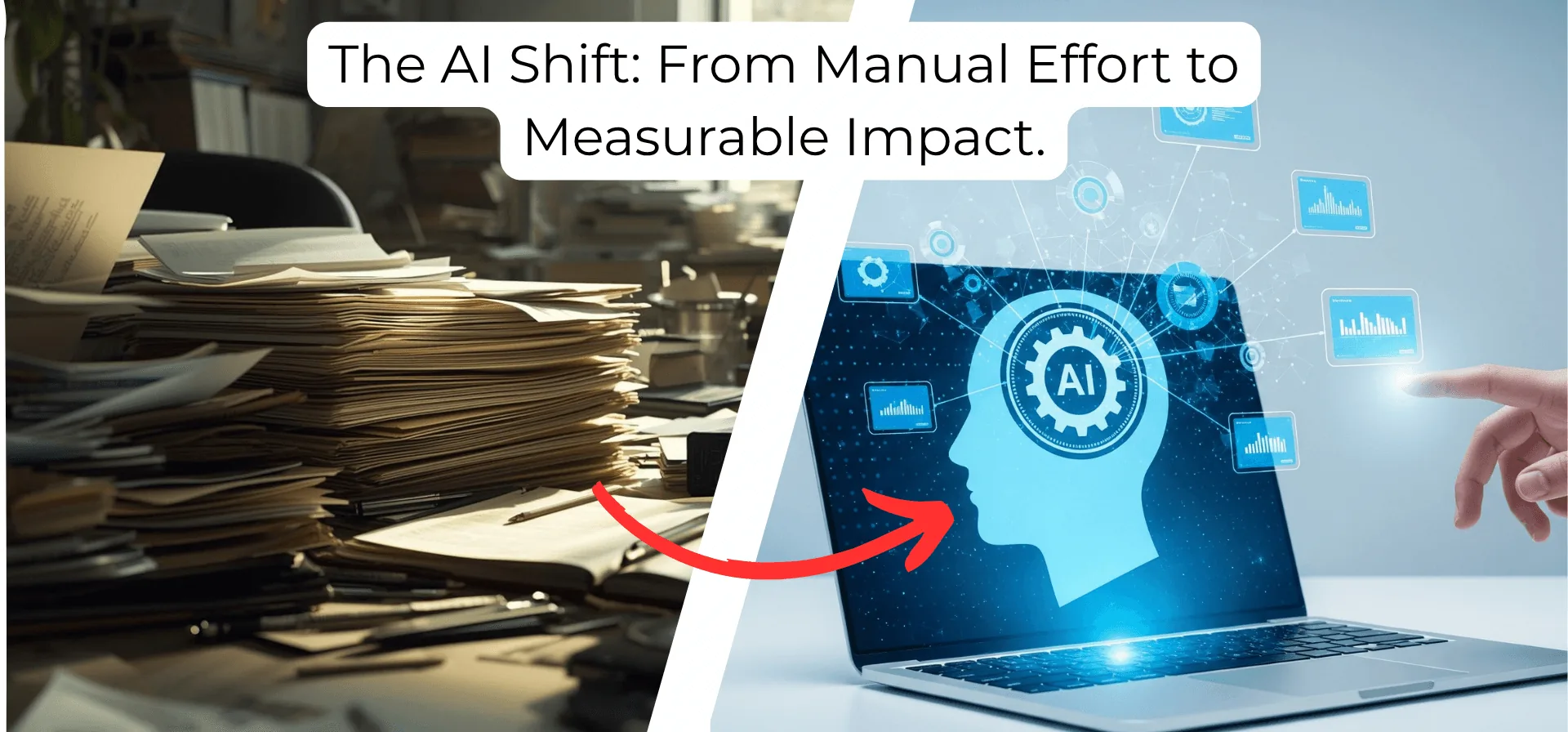
Understanding these objectives is only half the battle. The harder part? Actually delivering on them while juggling compliance deadlines, stakeholder expectations, and impact measurement. This is where CSR software stops being optional and starts being essential, the engine that turns your strategic framework into automated, audit-ready action.
5. What is CSR Software? The Engine for Compliance and Impact

CSR software is a digital platform that centralises and automates corporate social responsibility management from compliance tracking and budget allocation to impact measurement and regulatory reporting. Think of it as your organisation's central nervous system for social responsibility, transforming scattered spreadsheets and manual processes into a streamlined ecosystem with real-time visibility.
Instead of spending weeks compiling data across departments, CSR software digitalises your entire workflow: tracking expenditures against the 2% mandate, monitoring project milestones, measuring beneficiary outcomes, and generating audit-ready reports all from a single dashboard.
Don't let compliance be a bottleneck. The right technology doesn't just help you tick regulatory boxes, it empowers you to tell a compelling story about the change you're creating. We've broken down exactly how CSR software digitalises your objectives and reporting, so you can spend less time wrestling with data and more time driving measurable impact.
5.1 Why Automation Isn't Optional Anymore
The future of CSR reporting is automated, especially with India's mandatory 2025 reporting deadlines approaching. Companies still relying on manual compilation face significant operational risks:
- Compliance gaps from human error in data aggregation
- Missed deadlines that trigger regulatory penalties
- Reputational damage from delayed or incomplete public disclosures
- Lost strategic insights buried in static spreadsheets
Automated reporting delivers more than speed; it ensures accuracy, auditability, and the ability to demonstrate measurable outcomes when boards, investors, and regulators demand proof of impact.
If you're still manually compiling CSR reports, it's time for a strategic upgrade. Our comprehensive guide to automated CSR reporting for Indian companies walks you through everything you need to meet the 2025 mandate without last-minute chaos.
5.2 What Sets Relific Apart
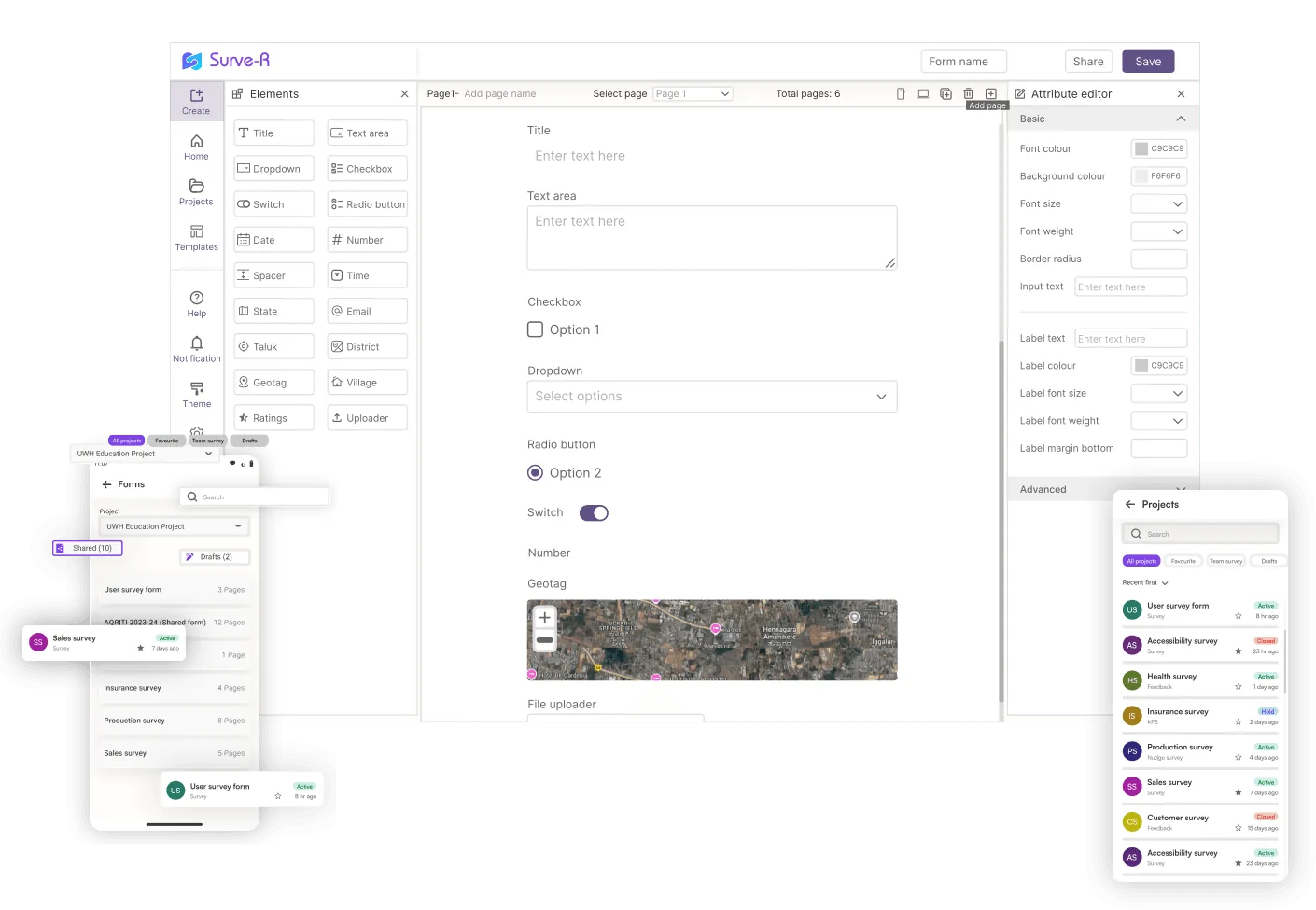
Not all CSR platforms are created equal. While many solutions stop at basic compliance tracking, Relific delivers enterprise-grade social impact intelligence that connects regulatory requirements with measurable business outcomes.
Here's what that means in practice:
Data infrastructure that proves ROI: Our platform doesn't just track where money goes; it measures what changes because of it. Track beneficiary outcomes at scale, monitor NGO performance against milestones, and generate impact metrics that resonate with ESG-focused investors.
Compliance meets strategy: Align your CSR programs with UN SDGs, GRI standards, and emerging ESG frameworks while staying compliant with Companies Act requirements. Relific bridges the gap between mandatory reporting and voluntary sustainability disclosure.
Real-time visibility from ground to boardroom: Surve-R, Relific's mobile-first data engine, eliminates the typical weeks-long reporting lag. Field teams capture verified data offline with GPS, photos, and e-signatures, then automated workflows push it straight to your dashboard. Whether it's health camps or education programs, your leadership sees impact as it unfolds, not months after the fact.
The right platform is the difference between reactive compliance and strategic impact. Choosing CSR software isn't just a procurement decision; it's a strategic choice that shapes your entire approach to social responsibility and stakeholder communication.
That's why we've compiled an honest, detailed comparison of the top 10 CSR software platforms in India for 2025, complete with feature breakdowns, pricing considerations, and what each platform does best for different organisational needs.
6. What's Changing in Corporate Social Responsibility Right Now
Look, the CSR playbook you've been following? It's outdated. Companies still treating these issues as "nice to have" are going to struggle hard to attract talent, secure investment, and maintain their reputation. Here's what actually matters in 2025.
6.1 The Real Priorities: What Companies Should Focus On
6.1.1 Climate Adaptation is the New Climate Action
We've moved past just talking about reducing emissions. The question now is: how resilient is your business when extreme weather hits? Companies leading this space are investing in infrastructure that can withstand disasters, training programs for emergency preparedness, and helping vulnerable communities build climate-resilient income sources.
Why this matters: Protecting your operations and the communities around you isn't just good ethics; it's business continuity.
6.1.2 The Just Transition: Don't Leave Workers Behind
Decarbonization sounds great until you're the worker losing your job in a coal plant or manufacturing facility. Forward-thinking CSR strategies now include comprehensive retraining programs for displaced workers. This isn't optional when communities get left behind; they push back politically, and that stalls everyone's climate goals.
Key insight: Environmental progress and worker welfare must go hand-in-hand, not compete with each other.
6.1.3 Digital Inclusion Means More Than Wi-Fi
Yes, internet access matters. But real digital inclusion goes deeper: protecting people's data privacy, teaching meaningful digital skills, and making sure vulnerable populations aren't exploited by technology they don't understand. The goal should be giving people agency over technology, not just access to it.
6.1.4 AI Ethics Can't Wait
This is urgent. If your company uses AI or automation, your CSR team needs to be involved in decisions about workforce impacts, algorithmic bias, and how these systems respect human dignity. Companies deploying AI without ethical frameworks aren't just risking regulatory trouble; they're destroying trust with customers, employees, and communities.
6.1.5 Balancing Stakeholder Value and Shareholder Returns
Here's the tension: boards want long-term stakeholder value, but they also face quarterly earnings pressure. The answer isn't choosing between them. The best CSR strategies show clearly how social impact drives sustainable financial performance. If you can't make that connection, leadership will always see CSR as an expense rather than an investment.
7. How to Avoid the Most Common CSR Failures
Even companies with good intentions mess this up. Here's what goes wrong and how to fix it.
7.1 Problem: Treating CSR Like a Compliance Checkbox
The solution: Build a real Monitoring and Evaluation system that tracks outcomes, not just activities. Don't just report "we spent $X" or "we reached Y people." Measure what actually changed in people's lives because of what you did.
7.2 Problem: CSR Programs That Don't Match Your Business
The solution: Connect your CSR directly to your operations. If you're a manufacturer that uses massive amounts of water, randomly funding education projects looks suspicious. Investing in watershed protection and community water security? That's authentic and strategic.
Example: Your value chain should guide your CSR choices, not whatever sounds good in a press release.
7.3 Problem: Choosing the Wrong Partners
The solution: Do serious due diligence before partnering with NGOs or implementation organisations. Look past enthusiasm and evaluate their track record, financial transparency, ability to scale, and proven results. A compelling mission statement isn't enough; you need organisational competence.
7.4 Problem: Monitoring Programs Too Slowly
The solution: Use CSR management software for real-time tracking instead of waiting for quarterly reports. By the time you get those reports, it's often too late to fix problems. Technology gives you the ability to manage programs proactively instead of reactively.
7.5 Problem: Ignoring Your Own Negative Impacts
The solution: Start with a comprehensive Materiality Assessment to identify where your company causes harm. You can't claim to be socially responsible while funding health clinics in communities affected by your own pollution. Fix your operational harms first, then launch aspirational programs. Anything else is just sophisticated greenwashing.
7.6 Questions Companies Should Ask Themselves
- Have we mapped our CSR initiatives to our actual business operations and impacts?
- Are we measuring real outcomes or just counting activities and spending?
- Do our partners have proven capability, not just good intentions?
- Can we clearly explain how our social impact contributes to financial performance?
- Have we addressed our negative externalities before launching positive programs?
- Are we building resilience for both our operations and affected communities?
- Does our CSR strategy include plans for workers displaced by our environmental commitments?
7.7 Why This Matters Now
CSR isn't a nice-to-have anymore. It's fundamental to your social license to operate, your ability to attract talent, and your access to capital. Investors, employees, and communities can spot performative CSR from miles away. The companies that will succeed are those treating these issues as strategic priorities, not peripheral risks or PR opportunities.
The landscape is evolving faster than regulations can keep up. That means companies have a choice: lead with genuine impact or scramble to meet minimum standards later. The first approach builds competitive advantage. The second invites reputational risk.
8. Conclusion: Here's What It All Comes Down To8. Conclusion: Here's What It All Comes Down To
If you want CSR actually to work in 2025, there are three things you absolutely can't skip. Miss even one, and you're back to performative gestures that nobody believes.
8.1 The Three Non-Negotiables
- Authentic Integration: CSR isn't something you do on the side; it's how you do business. When it's real, it shows up in procurement decisions, operational procedures, and daily management. If your teams still think "that's a CSR thing, not my thing," you haven't integrated it.
- Rigorous Measurement: Stories work for annual reports. Data proves impact. You need hard numbers showing what changed, not "we trained 500 people", but "employment rates increased by X%." If you can't quantify your impact, you can't manage it.
- Strategic Alignment: Your CSR should drive business value and social value simultaneously. You should be able to say: "When we invest in X social outcome, we see Y business benefit." If your CFO sees CSR as pure cost with no return, you haven't achieved this.
Companies that treat CSR as governance, not goodwill, will define the next decade of business. Governance means systems, accountability, measurement, and integration into core operations. Goodwill means press releases and programs that exist separately from how you actually run your business.
One builds sustainable competitive advantage. The other builds vulnerability disguised as virtue.
The companies making this shift now won't just survive the changing landscape; they'll shape it. The ones waiting for external pressure will spend the next decade playing catch-up.
Look, we get it, moving from where you are to where you need to be isn't simple. The monitoring systems, the data frameworks, the real-time tracking that separates reactive programs from strategic ones? That's exactly what our tool is built for.
If you're serious about making this shift, book a demo. We'll walk through your specific challenges and show you how the right system can make rigorous measurement and strategic alignment actually manageable. No pitch, just a straightforward conversation about whether we can help make this easier for you.
Your move!
Frequently Asked Questions:
Corporate Social Responsibility is a strategic framework where companies integrate social and environmental objectives into their core business operations. It's no longer just about voluntary philanthropy in 2025, CSR is a comprehensive enterprise risk management and value creation framework that directly impacts your bottom line, investor relations, talent retention, and competitive advantage.
The old model treated CSR as writing checks to charities after making profits. Today's CSR operates as an integrated system that treats social impact as a strategic investment in resilience, talent, capital access, and growth opportunities. Companies with solid CSR frameworks outperformed competitors during the pandemic, with sustainable equity funds exceeding traditional peer funds by 4.3 percentage points in 2020.
Yes. Under Section 135 of the Companies Act 2013, qualifying companies must spend at least 2% of their average net profits from the past three years on CSR initiatives. India became the first country to make CSR spending a legal requirement, shifting it from voluntary philanthropy to mandatory governance.
Companies face fines up to ₹1 crore or even double the unspent CSR amount. This creates a serious legal risk that directly hits your bottom line. By FY 2023-24, Indian companies were dedicating nearly ₹35,000 crore toward CSR, with projections exceeding ₹38,000 crore.
Companies that meet specific thresholds related to net worth, turnover, or net profit during the preceding financial year must comply. This applies to both Indian companies and foreign companies with a branch or project office in India that meet the criteria.
Social license is the informal but critical permission from local communities, governments, and civil society needed for continuous operations. Legal licenses get you started; social license keeps you operating. Research shows community conflicts can cost large mining projects approximately $20 million per week in lost production. Companies that invest early in community relationships save billions by avoiding conflicts and operational shutdowns.